Banharak Samoraphop, Panpanit Ladawan, Subindee Suttinan, Narongsanoi Patcharawan, Sanun-Aur Panisara, Kulwong Walaiporn, Songtin Pachareeporn, Khemphimai Wanida
Department of Gerontological Nursing, Faculty of Nursing, Khon Kaen University, Khon Kaen, Thailand.
Nursing Department, Maharat Nakhon Ratchasima Hospital, Nakhon Ratchasima, Thailand.
J Multidiscip Healthc. 2021 Oct 26;14:2983-3004. doi: 10.2147/JMDH.S329672. eCollection 2021.
The prevalent rate of incontinence-associated dermatitis (IAD) trends upward in older populations. Skin breakdown from IAD impacts the quality of life of older adults and reflects the quality of care in hospitals and long-term care facilities. Specific and appropriate interventions for prevention and care are needed. This systematic review aims to review optimal strategies for prevention and care for older adults with IAD.
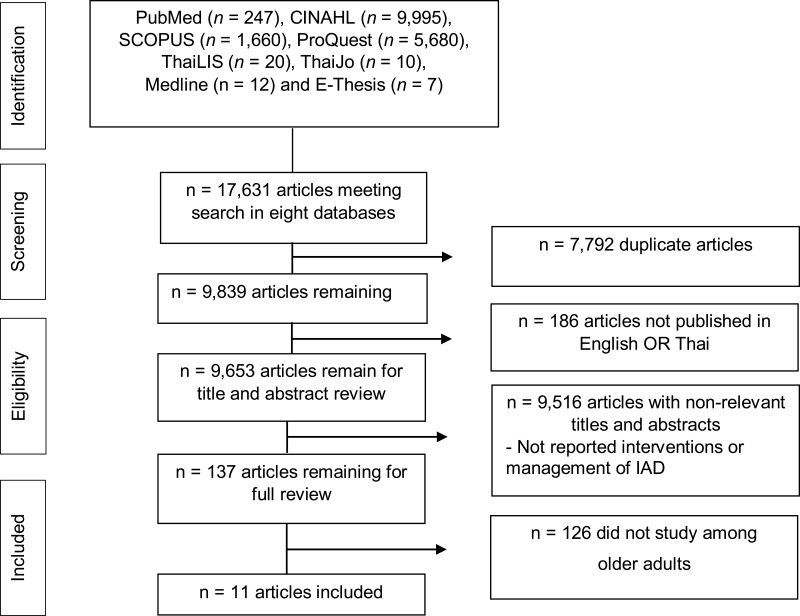
PubMed, CINAHL, SCOPUS, Medline, ProQuest, ThaiLIS, ThaiJo, and E-Thesis were searched for articles published between January 2010 and December 2020. Only articles focusing on older adults were included for the review.
Eleven articles met the inclusion/exclusion criteria. Interventions for the prevention and care of IAD among older adults were categorized as assessment, incontinence management/causative factors management, cleansing, application of medical products for both skin moisturizing and skin barrier, body positioning, nutrition promotion, health education and training, and outcome evaluation. Specific prevention and care strategies for older adults with IAD included using specific assessment tools, applying skin cleansing pH from 4.0 to 6.8, body positioning, and promoting food with high protein. Other strategies were similar to those reported for adult patients.
The systematic review extracted current and specific prevention and care strategies for IAD in older adults. The prevention and care strategies from this systematic review should be applied in clinical practice. However, more rigorous research methodology is recommended in future studies, especially in examining intervention outcomes. Nurses and other health professionals should be educated and trained to understand the causes of IAD in older adults and the specific prevention and care strategies for this population. Because older adults are prone to skin damage, and this type of skin breakdown differs from pressure ulcers, the tools for assessment and evaluation, and the strategies for prevention and care require special attention.
CRD42021251711.
失禁相关性皮炎(IAD)在老年人群中的患病率呈上升趋势。IAD导致的皮肤破损影响老年人的生活质量,也反映了医院和长期护理机构的护理质量。因此需要有针对性的适当预防和护理干预措施。本系统评价旨在综述针对老年IAD患者的最佳预防和护理策略。
检索了PubMed、CINAHL、SCOPUS、Medline、ProQuest、泰国学术数据库(ThaiLIS)、泰国期刊数据库(ThaiJo)和电子学位论文数据库(E-Thesis),查找2010年1月至2020年12月发表的文章。纳入综述的文章仅限于关注老年人的研究。
11篇文章符合纳入/排除标准。老年IAD患者的预防和护理干预措施分为评估、失禁管理/病因管理、清洁、应用皮肤保湿和皮肤屏障的医疗产品、体位摆放、营养促进、健康教育与培训以及结局评估。老年IAD患者的具体预防和护理策略包括使用特定评估工具、应用pH值为4.0至6.8的皮肤清洁剂、体位摆放以及推广高蛋白食物。其他策略与针对成年患者的报道相似。
本系统评价提取了当前针对老年IAD患者的特定预防和护理策略。本系统评价中的预防和护理策略应应用于临床实践。然而,建议在未来研究中采用更严谨的研究方法,尤其是在检验干预效果方面。护士和其他卫生专业人员应接受教育和培训,以了解老年IAD的病因以及针对该人群的具体预防和护理策略。由于老年人容易发生皮肤损伤,且这种类型的皮肤破损与压疮不同,因此评估和评价工具以及预防和护理策略需要特别关注。
CRD42021251711。