Hadei Mostafa, Hopke Philip K, Shahsavani Abbas, Raeisi Alireza, Jafari Ahmad Jonidi, Yarahmadi Maryam, Farhadi Mohsen, Rahmatinia Masoumeh, Bazazpour Shahriar, Bandpey Anooshiravan Mohseni, Zali Alireza, Kermani Majid, Vaziri Mohmmad Hossien, Aghazadeh Mehrab
Department of Environmental Health Engineering, School of Public Health, Tehran University of Medical Sciences, Tehran, Iran.
Center for Air Resources Engineering and Science, Clarkson University, Potsdam, NY 13699 USA.
J Environ Health Sci Eng. 2021 Oct 28;19(2):1807-1816. doi: 10.1007/s40201-021-00736-4. eCollection 2021 Dec.
The association between air pollutant (PM, PM, NO, and O) concentrations and daily number of COVID-19 confirmed cases and related deaths were evaluated in three major Iranian cities (Tehran, Mashhad, and Tabriz).
Hourly concentrations of air pollutants and daily number of PCR-confirmed cases and deaths of COVID-19 were acquired (February 20, 2020 to January 4, 2021). A generalized additive model (GAM) assuming a quasi-Poisson distribution was used to model the associations in each city up to lag-day 7 (for mortality) and 14 (for morbidity). Then, the city-specific estimates were meta-analyzed using a fixed effect model to obtain the overall relative risks (RRs).
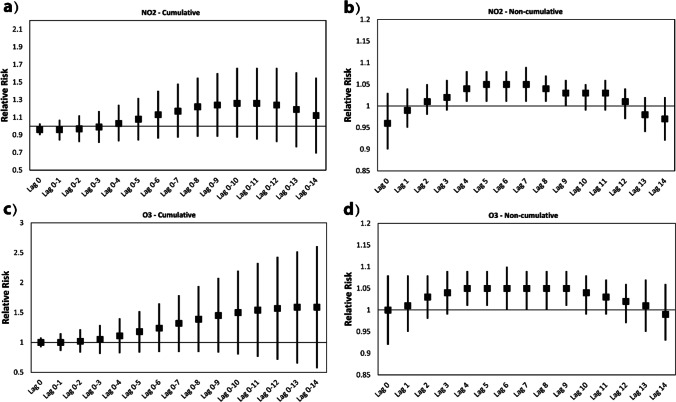
A total of 114,964 confirmed cases and 21,549 deaths were recorded in these cities. For confirmed cases, exposure to PM, NO, and O for several lag-days showed significant associations. In case of mortality, meta-analysis estimated that the RRs for PM, PM, NO, and O concentrations were 1.06 (95% CI: 0.99, 1.13), 1.06 (95% CI: 0.93, 1.19), 1.15 (95% CI: 0.93, 1.38), and 1.07 (95% CI: 0.84, 1.31), respectively. Despite several positive associations with all air pollutants over multiple lag-days, COVID-19 mortality was only significantly associated with NO on lag-days 0-1 and 1 with the RRs of 1.35 (95% CI: 1.04, 1.67) and 1.16 (95% CI: 1.02, 1.31), respectively.
This study showed that air pollution can be a factor exacerbating COVID-19 infection and clinical outcomes. Actions should be taken to reduce the exposure of the public and particularly patients to ambient air pollutants.
The online version contains supplementary material available at 10.1007/s40201-021-00736-4.
在伊朗三个主要城市(德黑兰、马什哈德和大不里士)评估空气污染物(细颗粒物、可吸入颗粒物、二氧化氮和臭氧)浓度与新冠确诊病例每日数量及相关死亡之间的关联。
获取了空气污染物的每小时浓度以及新冠确诊病例和死亡的每日数量(2020年2月20日至2021年1月4日)。使用假定拟泊松分布广义相加模型(GAM)对每个城市滞后7天(针对死亡率)和14天(针对发病率)的关联进行建模。然后,使用固定效应模型对各城市的估计值进行荟萃分析,以获得总体相对风险(RRs)。
这些城市共记录了114964例确诊病例和21549例死亡。对于确诊病例,在多个滞后天数下暴露于细颗粒物、二氧化氮和臭氧显示出显著关联。在死亡率方面,荟萃分析估计细颗粒物、可吸入颗粒物、二氧化氮和臭氧浓度的RRs分别为1.06(95%置信区间:0.99,1.13)、1.06(95%置信区间:0.93,1.19)、1.15(95%置信区间:0.93,1.38)和1.07(95%置信区间:0.84,1.31)。尽管在多个滞后天数下与所有空气污染物存在若干正相关,但新冠死亡率仅在滞后0 - 1天和1天时与二氧化氮显著相关,RRs分别为1.35(95%置信区间:1.04,1.67)和1.16(95%置信区间:1.02,1.31)。
本研究表明空气污染可能是加剧新冠感染和临床结局的一个因素。应采取行动减少公众尤其是患者暴露于环境空气污染物中。
在线版本包含可在10.1007/s40201 - 021 - 00736 - 4获取的补充材料。