Wu Qin, Li Qianlin, Lu Jiahai
School of Public Health, Sun Yat-sen University, Guangzhou, China.
Key Laboratory for Tropical Disease Control, Sun Yat-sen University, Ministry of Education, Guangzhou, China.
J Biosaf Biosecur. 2022 Jun;4(1):5-11. doi: 10.1016/j.jobb.2021.09.003. Epub 2021 Oct 28.
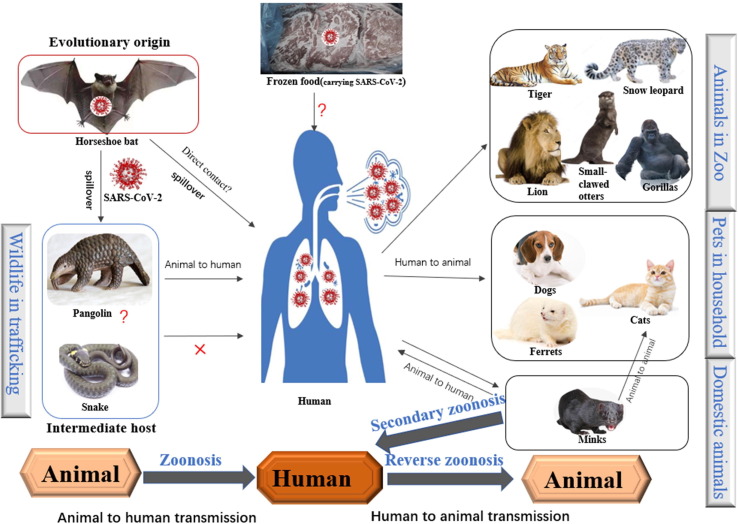
Coronavirus disease 2019 (COVID-19) is as an emerging infectious disease (EID) that has caused the worst public health catastrophe of the 21st century thus far. In terms of impact, the COVID-19 pandemic is second only to the Spanish Flu pandemic of 1918 in modern world history. As of 7 September 2021, there have been 220 million confirmed cases of COVID-19 and more than 4.5 million deaths. EIDs pose serious public health and socio-economic risks, and 70% of EIDs originate from wildlife. Preventing development of EIDs such as COVID-19 is a pressing concern. Here, taking the COVID-19 pandemic as an example, we illustrate the disastrous effects of EIDs and assess their emergence and evolution from a One Health perspective. We propose a One Health strategy, centered on 'moving the gates forward', for EID prevention and control at the human-animal-environment interface. This strategy may be instructive and provide early warnings of EIDs in the future.
2019冠状病毒病(COVID-19)是一种新出现的传染病,是21世纪至今最严重的公共卫生灾难。从影响范围来看,COVID-19大流行是现代世界历史上仅次于1918年西班牙流感大流行的事件。截至2021年9月7日,全球已有2.2亿例COVID-19确诊病例,死亡人数超过450万。新发传染病对公共卫生和社会经济构成严重风险,70%的新发传染病源自野生动物。预防COVID-19等新发传染病的发生是当务之急。在此,以COVID-19大流行为例,我们阐述新发传染病的灾难性影响,并从“同一个健康”视角评估其出现和演变。我们提出了一项以“关口前移”为核心的“同一个健康”战略,用于在人类-动物-环境界面预防和控制新发传染病。这一战略可能具有指导意义,并为未来新发传染病提供早期预警。