Ebrahimi-Fakhari Darius, Alecu Julian E, Brechmann Barbara, Ziegler Marvin, Eberhardt Kathrin, Jumo Hellen, D'Amore Angelica, Habibzadeh Parham, Faghihi Mohammad Ali, De Bleecker Jan L, Vuillaumier-Barrot Sandrine, Auvin Stéphane, Santorelli Filippo M, Neuser Sonja, Popp Bernt, Yang Edward, Barrett Lee, Davies Alexandra K, Saffari Afshin, Hirst Jennifer, Sahin Mustafa
Department of Neurology, The F.M. Kirby Neurobiology Center, Boston Children's Hospital, Harvard Medical School, Boston, MA 02115, USA.
The Manton Center for Orphan Disease Research, Boston Children's Hospital, Boston, MA 02115, USA.
Brain Commun. 2021 Sep 25;3(4):fcab221. doi: 10.1093/braincomms/fcab221. eCollection 2021.
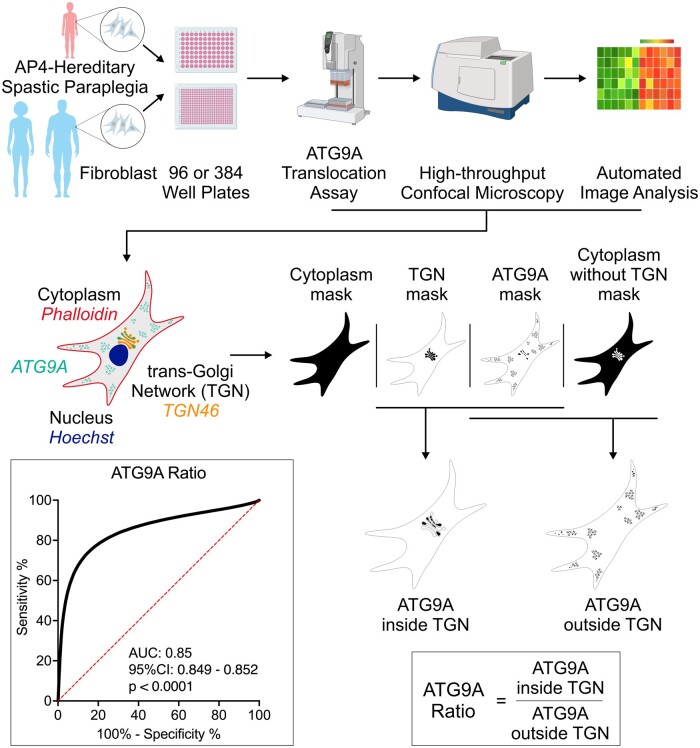
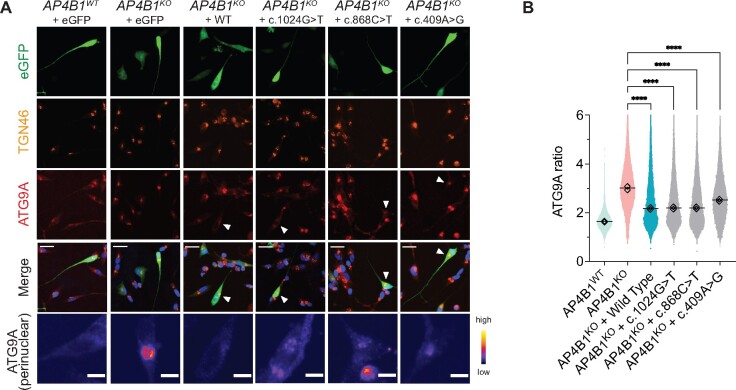
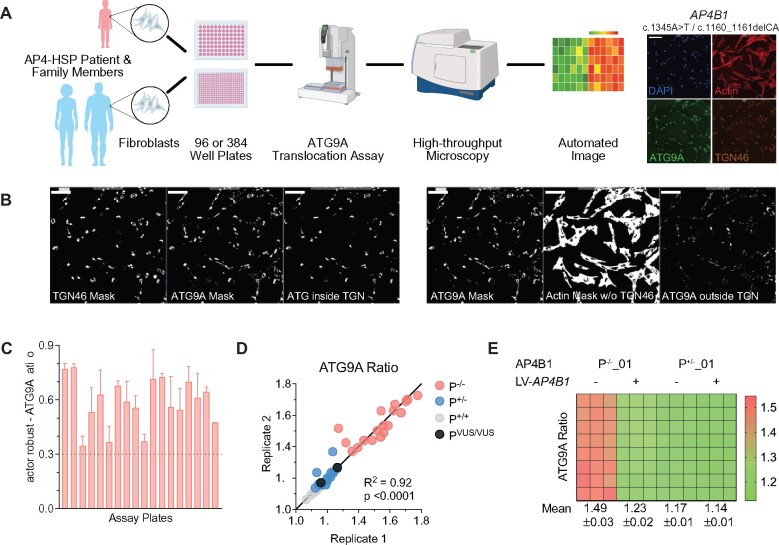
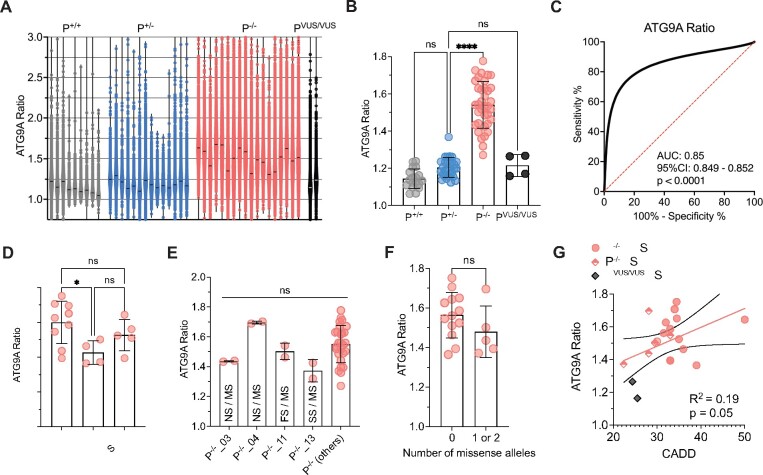
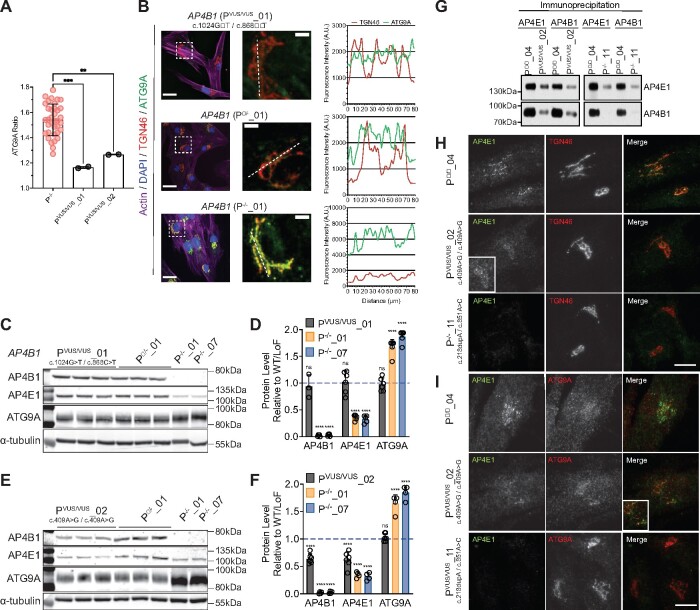
Adaptor protein complex 4-associated hereditary spastic paraplegia is caused by biallelic loss-of-function variants in , , or , which constitute the four subunits of this obligate complex. While the diagnosis of adaptor protein complex 4-associated hereditary spastic paraplegia relies on molecular testing, the interpretation of novel missense variants remains challenging. Here, we address this diagnostic gap by using patient-derived fibroblasts to establish a functional assay that measures the subcellular localization of ATG9A, a transmembrane protein that is sorted by adaptor protein complex 4. Using automated high-throughput microscopy, we determine the ratio of the ATG9A fluorescence in the trans-Golgi-network versus cytoplasm and ascertain that this metric meets standards for screening assays (Z'-factor robust >0.3, strictly standardized mean difference >3). The 'ATG9A ratio' is increased in fibroblasts of 18 well-characterized adaptor protein complex 4-associated hereditary spastic paraplegia patients [mean: 1.54 ± 0.13 versus 1.21 ± 0.05 (standard deviation) in controls] and receiver-operating characteristic analysis demonstrates robust diagnostic power (area under the curve: 0.85, 95% confidence interval: 0.849-0.852). Using fibroblasts from two individuals with atypical clinical features and novel biallelic missense variants of unknown significance in , we show that our assay can reliably detect adaptor protein complex 4 function. Our findings establish the 'ATG9A ratio' as a diagnostic marker of adaptor protein complex 4-associated hereditary spastic paraplegia.
衔接蛋白复合体4相关遗传性痉挛性截瘫由、、或中的双等位基因功能丧失变体引起,这些基因构成了这个必需复合体的四个亚基。虽然衔接蛋白复合体4相关遗传性痉挛性截瘫的诊断依赖于分子检测,但对新的错义变体的解释仍然具有挑战性。在这里,我们通过使用患者来源的成纤维细胞建立一种功能测定方法来解决这一诊断差距,该方法测量ATG9A的亚细胞定位,ATG9A是一种由衔接蛋白复合体4分选的跨膜蛋白。使用自动高通量显微镜,我们确定了反式高尔基体网络与细胞质中ATG9A荧光的比率,并确定该指标符合筛选测定的标准(Z因子稳健性>0.3,严格标准化均值差异>3)。在18例特征明确的衔接蛋白复合体4相关遗传性痉挛性截瘫患者的成纤维细胞中,“ATG9A比率”升高[平均值:1.54±0.13,而对照组为1.21±0.05(标准差)],受试者工作特征分析显示出强大的诊断能力(曲线下面积:0.85,95%置信区间:0.849 - 0.852)。使用来自两名具有非典型临床特征且在中有意义不明的新双等位基因错义变体的个体的成纤维细胞,我们表明我们的测定方法可以可靠地检测衔接蛋白复合体4的功能。我们的发现确立了“ATG9A比率”作为衔接蛋白复合体4相关遗传性痉挛性截瘫的诊断标志物。