Correia Carlos Eduardo, Umemura Yoshie, Flynn Jessica R, Reiner Anne S, Avila Edward K
Department of Neurology, Memorial Sloan Kettering Cancer Center, New York, New York, USA.
Epidemiology and Biostatistics, Memorial Sloan Kettering Cancer Center, New York, New York, USA.
Neurooncol Adv. 2021 Oct 4;3(1):vdab146. doi: 10.1093/noajnl/vdab146. eCollection 2021 Jan-Dec.
Many low-grade gliomas (LGG) harbor isocitrate dehydrogenase (IDH) mutations. Although mutation is known to be epileptogenic, the rate of refractory seizures in LGG with mutation vs wild-type had not been previously compared. We therefore compared seizure pharmacoresistance in -mutated and wild-type LGGs.
Single-institution retrospective study of patients with histologic proven LGG, known mutation status, seizures, and ≥2 neurology clinic encounters. Seizure history was followed until histological high-grade transformation or death. Seizures requiring ≥2 changes in anti-epileptic drugs were considered pharmacoresistant. Incidence rates of pharmacoresistant seizures were estimated using competing risks methodology.
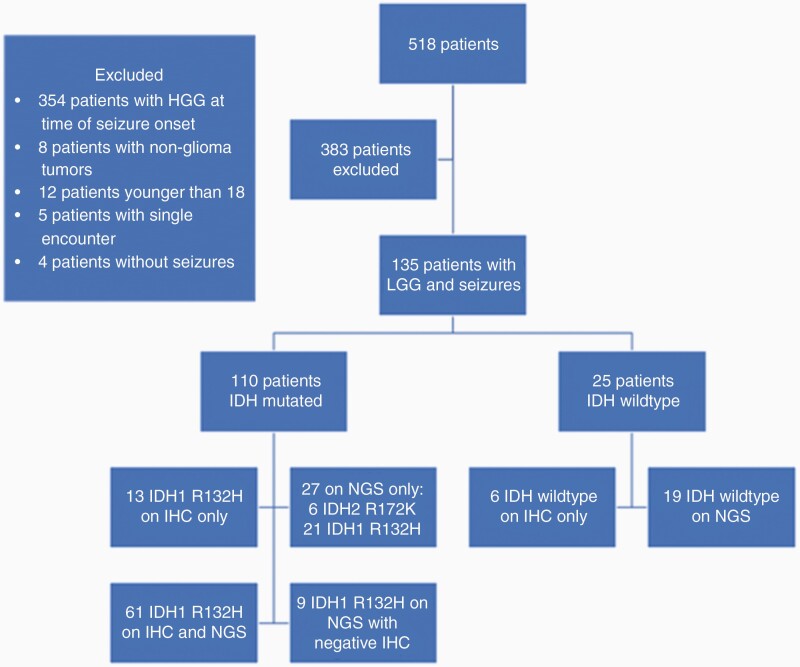
Of 135 patients, 25 patients (19%) had LGGs classified as wild-type. Of those with mutation, 104 (94.5%) were R132H; only 6 were R172K. 120 patients (89%) had tumor resection, and 14 (10%) had biopsy. Initial post-surgical management included observation (64%), concurrent chemoradiation (23%), chemotherapy alone (9%), and radiotherapy alone (4%). Seizures became pharmacoresistant in 24 -mutated patients (22%) and in 3 wild-type patients (12%). The 4-year cumulative incidence of intractable seizures was 17.6% (95% CI: 10.6%-25.9%) in -mutated and 11% (95% CI: 1.3%-32.6%) in wild-type LGG (Gray's -value = .26).
22% of the -mutated patients developed pharmacoresistant seizures, compared to 12% of the wild-type tumors. The likelihood of developing pharmacoresistant seizures in patients with LGG-related epilepsy is independent to mutation status, however, -mutated tumors were approximately twice as likely to experience LGG-related pharmacoresistant seizures.
许多低级别胶质瘤(LGG)存在异柠檬酸脱氢酶(IDH)突变。虽然已知该突变具有致痫性,但此前尚未比较过携带IDH突变的LGG与野生型LGG的难治性癫痫发作率。因此,我们比较了IDH突变型和野生型LGG的癫痫药物抵抗情况。
对经组织学证实为LGG、已知IDH突变状态、有癫痫发作且至少有2次神经内科门诊就诊经历的患者进行单机构回顾性研究。随访癫痫发作史直至组织学高级别转化或死亡。需要至少2次调整抗癫痫药物的癫痫发作被视为药物抵抗性发作。使用竞争风险方法估计药物抵抗性癫痫发作的发生率。
135例患者中,25例(19%)的LGG被分类为IDH野生型。在携带IDH突变的患者中,104例(94.5%)为IDH R132H;仅6例为IDH R172K。120例患者(89%)接受了肿瘤切除,14例(10%)接受了活检。术后初始治疗包括观察(64%)、同步放化疗(23%)、单纯化疗(9%)和单纯放疗(4%)。24例IDH突变患者(22%)和3例IDH野生型患者(12%)的癫痫发作出现药物抵抗。IDH突变型LGG的4年顽固性癫痫累积发生率为17.6%(95%CI:10.6%-25.9%),IDH野生型LGG为11%(95%CI:1.3%-32.6%)(Gray检验P值 = 0.26)。
22%的IDH突变患者出现了药物抵抗性癫痫发作,而IDH野生型肿瘤患者为12%。LGG相关性癫痫患者发生药物抵抗性癫痫发作的可能性与IDH突变状态无关,然而,IDH突变型肿瘤发生LGG相关性药物抵抗性癫痫发作的可能性约为野生型的两倍。