Mental Health Department, Biocruces Bizkaia Health Research Institute, Basurto University Hospital, Facultad de Medicina y Odontología, Campus de Leioa, University of the Basque Country, UPV/EHU, Barakaldo, Spain.
Department of Psychosis Studies, Institute of Psychiatry, Psychology and Neuroscience, King's College London, London, United Kingdom.
Eur Psychiatry. 2021 Nov 3;64(1):e69. doi: 10.1192/j.eurpsy.2021.2246.
To determine the proportion of patients in symptomatic remission and recovery following a first-episode of psychosis (FEP).
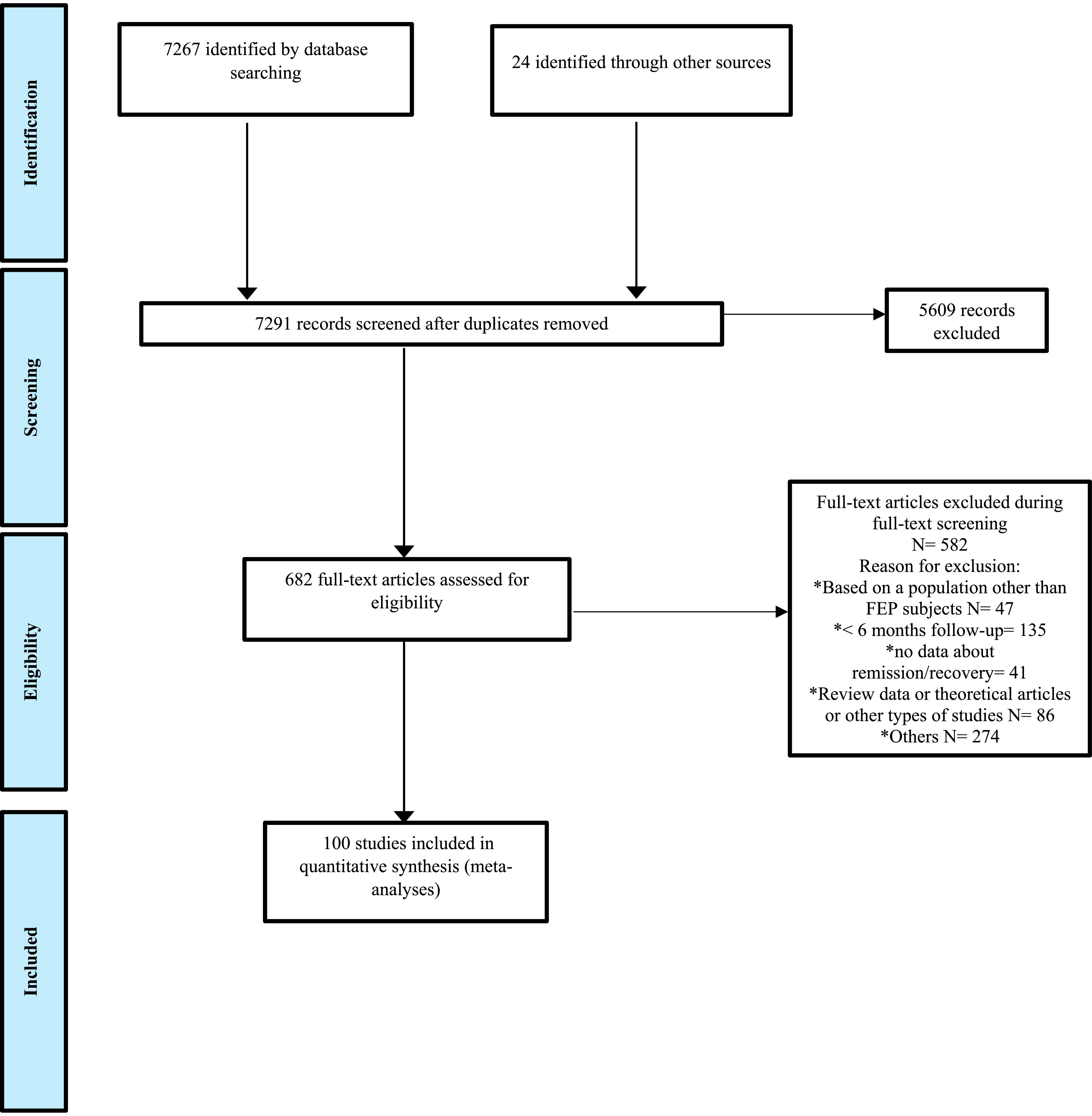
A multistep literature search using the Web of Science database, Cochrane Central Register of Reviews, Ovid/PsychINFO, and trial registries from database inception to November 5, 2020, was performed. Cohort studies and randomized control trials (RCT) investigating the proportion of remission and recovery following a FEP were included. Two independent researchers searched, following PRISMA and MOOSE guidelines and using a PROSPERO protocol. We performed meta-analyses regarding the proportion of remission/recovery (symptomatic plus functional outcomes). Heterogeneity was measured employing Q statistics and I2 test. To identify potential predictors, meta-regression analyses were conducted, as well as qualitative reporting of studies included in a systematic review. Sensitivity analyses were performed regarding different times of follow-up and type of studies.
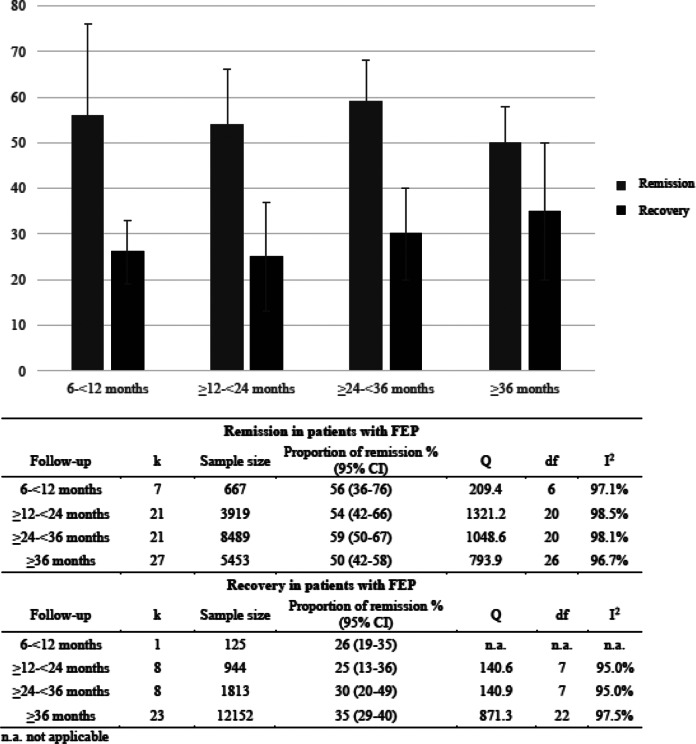
One hundred articles (82 cohorts and 18 RCTs) were included in the meta-analysis. The pooled proportion of symptomatic remission was 54% (95%CI [30, 49-58]) over a mean follow-up period of 43.57 months (SD = 51.82) in 76 studies. After excluding RCT from the sample, the proportion of remission remained similar (55%). The pooled proportion of recovery was 32% (95%CI [27-36]) over a mean follow-up period of 71.85 months (SD = 73.54) in 40 studies. After excluding RCT from the sample, the recovery proportion remained the same. No significant effect of any sociodemographic or clinical predictor was found.
Half of the patients are in symptomatic remission around 4 years after the FEP, while about a third show recovery after 5.5 years.
确定首次精神病发作(FEP)后症状缓解和康复的患者比例。
使用 Web of Science 数据库、Cochrane 中心对照试验注册库、Ovid/PsychINFO 和试验登记处进行多步骤文献检索,检索时间从数据库建立到 2020 年 11 月 5 日。纳入研究 FEP 后缓解和康复比例的队列研究和随机对照试验(RCT)。两名独立研究人员按照 PRISMA 和 MOOSE 指南以及 PROSPERO 方案进行搜索。我们对缓解/康复(症状和功能结局)的比例进行了荟萃分析。使用 Q 统计量和 I2 检验来衡量异质性。为了确定潜在的预测因素,进行了元回归分析,以及对系统评价中纳入的研究进行定性报告。对不同随访时间和研究类型进行了敏感性分析。
有 100 篇文章(82 个队列和 18 个 RCT)纳入荟萃分析。在 76 项研究中,平均随访时间为 43.57 个月(SD=51.82),有症状缓解的患者比例为 54%(95%CI [30, 49-58])。在从样本中排除 RCT 后,缓解比例仍然相似(55%)。在 40 项研究中,平均随访时间为 71.85 个月(SD=73.54),康复的患者比例为 32%(95%CI [27, 36])。在从样本中排除 RCT 后,康复比例保持不变。没有发现任何社会人口统计学或临床预测因素的显著影响。
大约一半的患者在 FEP 后 4 年左右处于症状缓解状态,而大约三分之一的患者在 5.5 年后显示出康复。