Department of Psychology and Methods, Jacobs University Bremen, Bremen, Germany.
Dr. Becker Klinikgruppe, Cologne, Germany.
J Med Internet Res. 2021 Nov 3;23(11):e31274. doi: 10.2196/31274.
Adherence to internet-delivered interventions targeting mental health such as online psychotherapeutic aftercare is important for the intervention's impact. High dropout rates limit the impact and generalizability of findings. Baseline differences may be putting patients at risk for dropping out, making comparisons between online with face-to-face (F2F) therapy and care as usual (CAU) necessary to examine.
This study investigated adherence to online, F2F, and CAU interventions as well as study dropout among these groups and the subjective evaluation of the therapeutic relationship. Sociodemographic, social-cognitive, and health-related variables were considered.
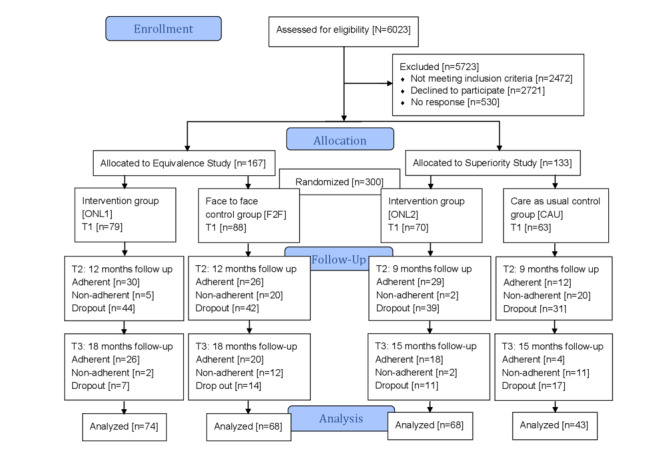
In a randomized controlled trial, 6023 patients were recruited, and 300 completed the baseline measures (T1), 144 completed T2 (retention 44%-52%), and 95 completed T3 (retention 24%-36%). Sociodemographic variables (eg, age, gender, marital status, educational level), social-cognitive determinants (eg, self-efficacy, social support), health-related variables (eg, depressiveness), and expectation towards the treatment for patients assigned to online or F2F were measured at T1.
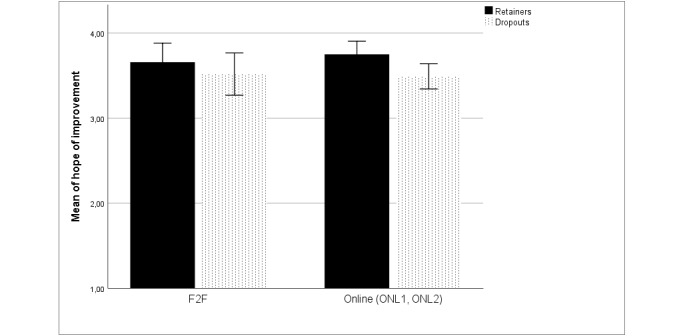
There were no significant differences between the groups regarding dropout rates (χ=0.02-1.06, P≥.30). Regarding adherence to the treatment condition, the online group outperformed the F2F and CAU conditions (P≤.01), indicating that patients randomized into the F2F and CAU control groups were much more likely to show nonadherent behavior in comparison with the online therapy groups. Within study groups, gender differences were significant only in the CAU group at T2, with women being more likely to drop out. At T3, age and marital status were also only significant in the CAU group. Patients in the online therapy group were significantly more satisfied with their treatment than patients in the F2F group (P=.02; Eta²=.09). Relationship satisfaction and success satisfaction were equally high (P>.30; Eta²=.02). Combining all study groups, patients who reported lower depressiveness scores at T1 (T2: odds ratio [OR] 0.55, 95% CI 0.35-0.87; T3: OR 0.56, 95% CI 0.37-0.92) were more likely to be retained, and patients who had higher self-efficacy (T2: OR 0.57, 95% CI 0.37-0.89; T3: OR 0.52, 95% CI 0.32-0.85) were more likely to drop out at T2 and T3. Additionally, at T3, the lower social support that patients reported was related to a higher likelihood of remaining in the study (OR 0.68, 95% CI 0.48-0.96). Comparing the 3 intervention groups, positive expectation was significantly related with questionnaire completion at T2 and T3 after controlling for other variables (T2: OR 1.64, 95% CI 1.08-2.50; T3: OR 1.59, 95% CI 1.01-2.51).
While online interventions have many advantages over F2F variants such as saving time and effort to commute to F2F therapy, they also create difficulties for therapists and hinder their ability to adequately react to patients' challenges. Accordingly, patient characteristics that might put them at risk for dropping out or not adhering to the treatment plan should be considered in future research and practice. Online aftercare, as described in this research, should be provided more often to medical rehabilitation patients.
ClinicalTrials.gov NCT04989842; https://clinicaltrials.gov/ct2/show/NCT04989842.
坚持接受精神健康的互联网干预措施,如在线心理治疗后护理,对于干预的效果很重要。较高的辍学率限制了干预措施的影响和推广。基线差异可能会使患者面临辍学的风险,因此有必要比较在线治疗、面对面治疗和常规护理,以检验。
本研究调查了在线、面对面和常规护理干预的依从性以及这些组的研究辍学率,以及对治疗关系的主观评价。考虑了社会人口统计学、社会认知和健康相关变量。
在一项随机对照试验中,招募了 6023 名患者,其中 300 名完成了基线测量(T1),144 名完成了 T2(保留率为 44%-52%),95 名完成了 T3(保留率为 24%-36%)。社会人口统计学变量(如年龄、性别、婚姻状况、教育程度)、社会认知决定因素(如自我效能感、社会支持)、健康相关变量(如抑郁程度)以及对在线或面对面治疗的期望在 T1 时进行了测量。
各组之间的辍学率没有显著差异(χ=0.02-1.06,P≥.30)。关于治疗的依从性,在线组的表现优于面对面组和常规护理组(P≤.01),这表明随机分配到面对面和常规护理对照组的患者在比较时更有可能表现出不依从的行为与在线治疗组相比。在研究组内,只有在常规护理组中,性别差异在 T2 时才具有统计学意义,女性更有可能辍学。在 T3 时,年龄和婚姻状况在常规护理组中也只有统计学意义。在线治疗组的患者对治疗的满意度明显高于面对面治疗组(P=.02;Eta²=.09)。关系满意度和成功满意度同样很高(P>.30;Eta²=.02)。结合所有研究组,T1 时报告抑郁程度较低的患者(T2:优势比[OR]0.55,95%可信区间 0.35-0.87;T3:OR 0.56,95%可信区间 0.37-0.92)更有可能保留,而自我效能感较高的患者(T2:OR 0.57,95%可信区间 0.37-0.89;T3:OR 0.52,95%可信区间 0.32-0.85)更有可能在 T2 和 T3 时辍学。此外,在 T3 时,患者报告的社会支持越低,留在研究中的可能性就越高(OR 0.68,95%可信区间 0.48-0.96)。在比较 3 种干预组时,积极的期望与其他变量控制后 T2 和 T3 的问卷完成情况显著相关(T2:OR 1.64,95%可信区间 1.08-2.50;T3:OR 1.59,95%可信区间 1.01-2.51)。
虽然在线干预措施比面对面治疗等方式具有许多优势,例如节省时间和精力前往面对面治疗,但它们也给治疗师带来了困难,阻碍了他们对患者挑战做出适当反应的能力。因此,应该在未来的研究和实践中考虑可能使患者面临辍学或不遵守治疗计划风险的患者特征。本研究中描述的在线康复后护理应更频繁地提供给医疗康复患者。
ClinicalTrials.gov NCT04989842;https://clinicaltrials.gov/ct2/show/NCT04989842。