Universidade Federal do Maranhão. Programa de Pós-Graduação em Saúde Coletiva. São Luís, MA, Brasil.
Universidade Federal do Maranhão. Departamento de Engenharia da Computação. São Luís, MA, Brasil.
Rev Saude Publica. 2021 Oct 29;55:71. doi: 10.11606/s1518-8787.2021055004137. eCollection 2021.
To estimate the 2020 all-cause and COVID-19 excess mortality according to sex, age, race/color, and state, and to compare mortality rates by selected causes with that of the five previous years in Brazil.
Data from the Mortality Information System were used. Expected deaths for 2020 were estimated from 2015 to 2019 data using a negative binomial log-linear model.
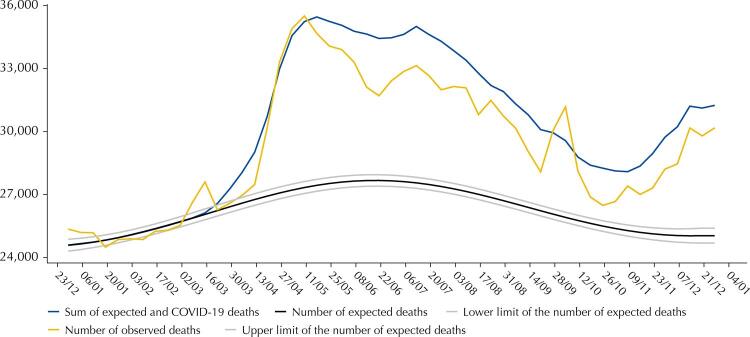
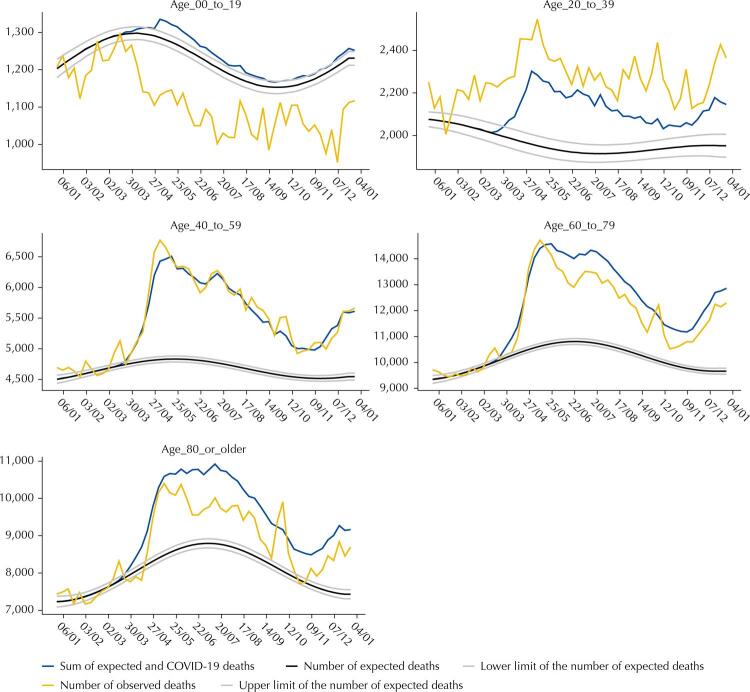
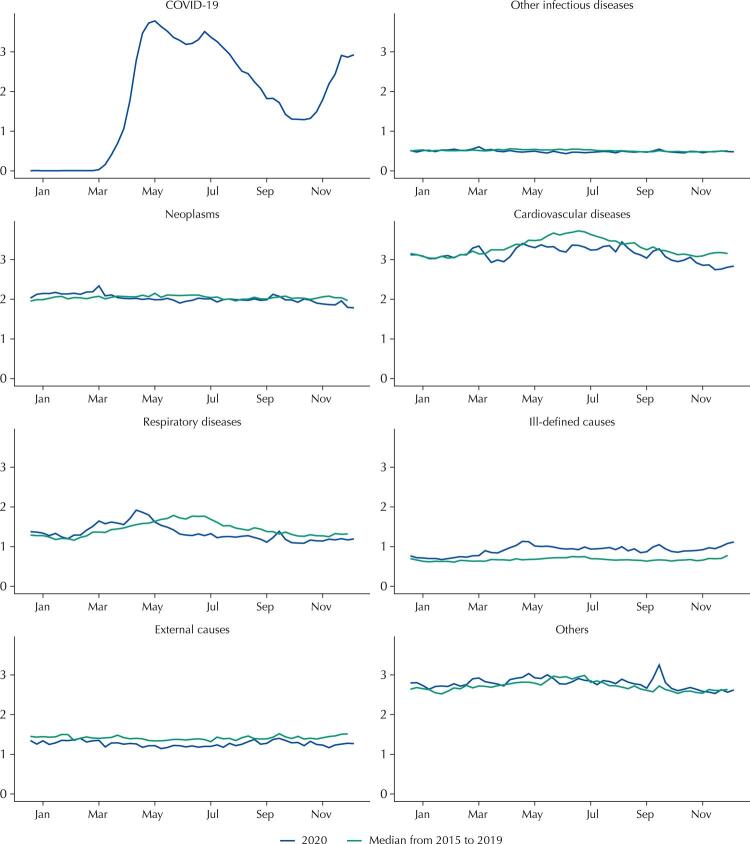
Excess deaths in Brazil in 2020 amounted to 13.7%, and the ratio of excess deaths to COVID-19 deaths was 0.90. Reductions in deaths from cardiovascular diseases (CVD), respiratory diseases, and external causes, and an increase in ill-defined causes were all noted. Excess deaths were also found to be heterogeneous, being higher in the Northern, Center-Western, and Northeastern states. In some states, the number of COVID-19 deaths was lower than that of excess deaths, whereas the opposite occurred in others. Moreover, excess deaths were higher in men aged 20 to 59, and in black, yellow, or indigenous individuals. Meanwhile, excess mortality was lower in women, in individuals aged 80 years or older, and in whites. Additionally, deaths among those aged 0 to 19 were 7.2% lower than expected, with reduction in mortality from respiratory diseases and external causes. There was also a drop in mortality due to external causes in men and in those aged 20 to 39 years. Moreover, reductions in deaths from CVD and neoplasms were noted in some states and groups.
There is evidence of underreporting of COVID-19 deaths and of the possible impact of restrictive measures in the reduction of deaths from external causes and respiratory diseases. The impacts of COVID-19 on mortality were heterogeneous among the states and groups, revealing that regional, demographic, socioeconomic, and racial differences expose individuals in distinct ways to the risk of death from both COVID-19 and other causes.
根据性别、年龄、种族/肤色和州,估计 2020 年所有原因和 COVID-19 超额死亡率,并将选定原因的死亡率与巴西前五年进行比较。
使用死亡率信息系统的数据。使用 2015 年至 2019 年的数据,通过负二项对数线性模型估算 2020 年的预期死亡人数。
2020 年巴西的超额死亡人数达到 13.7%,超额死亡与 COVID-19 死亡人数的比例为 0.90。注意到心血管疾病(CVD)、呼吸道疾病和外部原因导致的死亡人数减少,以及未明确原因的死亡人数增加。还发现超额死亡存在异质性,在北部、中西部和东北部各州较高。在一些州,COVID-19 死亡人数低于超额死亡人数,而在其他州则相反。此外,20 至 59 岁的男性、黑种人、黄种人或土著人超额死亡人数较高。与此同时,女性、80 岁及以上的人以及白人的超额死亡率较低。此外,0 至 19 岁人群的死亡人数比预期低 7.2%,呼吸道疾病和外部原因导致的死亡率下降。男性和 20 至 39 岁人群的外部原因导致的死亡率也有所下降。此外,一些州和人群的 CVD 和肿瘤死亡率下降。
有证据表明 COVID-19 死亡人数可能存在漏报,以及限制措施可能对外部原因和呼吸道疾病导致的死亡人数减少产生影响。COVID-19 对死亡率的影响在各州和人群之间存在异质性,这表明地区、人口统计学、社会经济和种族差异以不同的方式使个体面临 COVID-19 和其他原因导致的死亡风险。