School of Biological Sciences, Georgia Institute of Technology, Atlanta, Georgia.
Barrow Neurological Institute, St. Joseph's Hospital and Medical Center, Phoenix, Arizona.
J Neurophysiol. 2022 Jan 1;127(1):56-85. doi: 10.1152/jn.00191.2021. Epub 2021 Nov 3.
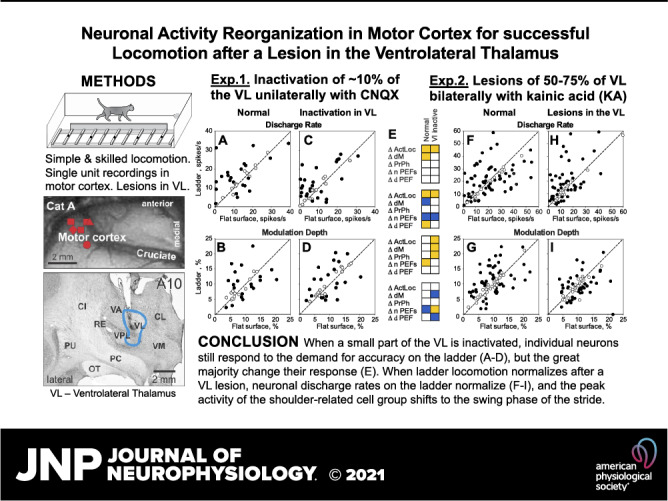
Thalamic stroke leads to ataxia if the cerebellum-receiving ventrolateral thalamus (VL) is affected. The compensation mechanisms for this deficit are not well understood, particularly the roles that single neurons and specific neuronal subpopulations outside the thalamus play in recovery. The goal of this study was to clarify neuronal mechanisms of the motor cortex involved in mitigation of ataxia during locomotion when part of the VL is inactivated or lesioned. In freely ambulating cats, we recorded the activity of neurons in layer V of the motor cortex as the cats walked on a flat surface and horizontally placed ladder. We first reversibly inactivated ∼10% of the VL unilaterally using glutamatergic transmission antagonist CNQX and analyzed how the activity of motor cortex reorganized to support successful locomotion. We next lesioned 50%-75% of the VL bilaterally using kainic acid and analyzed how the activity of motor cortex reorganized when locomotion recovered. When a small part of the VL was inactivated, the discharge rates of motor cortex neurons decreased, but otherwise the activity was near normal, and the cats walked fairly well. Individual neurons retained their ability to respond to the demand for accuracy during ladder locomotion; however, most changed their response. When the VL was lesioned, the cat walked normally on the flat surface but was ataxic on the ladder for several days after lesion. When ladder locomotion normalized, neuronal discharge rates on the ladder were normal, and the shoulder-related group was preferentially active during the stride's swing phase. This is the first analysis of reorganization of the activity of single neurons and subpopulations of neurons related to the shoulder, elbow, or wrist, as well as fast- and slow-conducting pyramidal tract neurons in the motor cortex of animals walking before and after inactivation or lesion in the thalamus. The results offer unique insights into the mechanisms of spontaneous recovery after thalamic stroke, potentially providing guidance for new strategies to alleviate locomotor deficits after stroke.
如果小脑接受的腹外侧丘脑(VL)受到影响,丘脑卒中可导致共济失调。对于这种缺陷的补偿机制还不是很清楚,特别是丘脑外的单个神经元和特定神经元亚群在恢复中的作用。本研究的目的是阐明运动皮层中参与缓解 VL 部分失活或损伤时运动时共济失调的神经元机制。在自由行走的猫中,我们在猫在平坦表面和水平放置的梯子上行走时记录了运动皮层 V 层神经元的活动。我们首先使用谷氨酸能传递拮抗剂 CNQX 可逆地单侧失活 VL 的约 10%,并分析了运动皮层的活动如何重新组织以支持成功的运动。接下来,我们使用海人酸双侧损伤 VL 的 50%-75%,并分析了运动皮层的活动在运动恢复时是如何重新组织的。当 VL 的一小部分失活时,运动皮层神经元的放电率降低,但活动基本正常,猫行走相当好。个别神经元保留了它们在梯子运动中响应准确性要求的能力;然而,大多数神经元改变了它们的反应。当 VL 损伤时,猫在平坦表面上正常行走,但在损伤后几天在梯子上表现出共济失调。当梯子运动正常化时,梯子上的神经元放电率正常,与肩部相关的组在步幅摆动阶段优先活跃。这是首次分析丘脑失活或损伤前后动物行走时,与肩部、肘部或手腕相关的单个神经元和神经元亚群以及快速和慢速传导的锥体束神经元的活动重组。结果为丘脑卒中后自发恢复的机制提供了独特的见解,可能为减轻卒中后运动缺陷提供新的策略。