Laboratory of Functional Neuroscience, Universidad Pablo de Olavide, Seville, Spain.
CIBERNED, Network Center for Biomedical Research in Neurodegenerative Diseases, Madrid, Spain.
Aging (Albany NY). 2021 Nov 3;13(21):23936-23952. doi: 10.18632/aging.203668.
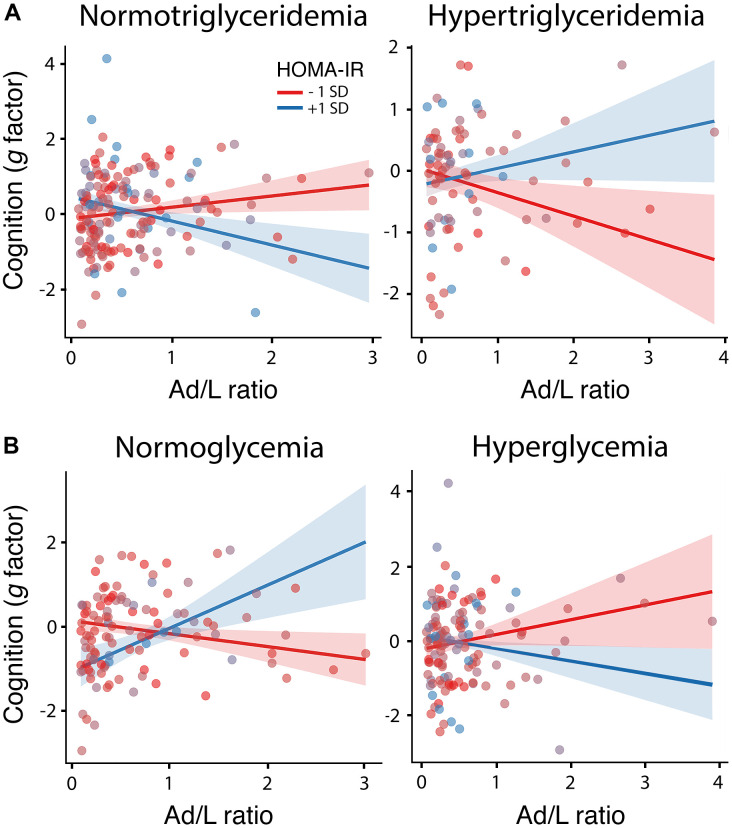
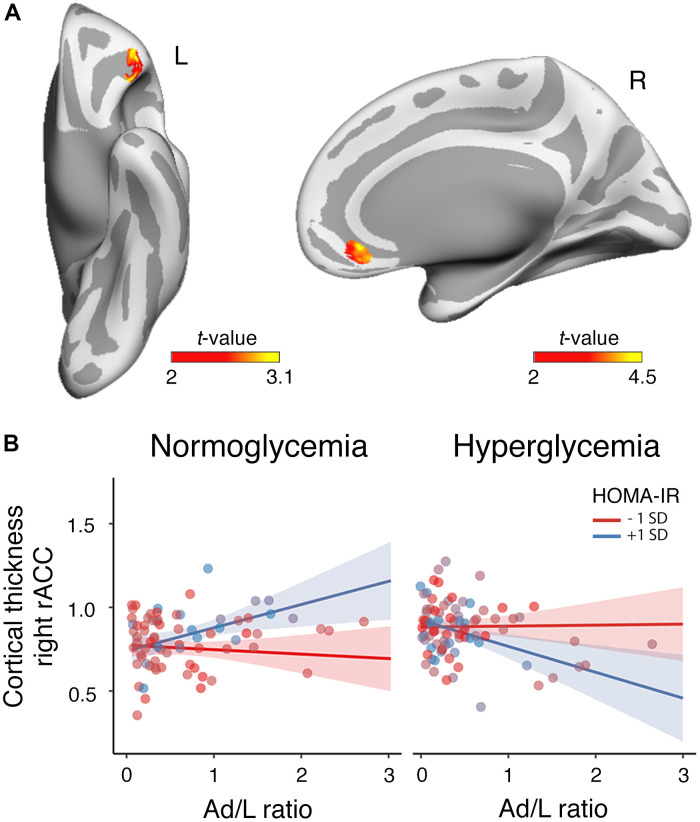
Evidence suggests that aging-related dysfunctions of adipose tissue and metabolic disturbances increase the risk of diabetes and metabolic syndrome (MtbS), eventually leading to cognitive impairment and dementia. However, the neuroprotective role of adipocytokines in this process has not been specifically investigated. The present study aims to identify metabolic alterations that may prevent adipocytokines from exerting their neuroprotective action in normal ageing. We hypothesize that neuroprotection may occur under insulin resistance (IR) conditions as long as there are no other metabolic alterations that indirectly impair the action of adipocytokines, such as hyperglycemia. This hypothesis was tested in 239 cognitively normal older adults (149 females) aged 52 to 87 years (67.4 ± 5.9 yr). We assessed whether the homeostasis model assessment-estimated insulin resistance (HOMA-IR) and the presence of different components of MtbS moderated the association of plasma adipocytokines (i.e., adiponectin, leptin and the adiponectin to leptin [Ad/L] ratio) with cognitive functioning and cortical thickness. The results showed that HOMA-IR, circulating triglyceride and glucose levels moderated the neuroprotective effect of adipocytokines. In particular, elevated triglyceride levels reduced the beneficial effect of Ad/L ratio on cognitive functioning in insulin-sensitive individuals; whereas under high IR conditions, it was elevated glucose levels that weakened the association of the Ad/L ratio with cognitive functioning and with cortical thickness of prefrontal regions. Taken together, these findings suggest that the neuroprotective action of adipocytokines is conditioned not only by whether cognitively normal older adults are insulin-sensitive or not, but also by the circulating levels of triglycerides and glucose, respectively.
有证据表明,与衰老相关的脂肪组织功能障碍和代谢紊乱会增加糖尿病和代谢综合征(MtbS)的风险,最终导致认知障碍和痴呆。然而,脂肪细胞因子在这一过程中的神经保护作用尚未得到专门研究。本研究旨在确定可能阻止脂肪细胞因子发挥其在正常衰老中神经保护作用的代谢变化。我们假设,只要没有其他代谢变化间接损害脂肪细胞因子的作用,例如高血糖,那么在胰岛素抵抗(IR)情况下就可能发生神经保护作用。这一假设在 239 名认知正常的老年人(女性 149 名,年龄 52 至 87 岁,67.4 ± 5.9 岁)中进行了测试。我们评估了稳态模型评估估计的胰岛素抵抗(HOMA-IR)和 MtbS 不同成分的存在是否调节了血浆脂肪细胞因子(即脂联素、瘦素和脂联素与瘦素的比值 [Ad/L])与认知功能和皮质厚度的关系。结果表明,HOMA-IR、循环甘油三酯和血糖水平调节了脂肪细胞因子的神经保护作用。具体而言,甘油三酯水平升高降低了 Ad/L 比值对胰岛素敏感个体认知功能的有益影响;而在高 IR 情况下,正是升高的血糖水平削弱了 Ad/L 比值与认知功能以及与前额区域皮质厚度的关联。总之,这些发现表明,脂肪细胞因子的神经保护作用不仅取决于认知正常的老年人是否对胰岛素敏感,还取决于循环甘油三酯和血糖水平。