Department of Nutrition, Affiliated Hospital of Jining Medical University, Jining, Shandong, China.
Department of Endocrinology, Affiliated Hospital of Jining Medical University, Jining, Shandong, China.
BMJ Open Diabetes Res Care. 2021 Nov;9(2). doi: 10.1136/bmjdrc-2021-002430.
Since the ratio of creatinine to cystatin C (Cre/CysC) can reflect muscle volume, it has been proven to be a predictor of sarcopenia in patients with or without diabetes. Here, we investigated the predictive value of Cre/CysC for the skeletal muscle composition and its correlations with glucose disposal ability and diabetic complications in patients with type 2 diabetes.
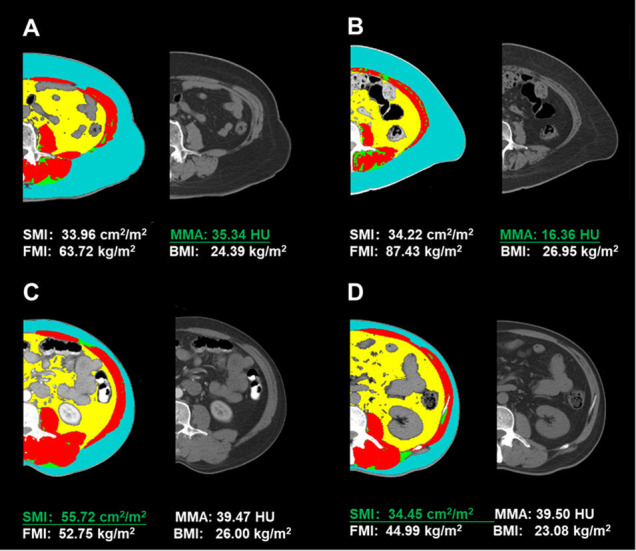
The skeletal muscle index (SMI) and mean skeletal muscle attenuation (MMA) values of 193 patients with type 2 diabetes were obtained through analyses of CT images at the lumbar 3 level.
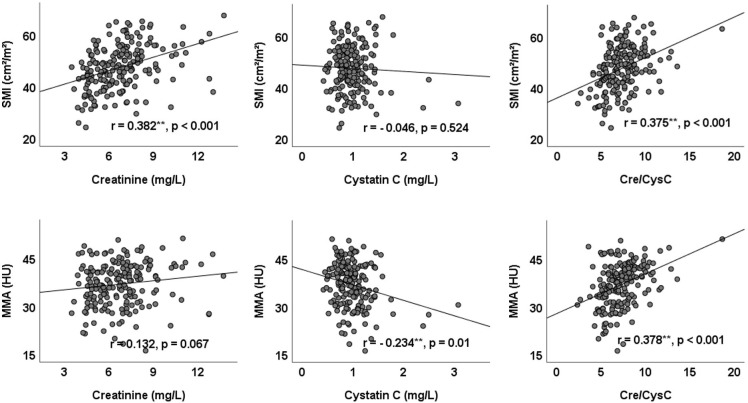
Serum Cre/CysC was significantly correlated with both the SMI (r=0.375, p<0.001) and MMA (r=0.378, p<0.001). Multiple stepwise linear regression analysis demonstrated that Cre/CysC was the only biochemical predictor of the SMI (β=0.48 (95% CI 0.02 to 0.94)) and MMA (β=0.57 (95% CI 0.14 to 1.01)). Furthermore, the fat mass index (FMI) was significantly associated with the MMA (r=-0.481, p<0.001) but not the SMI (r=0.101, p=0.164). In the diabetic complications analysis, Cre/CysC was significantly lower in patients with cardiovascular disease (95% CI (-1.47 to -0.22), p=0.008) and lower extremity arterial disease (95% CI (-1.44 to -0.29), p=0.004). Moreover, in the 100 g steamed bun test, Cre/CysC was significantly correlated with glucose levels at 60 min (r=-0.162, p=0.045), 120 min (r=-0.287, p<0.001) and 180 min (r=-0.313, p<0.001).
Cre/CysC may be a valuable predictor of skeletal muscle composition in type 2 diabetes. Patients with a higher Cre/CysC may have a better ability to dispose of postprandial glucose and are at a lower risk of macrovascular disease.
由于肌酸与半胱氨酸蛋白酶抑制剂 C 的比值(Cre/CysC)可以反映肌肉量,因此已被证明是预测有或没有糖尿病的患者发生肌肉减少症的指标。在这里,我们研究了 Cre/CysC 对 2 型糖尿病患者骨骼肌成分的预测价值及其与葡萄糖处置能力和糖尿病并发症的相关性。
通过对腰椎 3 水平 CT 图像进行分析,获得了 193 例 2 型糖尿病患者的骨骼肌指数(SMI)和平均骨骼肌衰减值(MMA)。
血清 Cre/CysC 与 SMI(r=0.375,p<0.001)和 MMA(r=0.378,p<0.001)均呈显著相关。多元逐步线性回归分析表明,Cre/CysC 是 SMI(β=0.48(95%CI 0.02 至 0.94))和 MMA(β=0.57(95%CI 0.14 至 1.01))的唯一生化预测因子。此外,脂肪质量指数(FMI)与 MMA 显著相关(r=-0.481,p<0.001),但与 SMI 不相关(r=0.101,p=0.164)。在糖尿病并发症分析中,患有心血管疾病的患者的 Cre/CysC 显著降低(95%CI(-1.47 至-0.22),p=0.008)和下肢动脉疾病(95%CI(-1.44 至-0.29),p=0.004)。此外,在 100 克馒头试验中,Cre/CysC 与 60 分钟(r=-0.162,p=0.045)、120 分钟(r=-0.287,p<0.001)和 180 分钟(r=-0.313,p<0.001)时的血糖水平显著相关。
Cre/CysC 可能是 2 型糖尿病患者骨骼肌成分的有价值的预测指标。Cre/CysC 较高的患者可能具有更好的餐后葡萄糖处置能力,并且发生大血管疾病的风险较低。