EMPIREO Diagnóstico Molecular, Madrid, Spain.
The Innate Immune Response Group, La Paz University Hospital Institute for Health Research (IdiPAZ), Madrid, Spain.
Sci Rep. 2021 Nov 3;11(1):21612. doi: 10.1038/s41598-021-00990-4.
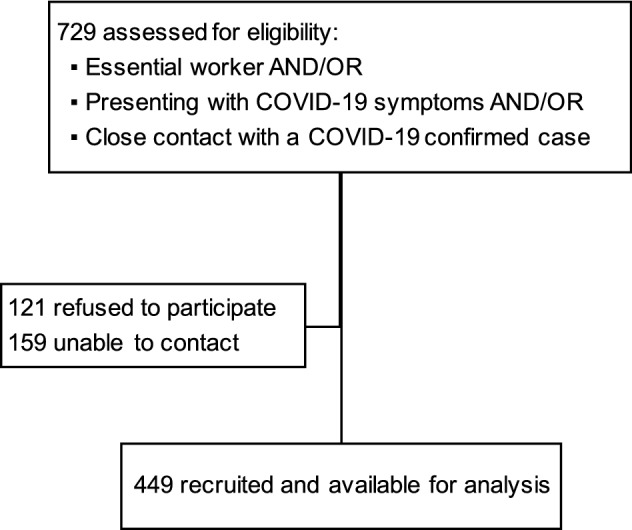
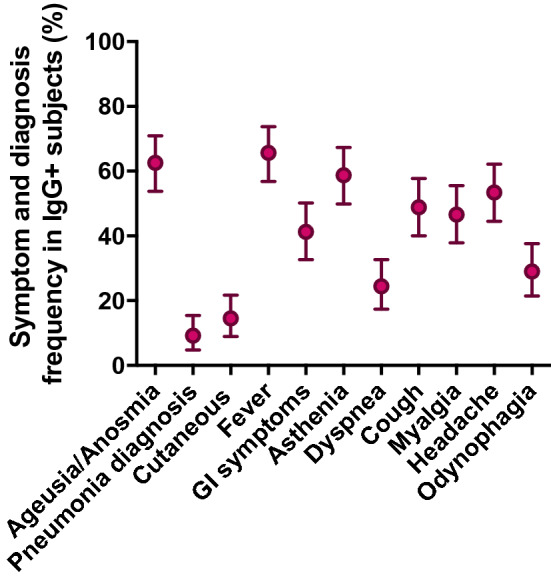
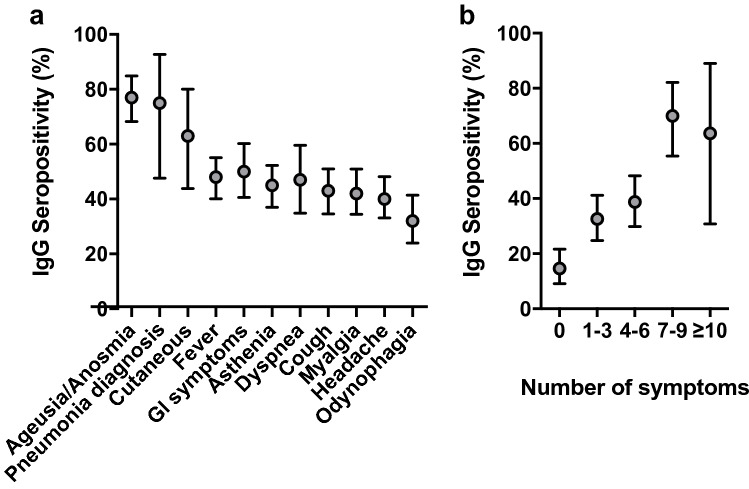
The Coronavirus Disease of 2019 (COVID-19) pandemic caused by SARS-CoV-2 led the Spanish government to impose a national lockdown in an attempt to control the spread of the infection. Mobility restrictions and the requirement of a medical prescription for serological testing for COVID-19 were included among the control measures. Under this scenario, between April 15th and June 15th, 2020, we performed an observational study including 449 individuals allowed to be tested according to the governmental restrictions, i.e. fulfilling the following prescription requirements: manifestation of COVID-19-compatible symptoms, contact with a confirmed COVID-19 patient, or employment as an essential worker, including health care workers, firefighters and public safety personnel such as police. Importantly, a relevant feature of the studied cohort was that none of the participants had been hospitalized. We analyzed SARS-CoV-2 IgG seropositivity in this specific cohort, uncovering intrinsic features of great demographic interest. The overall rate of IgG seropositivity was 33.69% (95% CI: 29.27-38.21). This frequency was comparable among the different participant occupations. A RT-PCR positive test, contact with a household member previously tested positive and the presence of COVID-19-compatible symptoms were positively associated with IgG + results. Among these symptoms, ageusia/anosmia was positively and independently associated with SARS-CoV-2 IgG seropositivity, while odynophagia was inversely associated. However, fever, ageusia/anosmia and asthenia were the most frequent symptoms described by IgG + subjects. Therefore, our data illustrate how specific cohorts display particular characteristics that should be taken into account when studying population-wide SARS-CoV-2 seroprevalence and key defining symptoms of COVID-19.
2019 年冠状病毒病(COVID-19)大流行是由严重急性呼吸综合征冠状病毒 2(SARS-CoV-2)引起的,西班牙政府因此实施了全国封锁,试图控制感染的传播。限制流动性和要求进行 COVID-19 血清学检测需凭医学处方是控制措施之一。在这种情况下,我们于 2020 年 4 月 15 日至 6 月 15 日进行了一项观察性研究,纳入了 449 名根据政府限制获准检测的个体,即符合以下处方要求的个体:出现 COVID-19 症状、与确诊 COVID-19 患者接触或从事基本工作,包括医护人员、消防员和公共安全人员(如警察)。重要的是,研究队列的一个相关特征是,没有参与者住院。我们分析了这一特定队列的 SARS-CoV-2 IgG 血清阳性率,揭示了具有重要人口统计学意义的内在特征。总的 IgG 血清阳性率为 33.69%(95%CI:29.27-38.21)。不同参与者职业之间的这一频率相当。RT-PCR 阳性检测、与先前检测呈阳性的家庭成员接触以及出现 COVID-19 症状与 IgG 阳性结果呈正相关。在这些症状中,味觉丧失/嗅觉丧失与 SARS-CoV-2 IgG 血清阳性呈正相关且独立相关,而咽痛与之相反。然而,发热、味觉丧失/嗅觉丧失和乏力是 IgG 阳性者描述最多的症状。因此,我们的数据说明了特定队列如何显示出在研究人群 SARS-CoV-2 血清流行率和 COVID-19 的关键定义症状时应考虑的特定特征。