Perkins Anita K, Rose Andrew L, Grossart Hans-Peter, Rojas-Jimenez Keilor, Barroso Prescott Selva K, Oakes Joanne M
Centre for Coastal Biogeochemistry, Faculty of Science and Engineering, Southern Cross University, Lismore, NSW, Australia.
Southern Cross Geoscience, Faculty of Science and Engineering, Southern Cross University, Lismore, NSW, Australia.
Front Microbiol. 2021 Oct 18;12:726138. doi: 10.3389/fmicb.2021.726138. eCollection 2021.
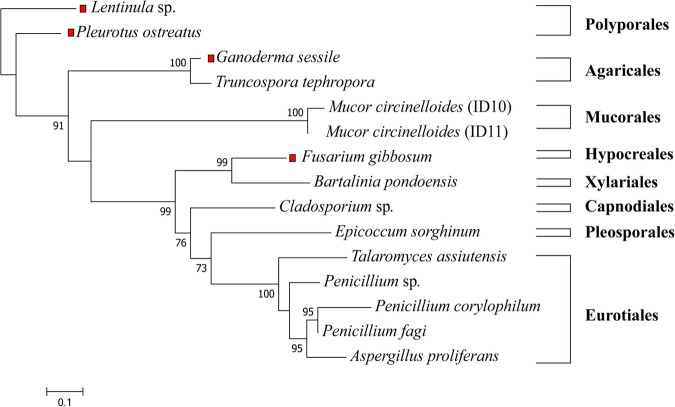
Cellulose and chitin are the most abundant polymeric, organic carbon source globally. Thus, microbes degrading these polymers significantly influence global carbon cycling and greenhouse gas production. Fungi are recognized as important for cellulose decomposition in terrestrial environments, but are far less studied in marine environments, where bacterial organic matter degradation pathways tend to receive more attention. In this study, we investigated the potential of fungi to degrade kelp detritus, which is a major source of cellulose in marine systems. Given that kelp detritus can be transported considerable distances in the marine environment, we were specifically interested in the capability of endophytic fungi, which are transported with detritus, to ultimately contribute to kelp detritus degradation. We isolated 10 species and two strains of endophytic fungi from the kelp . We then used a dye decolorization assay to assess their ability to degrade organic polymers (lignin, cellulose, and hemicellulose) under both oxic and anoxic conditions and compared their degradation ability with common terrestrial fungi. Under oxic conditions, there was evidence that Ascomycota isolates produced cellulose-degrading extracellular enzymes (associated with manganese peroxidase and sulfur-containing lignin peroxidase), while Mucoromycota isolates appeared to produce both lignin and cellulose-degrading extracellular enzymes, and all Basidiomycota isolates produced lignin-degrading enzymes (associated with laccase and lignin peroxidase). Under anoxic conditions, only three kelp endophytes degraded cellulose. We concluded that kelp fungal endophytes can contribute to cellulose degradation in both oxic and anoxic environments. Thus, endophytic kelp fungi may play a significant role in marine carbon cycling via polymeric organic matter degradation.
纤维素和几丁质是全球最为丰富的聚合态有机碳源。因此,降解这些聚合物的微生物对全球碳循环和温室气体产生有着重大影响。真菌被认为在陆地环境中对纤维素分解很重要,但在海洋环境中的研究要少得多,在海洋环境中细菌的有机物降解途径往往更受关注。在本研究中,我们调查了真菌降解海带碎屑的潜力,海带碎屑是海洋系统中纤维素的主要来源。鉴于海带碎屑在海洋环境中可被远距离运输,我们特别关注与碎屑一同运输的内生真菌最终对海带碎屑降解的贡献能力。我们从海带中分离出10种内生真菌和2个菌株。然后我们使用染料脱色试验评估它们在有氧和无氧条件下降解有机聚合物(木质素、纤维素和半纤维素)的能力,并将它们的降解能力与常见的陆生真菌进行比较。在有氧条件下,有证据表明子囊菌门分离株产生降解纤维素的胞外酶(与锰过氧化物酶和含硫木质素过氧化物酶有关),而毛霉门分离株似乎同时产生降解木质素和纤维素的胞外酶,所有担子菌门分离株都产生降解木质素的酶(与漆酶和木质素过氧化物酶有关)。在无氧条件下,只有三种海带内生菌降解纤维素。我们得出结论,海带内生真菌在有氧和无氧环境中都有助于纤维素降解。因此,海带内生真菌可能通过聚合态有机物降解在海洋碳循环中发挥重要作用。