Nakaji Konosuke, Kumamoto Mitsutaka, Yodozawa Mikiko, Okahara Kazuki, Suzumura Shigeo, Nakae Yukinori
Endoscopy Center, Aishinkai Nakae Hospital, Wakayama-shi 640-8461, Wakayama, Japan.
Internal Medicine, Japanese Red Cross Urakawa Hospital, Higashichochinomi, Urakawagun Urakawacho 057-0007, Hokkaido, Japan.
World J Gastrointest Endosc. 2021 Oct 16;13(10):502-509. doi: 10.4253/wjge.v13.i10.502.
Colon capsule endoscopy (CCE), which became clinically applicable in 2006, is a simple and noninvasive procedure to evaluate colonic diseases; the accuracy of second-generation CCE, introduced in 2009, has dramatically improved. Currently, CCE is used as an alternative method for colorectal cancer screening, as well as for evaluating the mucosal lesions of inflammatory bowel disease, in cases where performing colonoscopy (CS) is difficult. However, the outcomes of CCE are uncertain.
To investigate the outcomes of Japanese patients with negative findings (no polyps or colorectal cancer) on initial CCE.
This retrospective, single-center study was conducted at the Endoscopic Center at Aishinkai Nakae Hospital. This study included patients who underwent continuous CCE between November 2013 and August 2019, that exhibited no evidence of polyps or colorectal cancer at the initial CCE, and could be followed up using either the fecal immunochemical test (FIT), CS, or CCE. The observational period, follow-up method, presence or absence of polyps and colorectal cancer, pathological diagnosis, and number of colorectal cancer deaths were evaluated.
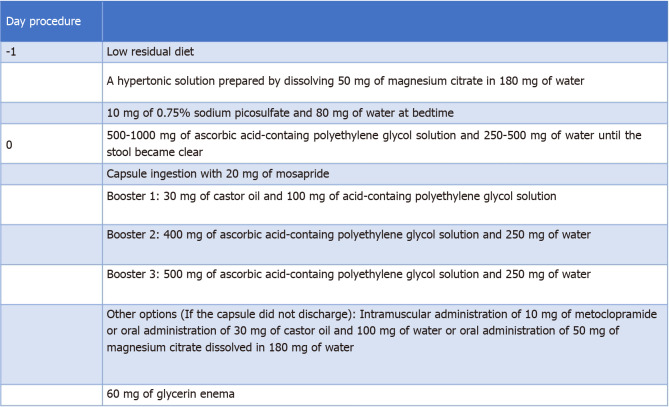
Thirty-one patients (mean age, 60.4 ± 15.6 years; range, 28-84 years; 14 men and 17 women) were enrolled in this study. The reasons for performing the first CCE were screening in 12, a positive FIT in six, lower abdominal pain in nine, diarrhea in two, and anemia in two patients. The mean total water volume at the time of examination was 3460 ± 602 mL (2250-4800 mL), and a total CS was performed in 28 patients (90%). The degree of cleanliness was excellent in 15 patients and good in 16, and no poor cases were observed. No adverse events, such as retention or capsule aspiration, were observed in any of the patients. The mean follow-up period was 3.1 ± 1.5 years (range, 0.3-5.5 years). Follow-up included FIT in nine, CS in 20, and CCE in four patients (including duplicate patients). The FIT was positive in two patients, while CS revealed five polyp lesions (three in the ascending colon, one in the transverse colon, and one in the descending colon), with sizes ranging between 2 mm and 8 mm. Histopathological findings revealed a hyperplastic polyp in one patient, and adenoma with low grade dysplasia in four patients; colorectal cancers were not recognized. In the follow-up example by CCE, polyps and colorectal cancer could not be recognized. During the follow-up period, there were no deaths due to colorectal cancer in any of the patients.
We determined the outcomes in patients with negative initial CCE findings.
结肠胶囊内镜检查(CCE)于2006年开始临床应用,是一种评估结肠疾病的简单且无创的检查方法;2009年推出的第二代CCE的准确性有了显著提高。目前,CCE被用作结肠直肠癌筛查的替代方法,以及在难以进行结肠镜检查(CS)的情况下评估炎症性肠病的黏膜病变。然而,CCE的结果尚不确定。
研究初诊CCE结果为阴性(无息肉或结肠直肠癌)的日本患者的后续情况。
这项回顾性单中心研究在爱新海仲江医院内镜中心进行。本研究纳入了2013年11月至2019年8月期间接受连续CCE检查、初诊CCE未发现息肉或结肠直肠癌证据、且可通过粪便免疫化学检测(FIT)、CS或CCE进行随访的患者。评估观察期、随访方法、息肉和结肠直肠癌的有无、病理诊断以及结肠直肠癌死亡人数。
本研究共纳入31例患者(平均年龄60.4±15.6岁;范围28 - 84岁;男性1十四例,女性17例)。首次进行CCE的原因包括筛查12例、FIT阳性6例、下腹痛9例、腹泻2例、贫血2例。检查时的平均总水量为3460±602 mL(2250 - 4800 mL),28例患者(90%)进行了全结肠镜检查。15例患者的清洁程度为优秀,16例为良好,未观察到清洁程度差的病例。所有患者均未观察到诸如滞留或胶囊误吸等不良事件。平均随访期为3.1±1.5年(范围0.3 - 5.5年)。随访包括FIT检查9例、CS检查20例、CCE检查4例(包括重复检查的患者)。2例患者FIT呈阳性,而CS检查发现5处息肉病变(升结肠3处、横结肠1处、降结肠1处),大小在2 mm至8 mm之间。组织病理学检查结果显示,1例患者为增生性息肉,4例患者为低级别发育异常腺瘤;未发现结肠直肠癌。在CCE随访的病例中,未发现息肉和结肠直肠癌。在随访期间,所有患者均未因结肠直肠癌死亡。
我们确定了初诊CCE结果为阴性的患者的后续情况。