Shen Wei, Qiu Wen, Liu Yuting, Liao Weihua, Ma Yiyi, He Yan, Wang Zhang, Zhou Hongwei
Department of Neonatology, Nanfang Hospital, Southern Medical University, Guangzhou, China.
Microbiome Medicine Center, Department of Laboratory Medicine, Zhujiang Hospital, Southern Medical University, Guangzhou, China.
Transl Pediatr. 2021 Sep;10(9):2313-2324. doi: 10.21037/tp-21-367.
The gut microbiome plays a potential role in clinical events in preterm infants and may affect their lateral development. Understanding the initial colonization of microbes in the gut, their early dynamic changes, and the major factors correlated with these changes would provide crucial information about the developmental process in early life.
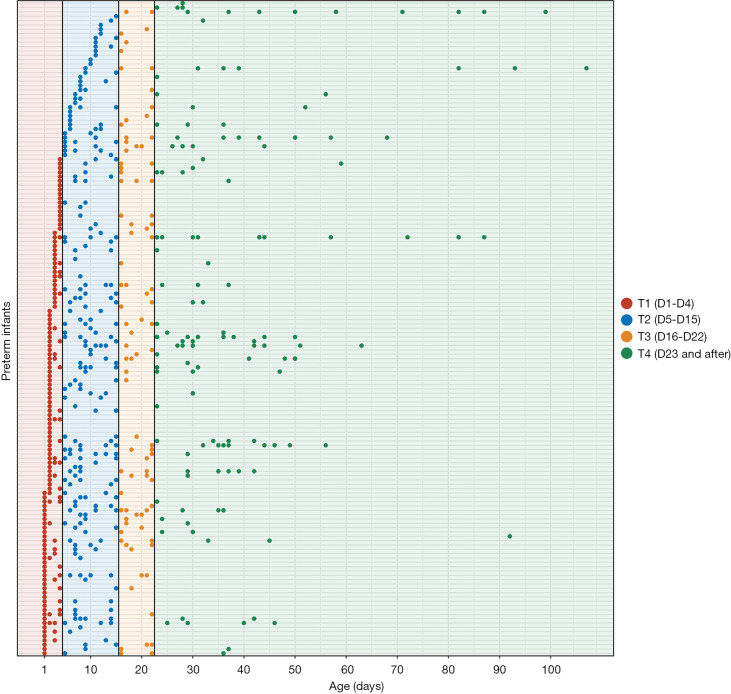
The present study enrolled 151 preterm infants and examined the longitudinal dynamics of their fecal microbiome profiles during the period of hospitalization using 16S ribosomal RNA gene sequencing. Random forest modeling was used to predict postnatal age (Age), postmenstrual age (PMA), and gestational age (GA), using gut microbiome features.
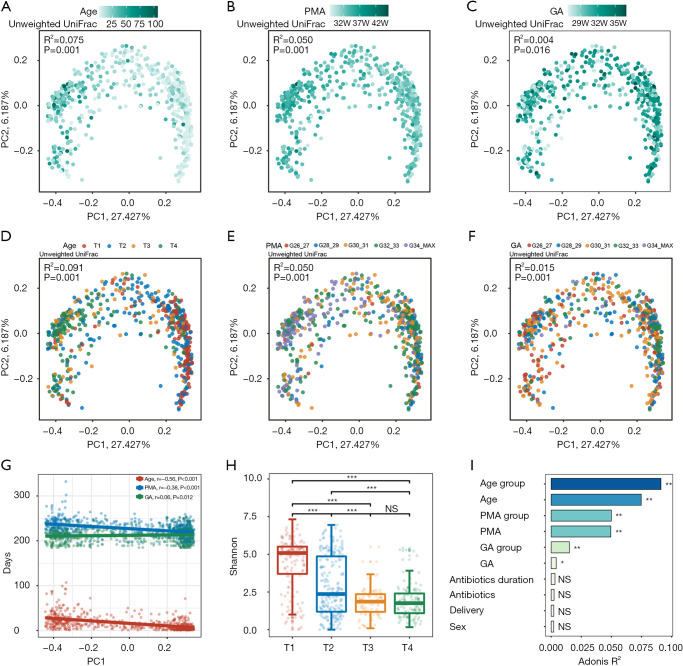
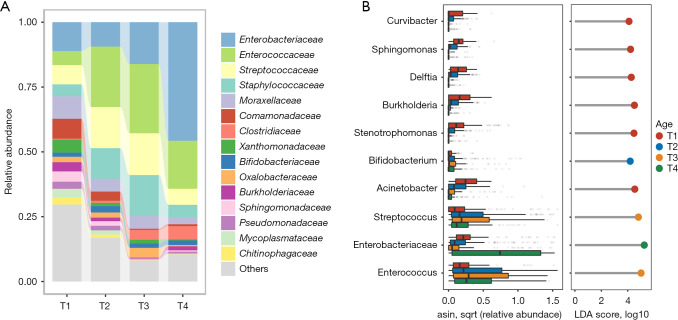
Principal coordinate analysis revealed that the gut microbiome of the preterm infants displayed an obvious time-dependent change pattern, which showed the strongest association with Age, followed by PMA, and a much weaker association with (GA). Random forest modeling further evidenced the time-dependent change pattern, with the Pearson's correlation coefficients between the actual values and the gut microbiome-predicted values being 0.68, 0.53, and 0.38 for postnatal, postmenstrual, and gestational age, respectively. The microbiome dynamism could be further divided into four Age stages, each with its own characteristic microbial taxa. The first 1-4 days (T1 stage) represented the meconium microbiome, with colonization of a high diversity of microbes before or during delivery. During 5-15 days (T2 stage), the gut microbiome of the preterm infants underwent a rapid turnover, in which microbial diversity declined, and stabilized afterward. , , , , and were the major classes in the gut microbiome in the lateral stages of development (T3-T4 stage).
Postnatal age, rather than the gestational age, is significantly correlated with the gut microbiome of preterm infants, suggesting that clinical interventions contribute more to the early dynamics of gut microbiome in preterm infants than the natural development of the gut.
肠道微生物群在早产儿的临床事件中发挥潜在作用,并可能影响其生长发育。了解肠道微生物的初始定植、早期动态变化以及与这些变化相关的主要因素,将为生命早期的发育过程提供关键信息。
本研究纳入了151名早产儿,使用16S核糖体RNA基因测序技术,对其住院期间粪便微生物群谱的纵向动态变化进行了检测。利用肠道微生物群特征,采用随机森林模型预测出生后年龄(Age)、月经后年龄(PMA)和胎龄(GA)。
主坐标分析显示,早产儿的肠道微生物群呈现出明显的时间依赖性变化模式,与Age的相关性最强,其次是PMA,与GA的相关性较弱。随机森林模型进一步证实了这种时间依赖性变化模式,出生后、月经后和胎龄的实际值与肠道微生物群预测值之间的Pearson相关系数分别为0.68、0.53和0.38。微生物群动态变化可进一步分为四个Age阶段,每个阶段都有其独特的微生物分类群。出生后的前1 - 4天(T1阶段)代表胎粪微生物群,在分娩前或分娩期间有多种微生物定植。在5 - 15天(T2阶段),早产儿的肠道微生物群经历了快速更替,微生物多样性下降,随后趋于稳定。在发育后期阶段(T3 - T4阶段),肠道微生物群中的主要类别为 、 、 、 和 。
出生后年龄而非胎龄与早产儿的肠道微生物群显著相关,这表明临床干预对早产儿肠道微生物群早期动态变化的影响大于肠道的自然发育。