Diesner-Treiber Susanne C, Voitl Peter, Voitl Julian J M, Langer Klara, Kuzio Ulrike, Riepl Angela, Patel Pia, Mühl-Riegler Alexandra, Mühl Bernhard
First Vienna Pediatric Medical Center, Vienna, Austria.
Medical University of Vienna, Vienna, Austria.
Front Pediatr. 2021 Oct 18;9:740785. doi: 10.3389/fped.2021.740785. eCollection 2021.
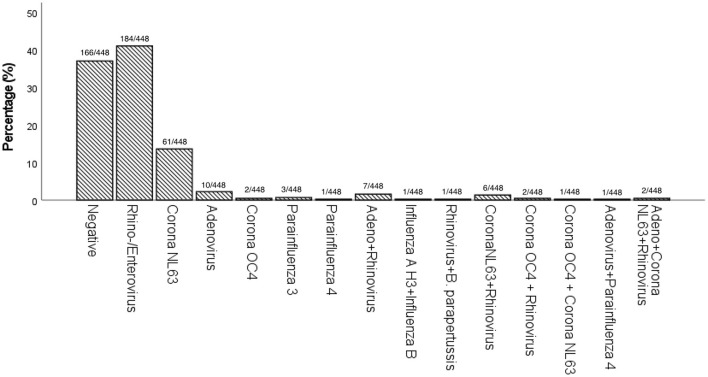
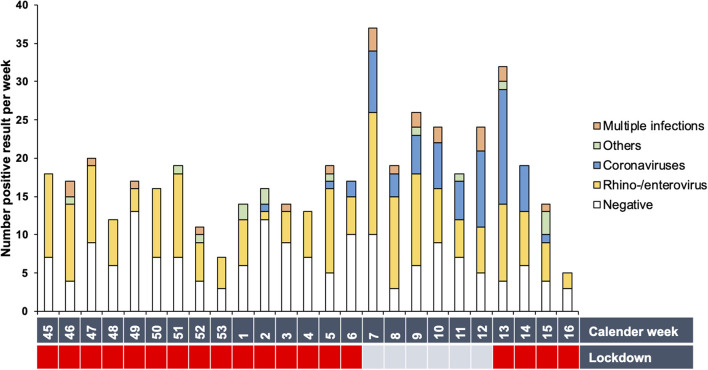
The Covid-19 pandemic compelled the implementation of measures to curb the SARS CoV-2 spread, such as social distancing, wearing FFP2 masks, and frequent hand hygiene. One anticipated ramification of these measures was the containment of other pathogens. This prospective, longitudinal study aimed to investigate the spread of 22 common seasonal non-SARS-CoV-2 pathogens, such as RSV and influenza, among children with an acute respiratory infection during a pandemic. Three hundred ninety children (0-24 months) admitted to Vienna's largest pediatric center with acute respiratory infection (November 2020-April 2021) were included in this study. The researchers tested nasal swabs for 22 respiratory pathogens by Multiplex PCR, documented clinical features and treatment, and evaluated data for a potential connection with the lockdown measures then in force. The 448 smears revealed the most common pathogens to be rhino-/enterovirus (41.4%), adenovirus (2.2%), and coronavirus NL63 (13.6%). While the first two were active throughout the entire season, coronaviruses peaked in the first trimester of 2021 in conjunction with the lift of the lockdown period (OR 4.371, 95%CI 2.34-8.136, < 0.001). RSV, metapneumovirus, and influenza were absent. This prospective, longitudinal study shows that Covid-19 measures suppressed the seasonal activity of influenza, RSV, and metapneumovirus among very young children, but not of rhino-/enterovirus and adenovirus. The 0-24 month-olds are considered the lowest risk group and were only indirectly affected by the public health measures. Lockdowns were negatively associated with coronaviruses infections.
新冠疫情促使人们采取措施遏制严重急性呼吸综合征冠状病毒2(SARS-CoV-2)的传播,如保持社交距离、佩戴FFP2口罩和勤洗手。这些措施的一个预期后果是遏制了其他病原体。这项前瞻性纵向研究旨在调查22种常见的季节性非SARS-CoV-2病原体,如呼吸道合胞病毒(RSV)和流感病毒,在疫情期间急性呼吸道感染儿童中的传播情况。本研究纳入了维也纳最大的儿科中心收治的390名急性呼吸道感染儿童(2020年11月至2021年4月,年龄0至24个月)。研究人员通过多重聚合酶链反应(Multiplex PCR)检测鼻拭子中的22种呼吸道病原体,记录临床特征和治疗情况,并评估数据与当时实施的封锁措施之间的潜在联系。448份涂片显示,最常见的病原体是鼻病毒/肠道病毒(41.4%)、腺病毒(2.2%)和冠状病毒NL63(13.6%)。前两种病原体在整个季节都很活跃,而冠状病毒在2021年第一季度随着封锁期的解除达到高峰(比值比4.371,95%置信区间2.34 - 8.136,P < 0.001)。呼吸道合胞病毒、偏肺病毒和流感病毒未检出。这项前瞻性纵向研究表明,新冠疫情防控措施抑制了幼儿中流感病毒、呼吸道合胞病毒和偏肺病毒的季节性活动,但对鼻病毒/肠道病毒和腺病毒无效。0至24个月大的儿童被认为是风险最低的群体,只是间接受到公共卫生措施的影响。封锁与冠状病毒感染呈负相关。