Yang Kelvin Jeason, Chi Nai-Hsin, Yu Hsi-Yu, Chen Yih-Sharng, Wang Shoei-Shen, Wu I-Hui
Division of Cardiovascular Surgery, Department of Surgery, National Taiwan University Hospital, College of Medicine, National Taiwan University, Taipei, Taiwan.
Graduate Institute of Clinical Medicine, College of Medicine, National Taiwan University, Taipei, Taiwan.
Front Cardiovasc Med. 2021 Oct 18;8:755214. doi: 10.3389/fcvm.2021.755214. eCollection 2021.
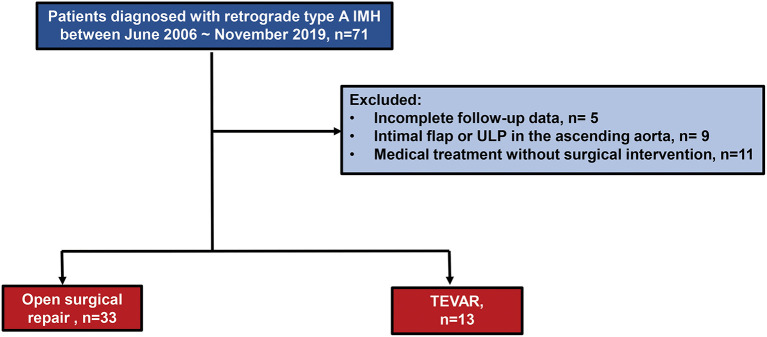
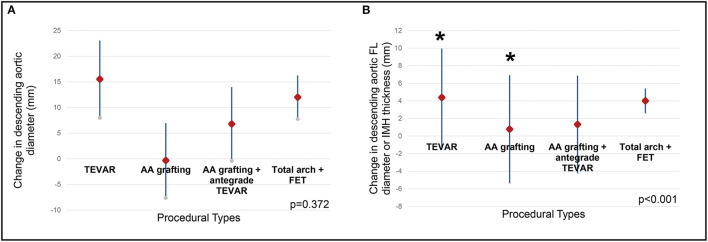
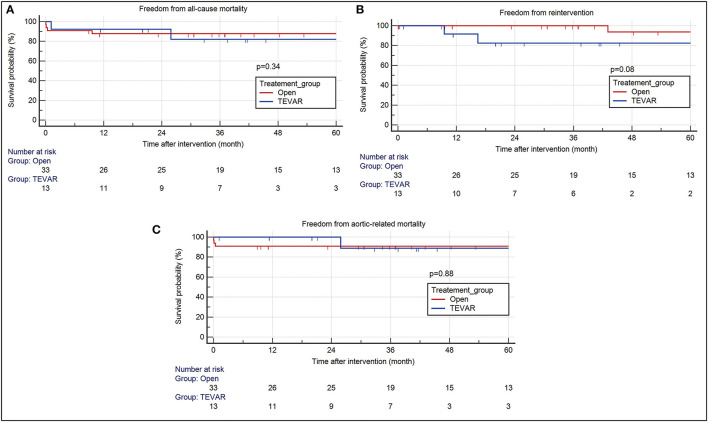
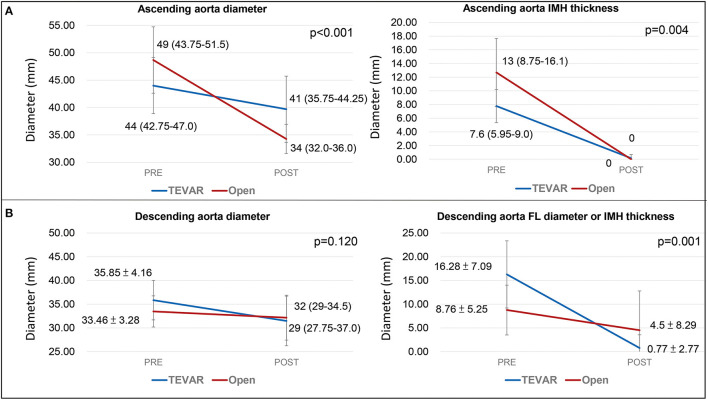
The optimal treatment modality for retrograde type A intramural hematoma (IMH) remains debatable. This study evaluated and compared surgical outcomes and aortic remodeling after open aortic repair and thoracic endovascular aortic repair (TEVAR) in patients with retrograde type A IMH with a primary intimal tear or ulcer like projection in the descending aorta. A single center, retrospective observational study was performed on patients with retrograde type A IMH undergoing either open aortic repair and TEVAR. From June 2009 and November 2019, 46 patients with retrograde type A IMH who received either open aortic repair or TEVAR at our institution were reviewed for clinical outcomes, including post-operative mortality/morbidity, re-intervention rate and aortic remodeling. 33 patients underwent open aortic repair and 13 underwent TEVAR. Median age was 68 years (interquartile range [IQR] 15.2 years) and 63 years (IQR 22.5 years) for the open repair group and TEVAR group, respectively. The median duration of follow-up for TEVAR patients was 37.6 months and 40.3 months for open aortic repair. No difference in the 5-year estimated freedom from all-cause mortality (82.1 vs. 87.8%, = 0.34), re-intervention (82.5 vs. 93.8%, = 0.08), and aortic-related mortality (88.9 vs. 90.9%, = 0.88) were observed between the TEVAR and open repair group, respectively; however, the open repair group had a significantly higher 30-day composite morbidity (39.4 vs. 7.7%, = 0.037). All patients from both treatment groups had complete resolution of the IMH in the ascending aorta. With regard to the descending thoracic aorta, TEVAR group had a significantly greater regression in the diameter of the false lumen or IMH thickness when compared to the open repair group [median 14mm (IQR 10.1) vs. 5mm (IQR 9.5), < 0.001]. TEVAR and open aortic repair were both effective treatments for retrograde type A IMH, in which no residual ascending aortic IMH was observed during follow-up. TEVAR was also associated with lower post-operative composite morbidities and better descending aortic remodeling. In selected patients with retrograde type A IMH, TEVAR might be a safe, effective alternative treatment modality.
逆行性A型主动脉壁内血肿(IMH)的最佳治疗方式仍存在争议。本研究评估并比较了在降主动脉存在原发性内膜撕裂或溃疡样突出的逆行性A型IMH患者中,开放主动脉修复术和胸主动脉腔内修复术(TEVAR)后的手术效果及主动脉重塑情况。对接受开放主动脉修复术和TEVAR的逆行性A型IMH患者进行了一项单中心回顾性观察研究。2009年6月至2019年11月,对在本机构接受开放主动脉修复术或TEVAR的46例逆行性A型IMH患者的临床结局进行了回顾,包括术后死亡率/发病率、再次干预率和主动脉重塑情况。33例患者接受了开放主动脉修复术,13例接受了TEVAR。开放修复组和TEVAR组的中位年龄分别为68岁(四分位间距[IQR] 15.2岁)和63岁(IQR 22.5岁)。TEVAR患者的中位随访时间为37.6个月,开放主动脉修复术患者为40.3个月。TEVAR组和开放修复组在5年全因死亡率估计自由度(82.1%对87.8%,P = 0.34)、再次干预率(82.5%对93.8%,P = 0.08)和主动脉相关死亡率(88.9%对90.9%,P = 0.88)方面均未观察到差异;然而,开放修复组的30天综合发病率显著更高(39.4%对7.7%,P = 0.037)。两个治疗组的所有患者升主动脉的IMH均完全消退。关于胸降主动脉,与开放修复组相比,TEVAR组假腔直径或IMH厚度的缩小更为显著[中位数14mm(IQR 10.1)对5mm(IQR 9.5);P < 0.001]。TEVAR和开放主动脉修复术都是治疗逆行性A型IMH的有效方法,随访期间未观察到升主动脉IMH残留。TEVAR还与较低的术后综合发病率和更好的胸降主动脉重塑相关。在选定的逆行性A型IMH患者中,TEVAR可能是一种安全、有效的替代治疗方式。