Zhao Zhe, Tang Yan, Hu Yang, Zhu Huijuan, Chen Xiaoguang, Zhao Bin
Department of Pharmacy, Peking Union Medical College Hospital, Chinese Academy of Medical Sciences & Peking Union Medical College, Beijing, China.
State Key Laboratory of Bioactive Substrate and Function of Natural Medicine, Institute of Materia Medica, Chinese Academy of Medical Sciences & Peking Union Medical College, Beijing, China.
Ann Transl Med. 2021 Sep;9(18):1482. doi: 10.21037/atm-21-4162.
Recent evidence has emerged concerning hypoglycemia following the application of glucagon-like peptide-1 receptor agonists (GLP-1RAs). Nevertheless, few real-world investigations have been performed to determine the clinical characteristics, onset, and outcomes of hypoglycemia associated with different GLP-1RAs. This study aimed to compare and assess the relationship between various GLP-1RAs and hypoglycemia in a large population based on updated data from the Food and Drug Administration Adverse Event Reporting System (FAERS).
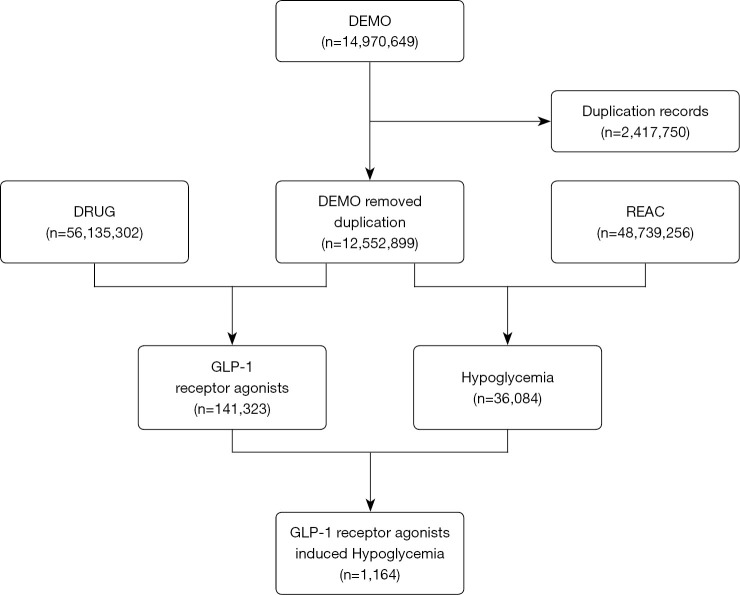
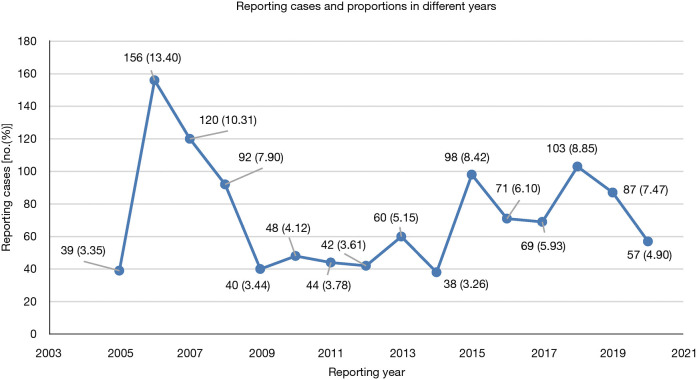
Bayesian and disproportionality analyses were applied to data mining in order to investigate suspected cases of hypoglycemia following various GLP-1RAs using the FAERS data between January 2004 and September 2020. We also evaluated the onset time, fatality risks, and hospitalization proportions of GLP-1RA-related hypoglycemia.
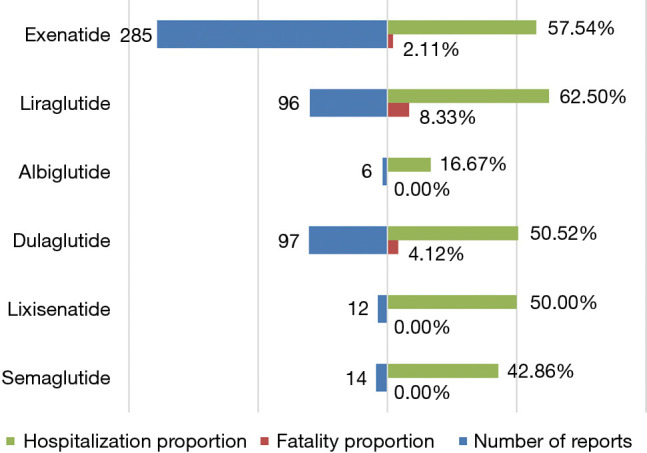
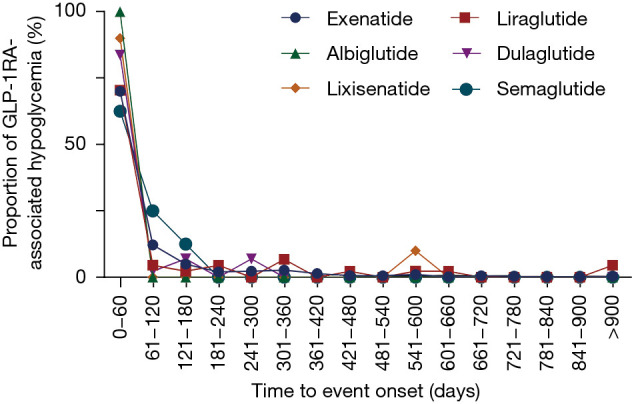
We identified 1,164 GLP-1RA-associated hypoglycemia cases, which seemed to affect more middle-aged patients than elderly ones. Also, females were more affected than males. Lixisenatide demonstrated a stronger association with hypoglycemia compared to other GLP-1RAs, according to the highest reporting odds ratio (ROR) (28.03, 95% confidence interval =15.92, 49.32), empirical Bayes geometric mean [26.00, 95% confidence interval (CI): 16.20], and proportional reporting ratio (PRR) (26.01, χ=313.37). The median time to hypoglycemia onset was 5 days (interquartile range, 0-67.75 days) following GLP-1RA treatment. In general, GLP-1RA-associated hypoglycemia resulted in fatality and hospitalization proportions of 3.53% and 56.08%, respectively.
By analyzing the FAERS data, we outlined the association between hypoglycemia and different GLP-1RAs in greater detail in terms of clinical features, onset, and outcomes. Among all six GLP-1RAs, lixisenatide demonstrated the strongest association with hypoglycemia while no relationship between albiglutide and hypoglycemia was observed. Attention should be given to GLP-1RAs when used in patients with high risks of hypoglycemia.
有关胰高血糖素样肽-1受体激动剂(GLP-1RAs)应用后发生低血糖的证据最近出现。然而,很少有真实世界的调查来确定与不同GLP-1RAs相关的低血糖的临床特征、发作情况和结局。本研究旨在基于美国食品药品监督管理局不良事件报告系统(FAERS)的最新数据,在大量人群中比较和评估各种GLP-1RAs与低血糖之间的关系。
应用贝叶斯和不成比例分析进行数据挖掘,以便使用2004年1月至2020年9月期间的FAERS数据调查各种GLP-1RAs之后的低血糖疑似病例。我们还评估了GLP-1RA相关低血糖的发作时间、死亡风险和住院比例。
我们识别出1164例GLP-1RA相关低血糖病例,似乎中年患者比老年患者受影响更多。此外,女性比男性受影响更严重。与其他GLP-1RAs相比,利司那肽与低血糖的关联更强,根据最高报告比值比(ROR)(28.03,95%置信区间=15.92,49.32)、经验贝叶斯几何均值[26.00,95%置信区间(CI):16.20]和比例报告比值(PRR)(26.01,χ=313.37)。GLP-1RA治疗后低血糖发作的中位时间为5天(四分位间距,0 - 67.75天)。一般来说,GLP-1RA相关低血糖导致的死亡率和住院率分别为3.53%和56.08%。
通过分析FAERS数据,我们在临床特征、发作情况和结局方面更详细地概述了低血糖与不同GLP-1RAs之间的关联。在所有六种GLP-1RAs中,利司那肽与低血糖的关联最强,而未观察到阿必鲁肽与低血糖之间的关系。在低血糖高风险患者中使用GLP-1RAs时应予以关注。