Neuroscience Institute Cavalieri Ottolenghi, Department of Neuroscience "Rita Levi Montalcini", University of Turin.
Department of Public Health and Paediatrics, University of Turin; Stem Cell Transplantation and Cellular Therapy Laboratory, Paediatric Onco-Haematology Division, Regina Margherita Children's Hospital, City of Health and Science of Turin.
Eur J Histochem. 2021 Nov 4;65(s1):3294. doi: 10.4081/ejh.2021.3294.
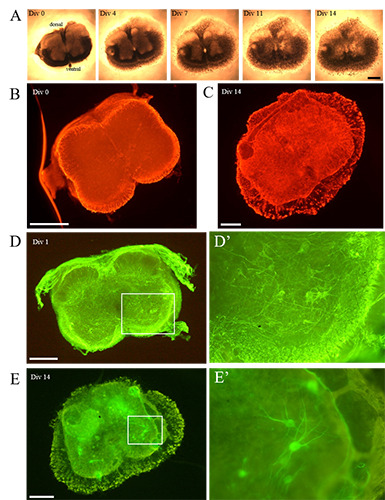
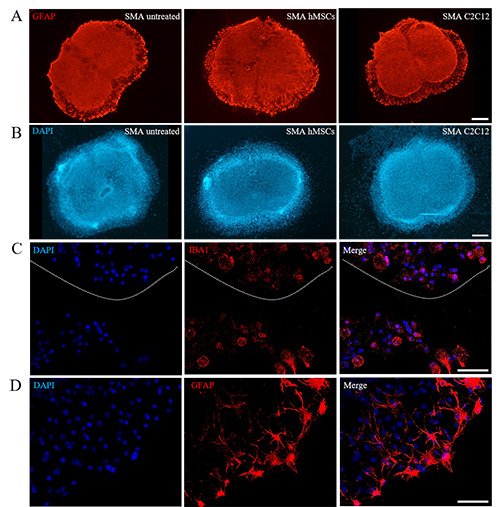
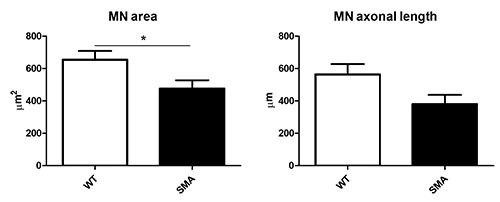
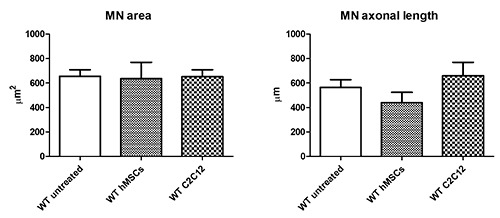
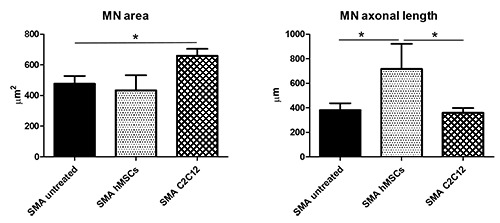
Spinal muscular atrophy (SMA) is a severe neuromuscular disease affecting children, due to mutation/deletion of survival motor neuron 1 (SMN1) gene. The lack of functional protein SMN determines motor neuron (MN) degeneration and skeletal muscle atrophy, leading to premature death due to respiratory failure. Nowadays, the Food and Drug Administration approved the administration of three drugs, aiming at increasing the SMN production: although assuring noteworthy results, all these therapies show some non-negligible limitations, making essential the identification of alternative/synergistic therapeutic strategies. To offer a valuable in vitro experimental model for easily performing preliminary screenings of alternative promising treatments, we optimized an organotypic spinal cord culture (derived from murine spinal cord slices), which well recapitulates the pathogenetic features of SMA. Then, to validate the model, we tested the effects of human Mesenchymal Stem Cells (hMSCs) or murine C2C12 cells (a mouse skeletal myoblast cell line) conditioned media: 1/3 of conditioned medium (obtained from either hMSCs or C2C12 cells) was added to the conventional medium of the organotypic culture and maintained for 7 days. Then the slices were fixed and immunoreacted to evaluate the MN survival. In particular we observed that the C2C12 and hMSCs conditioned media positively influenced the MN soma size and the axonal length respectively, without modulating the glial activation. These data suggest that trophic factors released by MSCs or muscular cells can exert beneficial effects, by acting on different targets, and confirm the reliability of the model. Overall, we propose the organotypic spinal cord culture as an excellent tool to preliminarily screen molecules and drugs before moving to in vivo models, in this way partly reducing the use of animals and the costs.
脊髓性肌萎缩症(SMA)是一种严重的神经肌肉疾病,影响儿童,由于生存运动神经元 1(SMN1)基因的突变/缺失。缺乏功能性蛋白 SMN 决定运动神经元(MN)退化和骨骼肌萎缩,导致呼吸衰竭的过早死亡。如今,美国食品和药物管理局批准了三种药物的管理,旨在增加 SMN 的产生:尽管保证了显著的结果,但所有这些治疗方法都显示出一些不可忽视的局限性,使得识别替代/协同治疗策略至关重要。为了提供一个有价值的体外实验模型,便于对替代有前途的治疗方法进行初步筛选,我们优化了一种器官型脊髓培养(源自鼠脊髓切片),该模型很好地概括了 SMA 的发病特征。然后,为了验证该模型,我们测试了人骨髓间充质干细胞(hMSCs)或鼠 C2C12 细胞(一种鼠骨骼肌成肌细胞系)条件培养基的效果:1/3 的条件培养基(从 hMSCs 或 C2C12 细胞获得)添加到器官型培养的常规培养基中并维持 7 天。然后固定切片并进行免疫反应,以评估 MN 的存活。特别是我们观察到 C2C12 和 hMSC 条件培养基分别对 MN 体大小和轴突长度产生积极影响,而不调节神经胶质细胞的激活。这些数据表明,MSC 或肌肉细胞释放的营养因子可以通过作用于不同的靶点发挥有益的作用,并证实了该模型的可靠性。总体而言,我们提出器官型脊髓培养作为在体内模型之前初步筛选分子和药物的优秀工具,从而在一定程度上减少了动物的使用和成本。