Mo-Im Kim Nursing Research Institute, Yonsei University, College of Nursing, Seoul, Republic of Korea.
Department of Information & Statistics, Chungbuk National University, Cheongju, Republic of Korea.
PLoS One. 2021 Nov 4;16(11):e0259212. doi: 10.1371/journal.pone.0259212. eCollection 2021.
The triglyceride-glucose (TyG) index is a reliable indicator of insulin resistance. We aimed to investigate the TyG index in relation to cardio-cerebrovascular diseases (CCVDs and mortality.
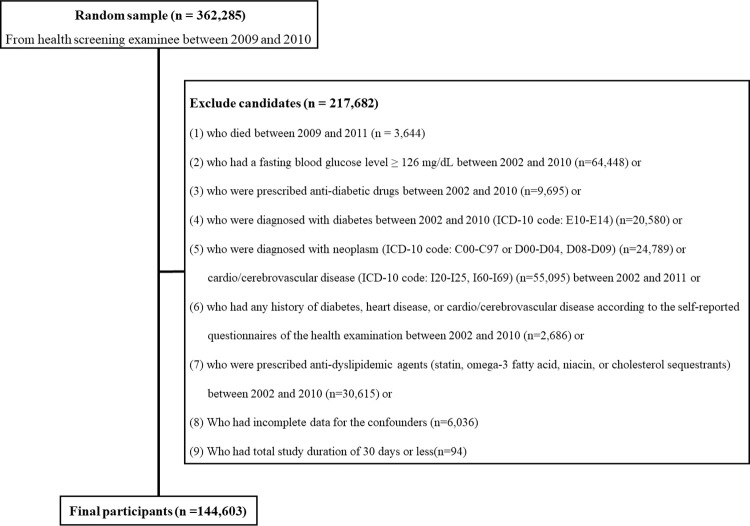
This retrospective study included 114,603 subjects. The TyG index was categorized into four quartiles by sex: Q1, <8.249 and <8.063; Q2, 8.249‒<8.614 and 8.063‒<8.403; Q3, 8.614‒< 8.998 and 8.403‒<8.752; and Q4, ≥8.998 and ≥8.752, in men and women, respectively. To calculate hazard ratios (HRs) and 95% confidence intervals (CIs) for the primary outcomes (CCVDs and all-cause mortality) and secondary outcomes (cardiovascular diseases [CVDs], cerebrovascular diseases [CbVDs], CCVD-related deaths, or all-cause deaths), Cox proportional hazards regression models were adopted.
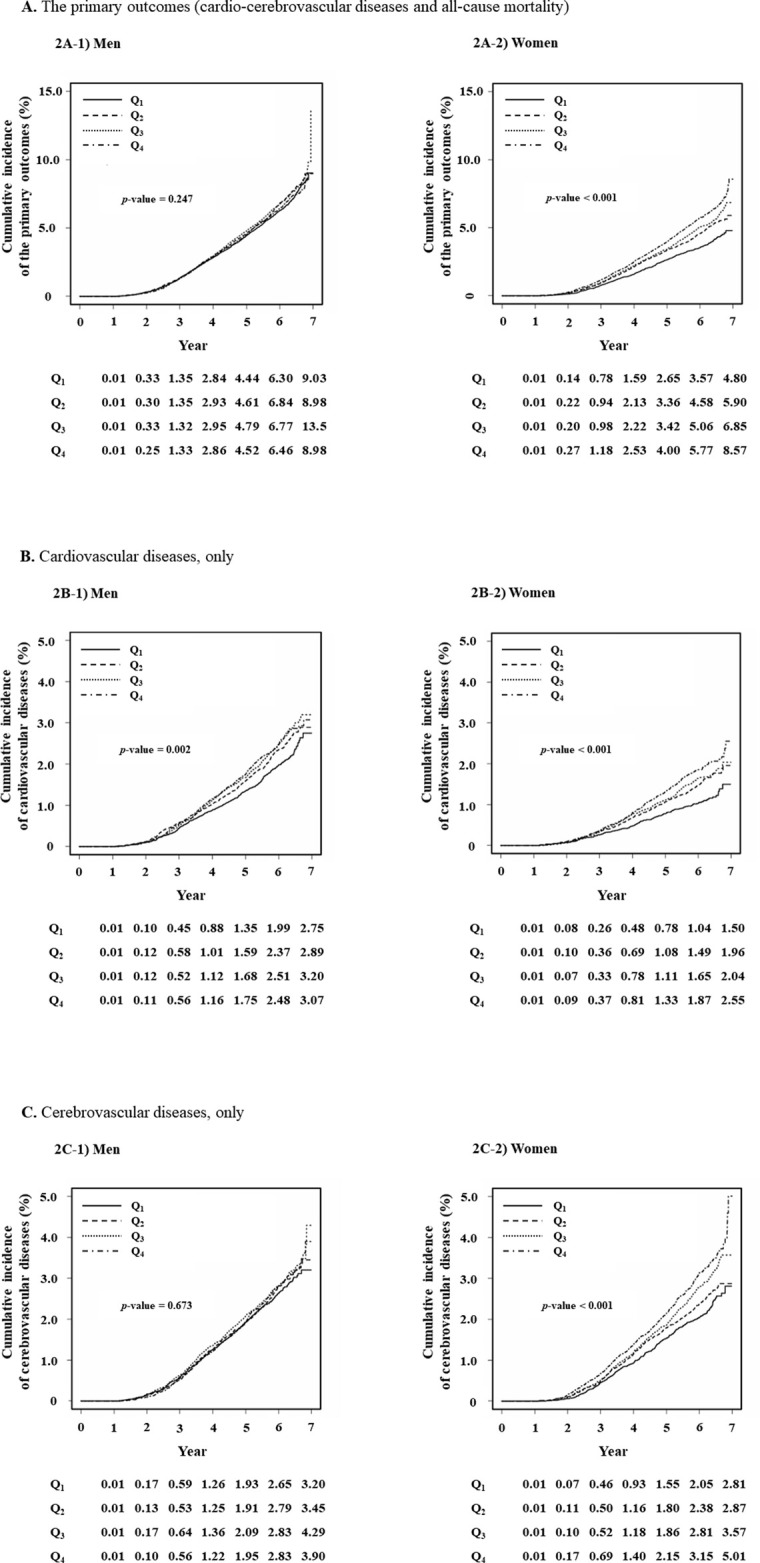
Compared to Q1, the HRs (95% CIs) for the primary outcomes of Q2, Q3, and Q4 were 1.062 (0.981‒1.150), 1.110 (1.024-1.204), and 1.151 (1.058-1.252) in men and 1.099 (0.986-1.226), 1.046 (0.938-1.166), and 1.063 (0.954-1.184) in women, respectively, after adjusted for age, smoking status, drinking status, physical activity, body mass index, systolic blood pressure, low-density lipoprotein cholesterol, economic status, and anti-hypertensive medications. Fully adjusted HRs (95% CIs) for CVDs of Q2, Q3, and Q4 were 1.114 (0.969-1.282), 1.185 (1.031-1.363), and 1.232 (1.068-1.422) in men and 1.238 (1.017-1.508), 1.183 (0.971-1.440), and 1.238 (1.018-1.505) in women, respectively. The adjusted HRs (95% CIs) for ischemic CbVDs of Q2, Q3, and Q4 were 1.005 (0.850-1.187), 1.225 (1.041-1.441), and 1.232 (1.039-1.460) in men and 1.040 (0.821-1.316), 1.226 (0.981-1.532), and 1.312 (1.054-1.634) in women, respectively, while the TyG index was negatively associated with hemorrhagic CbVDs in women but not in men. The TyG index was not significantly associated with CCVD-related death or all-cause death in either sex.
Elevated TyG index was positively associated with the primary outcomes (CCVDs and all-cause mortality) in men and predicted higher risk of CVDs and ischemic CbVDs in both sexes.
甘油三酯-葡萄糖(TyG)指数是胰岛素抵抗的可靠指标。我们旨在研究 TyG 指数与心脑血管疾病(CCVDs)和死亡率的关系。
这项回顾性研究纳入了 114603 名受试者。根据性别将 TyG 指数分为四个四分位区间:男性 Q1:<8.249 和 <8.063;Q2:8.249-<8.614 和 8.063-<8.403;Q3:8.614-<8.998 和 8.403-<8.752;Q4:≥8.998 和≥8.752。为了计算主要结局(CCVDs 和全因死亡率)和次要结局(心血管疾病[CVDs]、脑血管疾病[CbVDs]、CCVD 相关死亡或全因死亡)的风险比(HRs)和 95%置信区间(CIs),采用 Cox 比例风险回归模型。
与 Q1 相比,男性 Q2、Q3 和 Q4 的主要结局 HRs(95%CI)分别为 1.062(0.981-1.150)、1.110(1.024-1.204)和 1.151(1.058-1.252),女性分别为 1.099(0.986-1.226)、1.046(0.938-1.166)和 1.063(0.954-1.184)。调整年龄、吸烟状况、饮酒状况、体力活动、体重指数、收缩压、低密度脂蛋白胆固醇、经济状况和抗高血压药物后,男性 Q2、Q3 和 Q4 的 CVDs 的全调整 HRs(95%CI)分别为 1.114(0.969-1.282)、1.185(1.031-1.363)和 1.232(1.068-1.422),女性分别为 1.238(1.017-1.508)、1.183(0.971-1.440)和 1.238(1.018-1.505)。男性 Q2、Q3 和 Q4 的缺血性 CbVDs 的调整 HRs(95%CI)分别为 1.005(0.850-1.187)、1.225(1.041-1.441)和 1.232(1.039-1.460),女性分别为 1.040(0.821-1.316)、1.226(0.981-1.532)和 1.312(1.054-1.634),而 TyG 指数与女性的出血性 CbVDs 呈负相关,但与男性无关。TyG 指数与男性或女性的 CCVD 相关死亡或全因死亡无显著相关性。
升高的 TyG 指数与男性的主要结局(CCVDs 和全因死亡率)呈正相关,并预测男女 CVDs 和缺血性 CbVDs 的风险增加。