Department of Neurology and Advanced National Stroke Center, Foshan Sanshui District People's Hospital, No. 16, Guanghaidadaoxi, Sanshui District, Foshan, Guangdong Province 528100, China.
Thanh N. Nguyen Department of Neurology, Radiology, Boston University School of Medicine, Boston, MA, United States.
J Stroke Cerebrovasc Dis. 2022 Jan;31(1):106179. doi: 10.1016/j.jstrokecerebrovasdis.2021.106179. Epub 2021 Oct 20.
This study aims to evaluate shortening door-to-needle time of intravenous recombinant tissue plasminogen activator of acute ischemic stroke patients by multidisciplinary collaboration and workflow optimization based on our hospital resources.
We included patients undergoing thrombolysis with intravenous recombinant tissue plasminogen activator from January 1, 2018, to September 30, 2020. Patients were divided into pre- (January 1, 2018, to December 31, 2019) and post-intervention groups (January 1, 2020, to September 31, 2020). We conducted multi-department collaboration and process optimization by implementing 16 different measures in prehospital, in-hospital, and post-acute feedback stages for acute ischemic stroke patients treated with intravenous thrombolysis. A comparison of outcomes between both groups was analyzed.
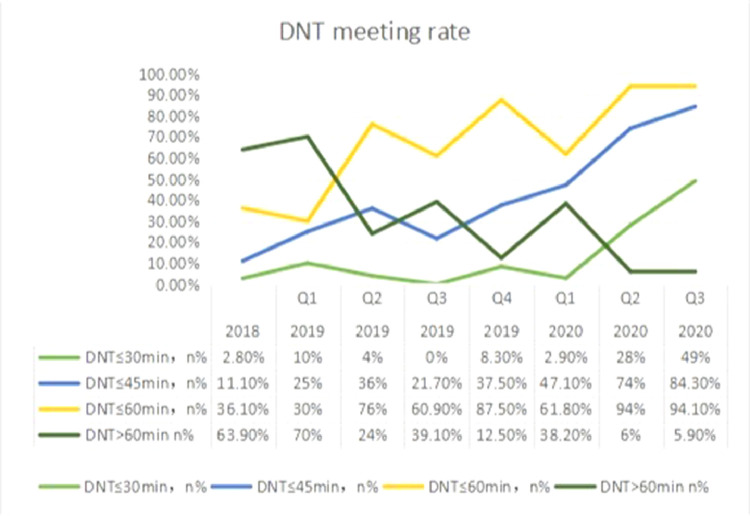
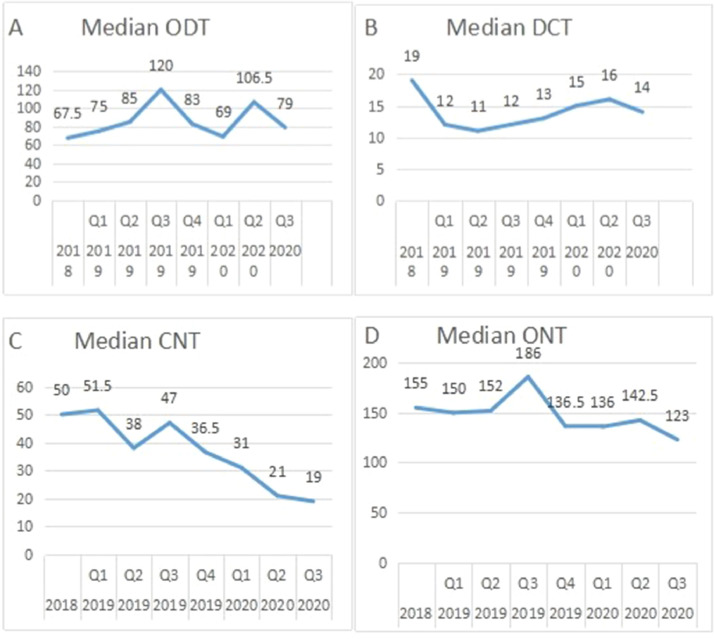
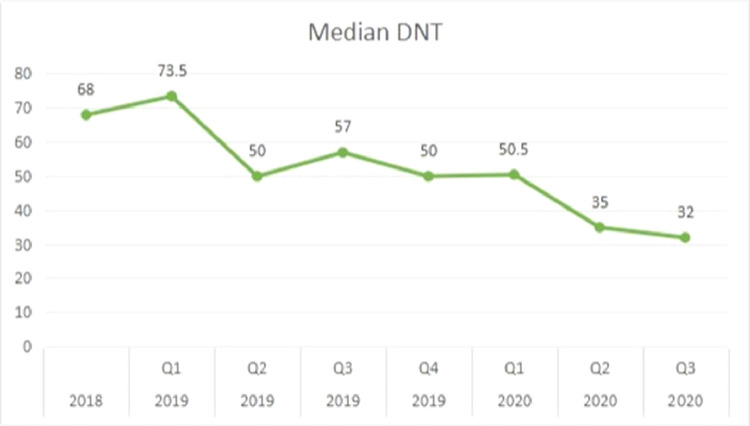
Two hundred and sixty-three patients received intravenous recombinant tissue plasminogen activator in our hospital during the study period, with 128 and 135 patients receiving treatment in the pre-intervention and post-intervention groups, respectively. The median (interquartile range) door-to-needle time decreased significantly from 57.0 (45.3-77.8) min to 37.0 (29.0-49.0) min. Door-to-needle time was shortened to 32 min in the post-intervention period in the 3rd quarter of 2020. The door-to-needle times at the metrics of ≤ 30 min, ≤ 45 min, ≤ 60 min improved considerably, and the DNT> 60 min metric exhibited a significant reduction.
A multidisciplinary collaboration and continuous process optimization can result in overall shortened door-to-needle despite the challenges incurred by the COVID-19 pandemic.
本研究旨在通过多学科合作和基于医院资源的工作流程优化,缩短急性缺血性脑卒中患者接受静脉重组组织型纤溶酶原激活剂治疗的门到针时间。
我们纳入了 2018 年 1 月 1 日至 2020 年 9 月 30 日期间接受静脉重组组织型纤溶酶原激活剂溶栓治疗的患者。患者分为干预前组(2018 年 1 月 1 日至 2019 年 12 月 31 日)和干预后组(2020 年 1 月 1 日至 2020 年 9 月 31 日)。我们通过在急性缺血性脑卒中患者接受静脉溶栓治疗的院前、院内和急性后反馈阶段实施 16 项不同措施,开展多部门合作和流程优化。分析两组患者的结局。
在研究期间,我院共有 263 例患者接受静脉重组组织型纤溶酶原激活剂治疗,干预前组和干预后组分别有 128 例和 135 例患者接受治疗。门到针时间中位数(四分位距)从 57.0(45.3-77.8)min 显著缩短至 37.0(29.0-49.0)min。2020 年第 3 季度,干预后组的门到针时间缩短至 32min。≤30min、≤45min、≤60min 时间的门到针时间明显改善,而 DNT>60min 时间显著减少。
尽管受到 COVID-19 大流行的挑战,但通过多学科合作和持续的流程优化,可以实现总体缩短门到针时间。