Neurology, Grady Memorial Hospital, Emory University, Atlanta, Georgia, USA.
Radiology, Boston Medical Center, Boston University School of Medicine, Boston, USA.
Int J Stroke. 2021 Jul;16(5):573-584. doi: 10.1177/1747493021991652. Epub 2021 Mar 29.
The COVID-19 pandemic led to profound changes in the organization of health care systems worldwide.
We sought to measure the global impact of the COVID-19 pandemic on the volumes for mechanical thrombectomy, stroke, and intracranial hemorrhage hospitalizations over a three-month period at the height of the pandemic (1 March-31 May 2020) compared with two control three-month periods (immediately preceding and one year prior).
Retrospective, observational, international study, across 6 continents, 40 countries, and 187 comprehensive stroke centers. The diagnoses were identified by their ICD-10 codes and/or classifications in stroke databases at participating centers.
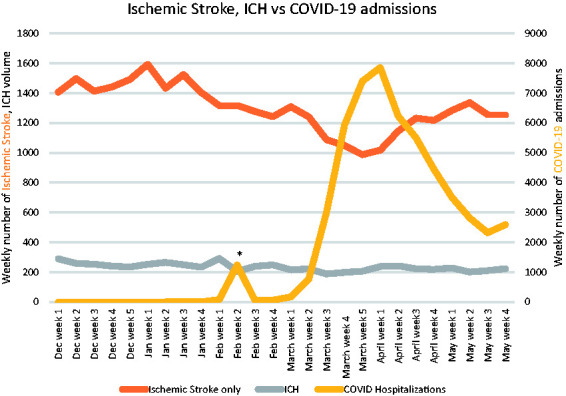
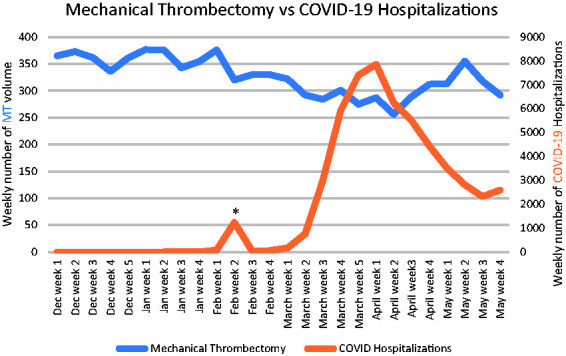
The hospitalization volumes for any stroke, intracranial hemorrhage, and mechanical thrombectomy were 26,699, 4002, and 5191 in the three months immediately before versus 21,576, 3540, and 4533 during the first three pandemic months, representing declines of 19.2% (95%CI, -19.7 to -18.7), 11.5% (95%CI, -12.6 to -10.6), and 12.7% (95%CI, -13.6 to -11.8), respectively. The decreases were noted across centers with high, mid, and low COVID-19 hospitalization burden, and also across high, mid, and low volume stroke/mechanical thrombectomy centers. High-volume COVID-19 centers (-20.5%) had greater declines in mechanical thrombectomy volumes than mid- (-10.1%) and low-volume (-8.7%) centers (p < 0.0001). There was a 1.5% stroke rate across 54,366 COVID-19 hospitalizations. SARS-CoV-2 infection was noted in 3.9% (784/20,250) of all stroke admissions.
The COVID-19 pandemic was associated with a global decline in the volume of overall stroke hospitalizations, mechanical thrombectomy procedures, and intracranial hemorrhage admission volumes. Despite geographic variations, these volume reductions were observed regardless of COVID-19 hospitalization burden and pre-pandemic stroke/mechanical thrombectomy volumes.
COVID-19 大流行导致全球卫生保健系统的组织发生了深刻变化。
我们旨在衡量 COVID-19 大流行期间(2020 年 3 月 1 日至 5 月 31 日)三个月内与两个对照期(之前三个月和前一年)相比,机械取栓术、中风和颅内出血住院量的全球影响。
回顾性、观察性、国际性研究,涉及 6 大洲、40 个国家和 187 个综合卒中中心。这些诊断通过其在参与中心的卒中数据库中的 ICD-10 代码和/或分类来确定。
在大流行前三个月中,任何中风、颅内出血和机械取栓术的住院量分别为 26699、4002 和 5191,而在大流行的前三个月中,住院量分别为 21576、3540 和 4533,分别下降了 19.2%(95%CI,-19.7 至-18.7)、11.5%(95%CI,-12.6 至-10.6)和 12.7%(95%CI,-13.6 至-11.8)。这些下降在高、中、低 COVID-19 住院负担的中心以及高、中、低容量中风/机械取栓术中心都有记录。高容量 COVID-19 中心(-20.5%)的机械取栓术量下降幅度大于中容量(-10.1%)和低容量(-8.7%)中心(p<0.0001)。在 54366 例 COVID-19 住院患者中,中风发生率为 1.5%。在所有中风入院患者中,有 3.9%(784/20250)被发现感染了 SARS-CoV-2。
COVID-19 大流行与全球整体中风住院量、机械取栓术和颅内出血入院量下降有关。尽管存在地域差异,但无论 COVID-19 住院负担和大流行前中风/机械取栓术量如何,都观察到了这些体积减少。