Gamete Research Centre, Laboratory for Veterinary Physiology and Biochemistry, Department of Veterinary Sciences, University of Antwerp, 2610, Wilrijk, Belgium.
Centre for Reproductive Medicine - Antwerp University Hospital, University of Antwerp, Wilrijkstraat 10, 2650, Edegem, Belgium.
Reprod Biol Endocrinol. 2021 Nov 4;19(1):166. doi: 10.1186/s12958-021-00848-4.
Maternal metabolic disorders are linked to reduced metabolic health and oocyte quality. Obese women are advised to lose weight before conception to increase pregnancy chances. However, as human studies show no univocal guidelines, more research is necessary to provide fundamental insights in the consequences of dietary weight loss on oocyte quality. Therefore, we investigated the impact of diet normalization or calorie restricted diet for two, four or six weeks, as preconception care intervention (PCCI), in obese mice on metabolic health and oocyte quality.
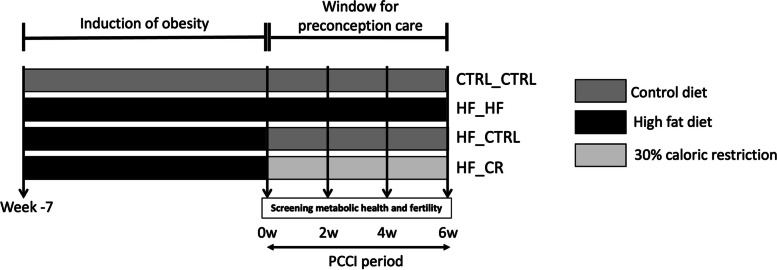
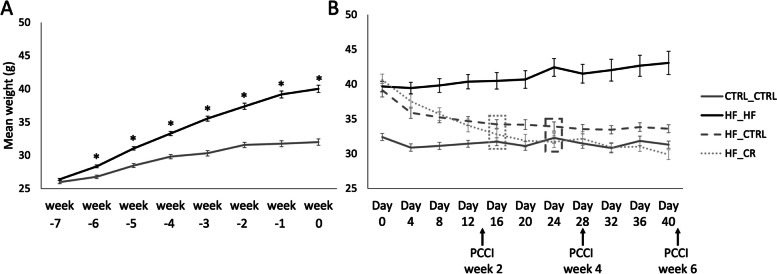
Outbred female mice were fed a control (CTRL) or high-fat (HF) diet for 7 weeks (7w). Afterwards, HF-mice were put on different PCCIs, resulting in four treatment groups: 1) control diet up to 13w, 2) HF diet up to 13w (HF_HF), switch from a HF (7w) to 3) an ad libitum control diet (HF_CTRL) or 4) 30% calorie restricted control diet (HF_CR) for two, four or six weeks. Body weight, metabolic health, oocyte quality and overall fertility results were assessed.
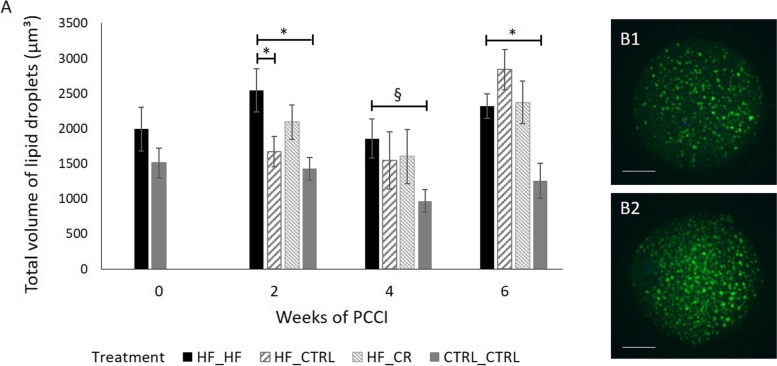
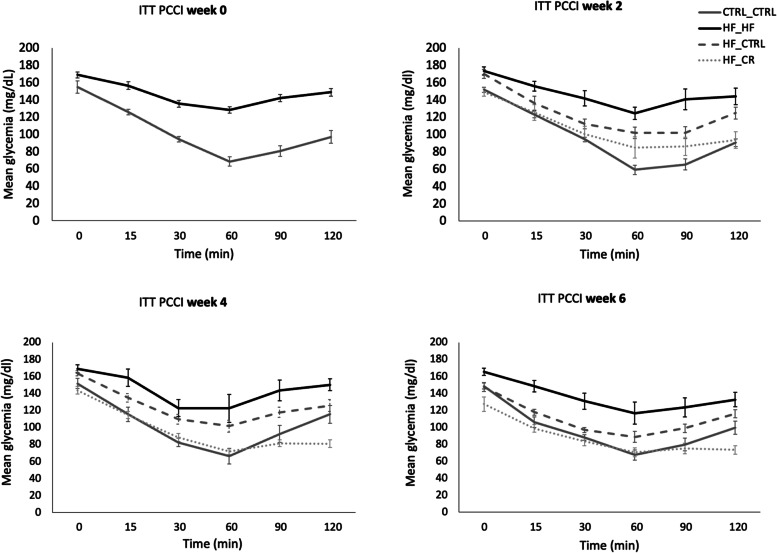
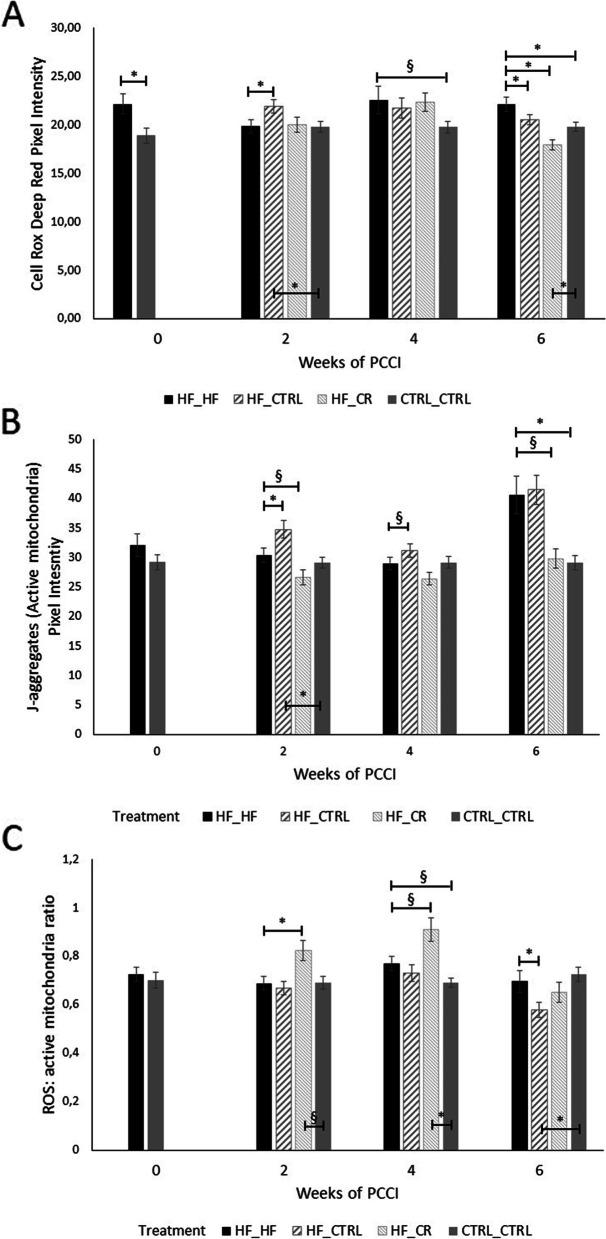
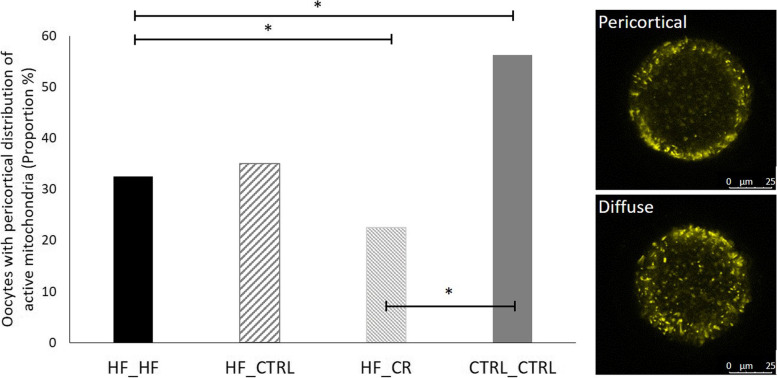
Negative effects of HF diet on metabolic health, oocyte quality and pregnancy rates were confirmed. HF_CTRL mice progressively improved insulin sensitivity, glucose tolerance, serum insulin and cholesterol from PCCI w2 to w4. No further improvements in metabolic health were present at PCCI w6. However, PCCI w6 showed best oocyte quality improvements. Mature oocytes still showed elevated lipid droplet volume and mitochondrial activity but a significant reduction in ROS levels and ROS: active mitochondria ratio compared with HF_HF mice. HF_CR mice restored overall insulin sensitivity and glucose tolerance by PCCI w4. However, serum insulin, cholesterol and ALT remained abnormal. At PCCI w6, glucose tolerance was again reduced. However, only at PCCI w6, oocytes displayed reduced ROS levels and restored mitochondrial activity compared with HF_HF mice. In addition, at PCCI w6, both PCCI groups showed decreased mitochondrial ultrastructural abnormalities compared with the HF_HF group and restored pregnancy rates.
Diet normalization for 4 weeks showed to be the shortest, most promising intervention to improve metabolic health. Most promising improvements in oocyte quality were seen after 6 weeks of intervention in both PCCI groups. This research provides fundamental insights to be considered in developing substantiated preconception guidelines for obese women planning for pregnancy.
母体代谢紊乱与代谢健康和卵母细胞质量下降有关。建议肥胖女性在怀孕前减肥,以增加怀孕的机会。然而,由于人体研究没有明确的指导方针,因此需要更多的研究来提供关于饮食减肥对卵母细胞质量的影响的基本见解。因此,我们研究了肥胖小鼠接受为期 2、4 或 6 周的饮食正常化或热量限制饮食作为孕前保健干预(PCCI)对代谢健康和卵母细胞质量的影响。
杂合雌性小鼠喂食对照(CTRL)或高脂肪(HF)饮食 7 周(7w)。之后,HF 小鼠接受不同的 PCCI,导致 4 个治疗组:1)对照饮食至 13w,2)HF 饮食至 13w(HF_HF),从 HF(7w)切换至 3)自由对照饮食(HF_CTRL)或 4)30%热量限制对照饮食(HF_CR)2、4 或 6 周。评估体重、代谢健康、卵母细胞质量和整体生育力结果。
HF 饮食对代谢健康、卵母细胞质量和妊娠率的负面影响得到了证实。HF_CTRL 小鼠从 PCCI w2 到 w4 逐渐改善胰岛素敏感性、葡萄糖耐量、血清胰岛素和胆固醇。在 PCCI w6 时,代谢健康没有进一步改善。然而,PCCI w6 显示出最佳的卵母细胞质量改善。成熟卵母细胞仍然显示出升高的脂滴体积和线粒体活性,但与 HF_HF 小鼠相比,ROS 水平和 ROS:活性线粒体比率显著降低。HF_CR 小鼠在 PCCI w4 时恢复了整体胰岛素敏感性和葡萄糖耐量。然而,血清胰岛素、胆固醇和 ALT 仍然异常。在 PCCI w6 时,葡萄糖耐量再次降低。然而,只有在 PCCI w6 时,与 HF_HF 小鼠相比,卵母细胞显示出降低的 ROS 水平和恢复的线粒体活性。此外,在 PCCI w6 时,与 HF_HF 组相比,两组 PCCI 均显示出减少的线粒体超微结构异常并恢复了妊娠率。
4 周的饮食正常化是改善代谢健康的最短、最有前途的干预措施。在两个 PCCI 组中,6 周的干预后卵母细胞质量得到了最有希望的改善。这项研究为制定肥胖女性孕前指导方针提供了基本见解,为计划怀孕的肥胖女性提供了依据。