Lilley Jonathan, O'Neil Erin C, Bunya Vatinee Y, Johnson Kennedy, Ying Gui-Shuang, Hua Peiying, Massaro-Giordano Mina
Department of Ophthalmology, Scheie Eye Institute, Perelman School of Medicine at the University of Pennsylvania, Philadelphia, PA, USA.
Center for Preventive Ophthalmology and Biostatistics, University of Pennsylvania, Philadelphia, PA, USA.
Clin Ophthalmol. 2021 Oct 27;15:4291-4296. doi: 10.2147/OPTH.S312108. eCollection 2021.
To assess the efficacy and safety of an intranasal tear neurostimulator (ITN) device in Sjögren syndrome (SS) patients.
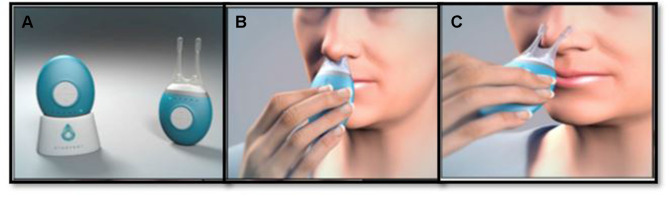
This was a two-visit prospective, randomized, controlled, same-day crossover study in participants with SS. Inclusion criteria were assessed at a baseline screening visit and included an Ocular Surface Disease Index (OSDI) score ≥13, and a Schirmer with anesthesia ≤10 mm/5 min (in at least one eye), with a cotton swab stimulation induced increase of ≥4 mm in the same eye. Participants returned for the application visit, where they received intranasal and extranasal applications of the ITN in random sequence, separated by at least 60 min. Schirmer scores were measured in both eyes after each application and compared to baseline values. Generalized linear models were performed to compare the change in Schirmer scores from baseline, and generalized estimating equations were used to account for correlations from repeated measurements in the same eye and measurements from two eyes of the same patient.
Fifty-five participants were screened and 35 were enrolled (all female), ranging in age from 31 to 72 years (mean, 57 years). The baseline OSDI score ranged from 14 to 91 (mean, 50.5), and the baseline Schirmer score had a mean (SD) of 6.4 (3.5) ranging from 0 to 20 (mm/5min). Improvement in Schirmer scores was significantly greater for intranasal device application (13.5 mm/5min, 95% CI: 10.4, 16.5) compared to extranasal device application (0.8mm/5min, 95% CI: -0.9, 2.4) (p<0.0001). The effects of the intranasal device application were significant regardless of the participant's baseline Schirmer score and systemic SS medication usage (p<0.05).
Intranasal application of the ITN device significantly increased tear production in a subset of SS patients compared to baseline and was more effective than extranasal application. While production of the ITN device was recently discontinued, our findings suggest that other therapies that neurostimulate the lacrimal function unit may be effective in a subset of SS patients.
评估鼻内泪液神经刺激器(ITN)装置对干燥综合征(SS)患者的疗效和安全性。
这是一项针对SS患者的两次就诊的前瞻性、随机、对照、同日交叉研究。在基线筛查就诊时评估纳入标准,包括眼表疾病指数(OSDI)评分≥13,且麻醉状态下泪液分泌试验(Schirmer试验)≤10毫米/5分钟(至少一只眼),且棉签刺激后同一只眼泪液分泌增加≥4毫米。参与者返回进行应用就诊,在该就诊中他们以随机顺序接受ITN的鼻内和鼻外应用,间隔至少60分钟。每次应用后测量双眼的Schirmer评分并与基线值进行比较。进行广义线性模型以比较Schirmer评分相对于基线的变化,并使用广义估计方程来考虑同一只眼重复测量以及同一患者双眼测量之间的相关性。
筛查了55名参与者,35名参与者入组(均为女性),年龄范围为31至72岁(平均57岁)。基线OSDI评分范围为14至91(平均50.5),基线Schirmer评分的均值(标准差)为6.4(3.5),范围为0至20(毫米/5分钟)。与鼻外装置应用(0.8毫米/5分钟,95%置信区间:-0.9,2.4)相比,鼻内装置应用时Schirmer评分的改善显著更大(13.5毫米/5分钟,95%置信区间:10.4,16.5)(p<0.0001)。无论参与者的基线Schirmer评分和全身SS药物使用情况如何,鼻内装置应用的效果均显著(p<0.05)。
与基线相比,鼻内应用ITN装置可显著增加一部分SS患者的泪液分泌,且比鼻外应用更有效。虽然ITN装置的生产最近已停止,但我们的研究结果表明,其他对泪腺功能单元进行神经刺激的疗法可能对一部分SS患者有效。