Al-Musawi Hashim, Hassaballa Mo, Manara Jonathan, Davies Hywel, Howells Nick, Clark Damian, Eldridge Jonathan, Robinson James R, Porteous Andrew, Murray James
Trauma and Orthopaedics, University Hospitals of Bristol, Bristol, GBR.
Trauma and Orthopaedics, Southmead Hospital, Bristol, GBR.
Cureus. 2021 Oct 2;13(10):e18439. doi: 10.7759/cureus.18439. eCollection 2021 Oct.
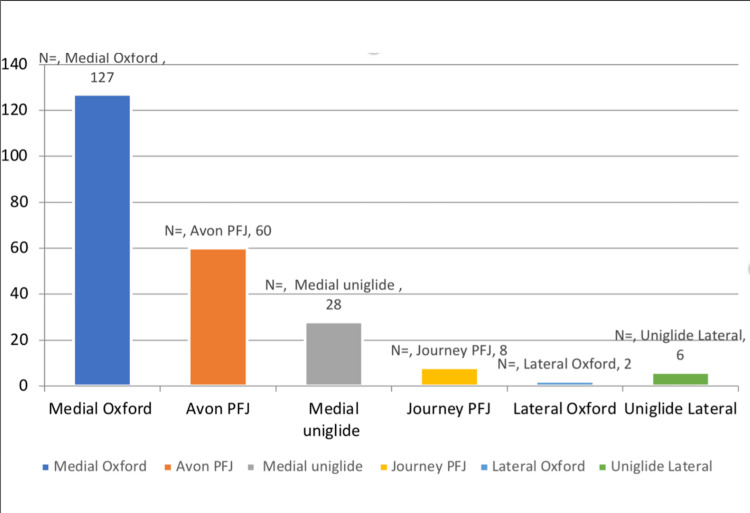
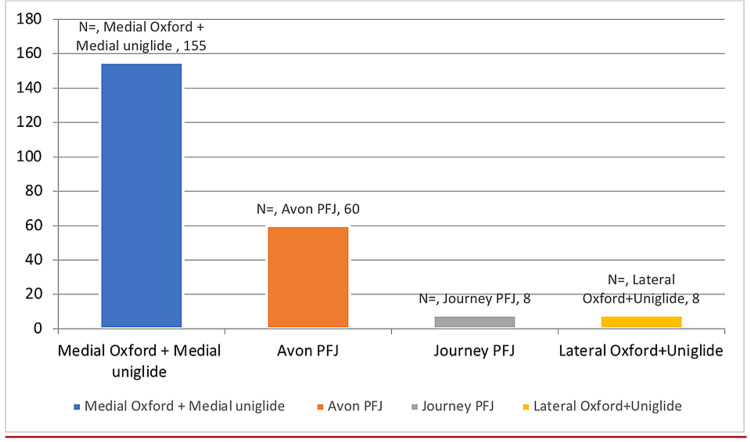
Purpose The purpose of this study was to assess postoperative partial knee replacement (PKR) functional improvement using the postoperative Oxford Knee Score for Activity and Participation Questionnaire (OKS-APQ). PKR includes medial, lateral, and patellofemoral knee arthroplasty. Methods A search of a National Health Service hospital database was made to identify eligible candidates for a survey of Patient-Reported Outcome Measure (PROM). Database records were collected for patients who had medial, lateral, and patellofemoral knee arthroplasty. The first author, an orthopaedic surgery resident, retrospectively reviewed the data and selected 318 patient records for inclusion in a questionnaire survey. The inclusion criteria were: patients who had PKR within three years from the time of the study and patients who don't have medical problems that may affect their mobility; for example, balance problems. The survey used the postoperative Oxford Knee Score for Activity and Participation Questionnaire (OKS-APQ), Tegner Activity Score (TAS), and four questions were added to the present study, namely, three free-text questions and one visual analogue score (VAS). The survey was sent by post seeking the patients' responses. Results Two-hundred five responded to the survey out of 318; a 64% response rate. The ceiling and floor effects were determined from patients' answers. Survey questions included: What is the most demanding activity you routinely do every month on your new knee? The patients' answers were divided into four groups. First, 29% were limited to low functional demand activities, for example, light walking for less than a mile. Second, 43% were involved in domestic work and sports activities, for example, golf, skittles, bowling, squatting, swimming, and gardening. Third, 21% had progressed to higher demand activities, for instance, dancing, racquet sports, cycling, and yoga. Fourth, 7% were performing higher demand activities involving impacts, for example, skiing, heavy gym workout, and marathon running. Conclusion The postoperative questionnaire demonstrated activities ranging from high-impact activities, for example, skiing, and from higher demand activities, for example, dancing to low function activities, for example, light walking.
目的 本研究的目的是使用术后牛津膝关节活动与参与度问卷(OKS - APQ)评估全膝关节置换术(PKR)后的功能改善情况。PKR包括内侧、外侧和髌股关节置换术。方法 检索了一家国民医疗服务体系医院的数据库,以确定符合患者报告结局测量(PROM)调查条件的候选人。收集了接受内侧、外侧和髌股关节置换术患者的数据库记录。第一作者,一名骨科住院医师,回顾性地审查了数据,并选择了318例患者记录纳入问卷调查。纳入标准为:在研究时间起三年内接受PKR的患者以及没有可能影响其活动能力的医疗问题的患者;例如,平衡问题。该调查使用术后牛津膝关节活动与参与度问卷(OKS - APQ)、泰格纳活动评分(TAS),并在本研究中增加了四个问题,即三个自由文本问题和一个视觉模拟评分(VAS)。通过邮寄方式发送调查问卷以寻求患者的回复。结果 在318名患者中,有205名回复了调查问卷;回复率为64%。根据患者的回答确定了天花板效应和地板效应。调查问题包括:你每个月日常在新膝关节上进行的要求最高的活动是什么?患者的回答分为四组。第一,29%的患者仅限于功能需求较低的活动,例如,步行不到一英里。第二,43%的患者参与家务和体育活动,例如,高尔夫、撞柱游戏、保龄球、深蹲、游泳和园艺。第三,21%的患者已经进展到需求更高的活动,例如,跳舞、球拍运动、骑自行车和瑜伽。第四,7%的患者正在进行涉及冲击的需求更高的活动,例如,滑雪、高强度健身房锻炼和马拉松跑步。结论 术后问卷显示了从高冲击活动(例如滑雪)到需求更高的活动(例如跳舞)再到低功能活动(例如轻度步行)的各种活动。