Zheng Yingying, Guan Haoyue, Yang Jie, Cai Jingzeng, Liu Qi, Zhang Ziwei
College of Veterinary Medicine, Northeast Agricultural University, Harbin, China.
College of Animal Science and Veterinary Medicine, Southwest Minzu University, Chengdu, Sichuan, China.
Anim Nutr. 2021 Dec;7(4):997-1008. doi: 10.1016/j.aninu.2021.05.005. Epub 2021 Sep 22.
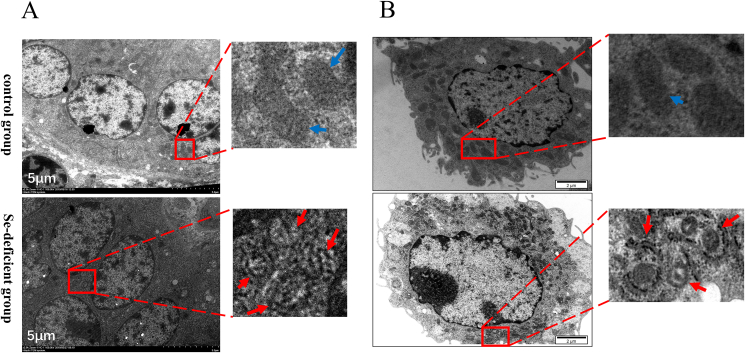
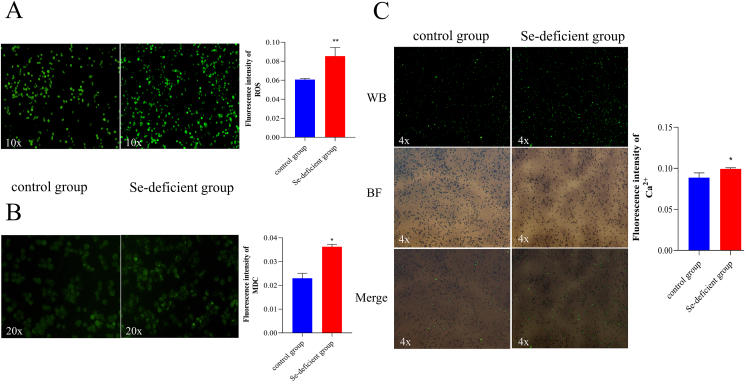
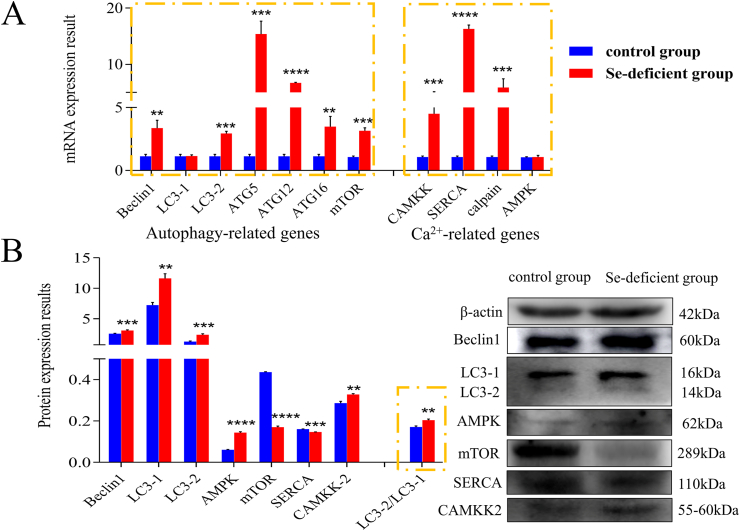
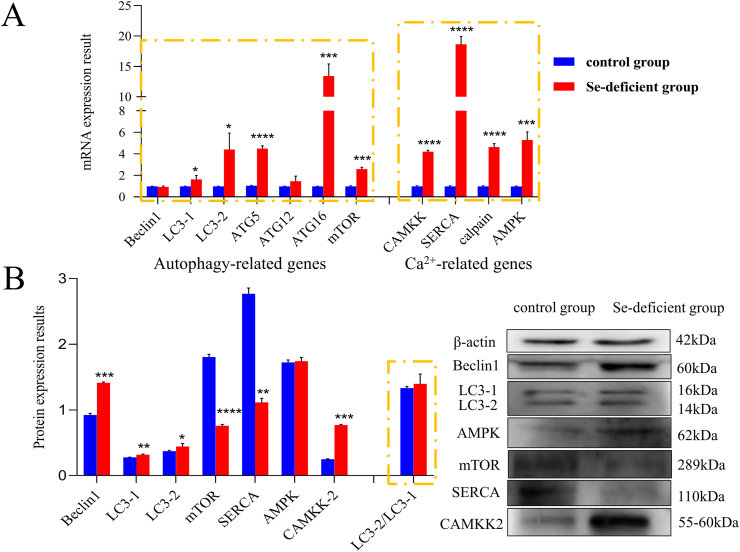
Selenium (Se) deficiency can seriously affect the small intestine of swine, and cause diarrhea in swine. However, the specific mechanism of Se deficiency-induced swine diarrhea has rarely been reported. Here, to explore the damage of Se deficiency on the calcium homeostasis and autophagy mechanism of swine, in vivo and in vitro models of swine intestinal Se deficiency were established. Twenty-four pure line castrated male Yorkshire pigs (45 d old, 12.50 ± 1.32 kg, 12 full-sibling pairs) were divided into 2 equal groups and fed Se-deficient diet (0.007 mg Se/kg) as the Se-deficiency group, or fed Se-adequate diet (0.3 mg Se/kg) as the control group for 16 weeks. The intestinal porcine enterocyte cell line (IPEC-J2) was divided into 2 groups, and cultured by Se-deficient medium as the Se-deficient group, or cultured by normal medium as the control group. Morphological observations showed that compared with the control group, intestinal cells in the Se-deficiency group were significantly damaged, and autophagosomes increased. Autophagy staining and cytoplasmic calcium staining results showed that in the Se-deficiency group, autophagy increased and calcium homeostasis was destroyed. According to the reactive oxygen species (ROS) staining results, the percentage of ROS in the Se-deficiency group was higher than that in the control group in the in vitro model. Compared with the control group, the protein and mRNA expressions of autophagy-calcium-related genes including , microtubule-associated proteins 1A (), microtubule-associated proteins 1B (), autophagy-related protein 5 (), autophagy-related protein 12 (), autophagy-related protein 16 (), mammalian target of rapamycin (), calmodulin-dependent protein kinase kinase β (), adenosine 5'-monophosphate-activated protein kinase (), sarco(endo)plasmic reticulum Ca-ATPase (), and calpain in the Se-deficiency group were significantly increased which was consistent in vivo and in vitro ( < 0.05). Altogether, our results indicated that Se deficiency could destroy the calcium homeostasis of the swine small intestine to trigger cell autophagy and oxidative stress, which was helpful to explain the mechanism of Se deficiency-induced diarrhea in swine.
硒(Se)缺乏会严重影响猪的小肠,并导致猪腹泻。然而,缺硒诱导猪腹泻的具体机制鲜有报道。在此,为探究缺硒对猪钙稳态和自噬机制的损害,建立了猪肠道缺硒的体内和体外模型。将24头纯种阉割雄性约克夏猪(45日龄,12.50±1.32千克,12对全同胞)分为2组,一组饲喂缺硒日粮(0.007毫克硒/千克)作为缺硒组,另一组饲喂硒充足日粮(0.3毫克硒/千克)作为对照组,持续16周。猪肠上皮细胞系(IPEC-J2)分为2组,一组用缺硒培养基培养作为缺硒组,另一组用正常培养基培养作为对照组。形态学观察表明,与对照组相比,缺硒组肠道细胞明显受损,自噬体增加。自噬染色和细胞质钙染色结果显示,缺硒组自噬增加,钙稳态被破坏。根据活性氧(ROS)染色结果,体外模型中缺硒组ROS百分比高于对照组。与对照组相比,缺硒组中自噬-钙相关基因包括微管相关蛋白1A()、微管相关蛋白1B()、自噬相关蛋白5()、自噬相关蛋白12()、自噬相关蛋白16()、雷帕霉素靶蛋白()、钙调蛋白依赖性蛋白激酶激酶β()、腺苷5'-单磷酸激活蛋白激酶()、肌质(内质)网Ca-ATP酶()和钙蛋白酶的蛋白质和mRNA表达显著增加,体内和体外结果一致(<0.05)。总之,我们的结果表明,缺硒会破坏猪小肠的钙稳态,引发细胞自噬和氧化应激,这有助于解释缺硒诱导猪腹泻的机制。