Li Shuang, Sun Wenjuan, Zhang Kai, Zhu Jiawei, Jia Xueting, Guo Xiaoqing, Zhao Qingyu, Tang Chaohua, Yin Jingdong, Zhang Junmin
State Key Laboratory of Animal Nutrition, Institute of Animal Sciences of Chinese Academy of Agricultural Sciences, Beijing, 100193, China.
State Key Laboratory of Animal Nutrition, College of Animal Science and Technology, China Agricultural University, Beijing, 100193, China.
J Anim Sci Biotechnol. 2021 May 17;12(1):65. doi: 10.1186/s40104-021-00587-x.
The immune system is one aspect of health that is affected by dietary selenium (Se) levels and selenoprotein expression. Spleen is an important immune organ of the body, which is directly involved in cellular immunity. However, there are limited reports on Se levels and spleen health. Therefore, this study established a Se-deficient pig model to investigate the mechanism of Se deficiency-induced splenic pathogenesis.
Twenty-four pure line castrated male Yorkshire pigs (45 days old, 12.50 ± 1.32 kg, 12 full-sibling pairs) were divided into two equal groups and fed Se-deficient diet (0.007 mg Se/kg) or Se-adequate diet (0.3 mg Se/kg) for 16 weeks. At the end of the trial, blood and spleen were collected to assay for erythroid parameters, the osmotic fragility of erythrocytes, the spleen index, histology, terminal deoxynucleotidyl transferase nick-end labeling (TUNEL) staining, Se concentrations, the selenogenome, redox status, and signaling related inflammation and apoptosis.
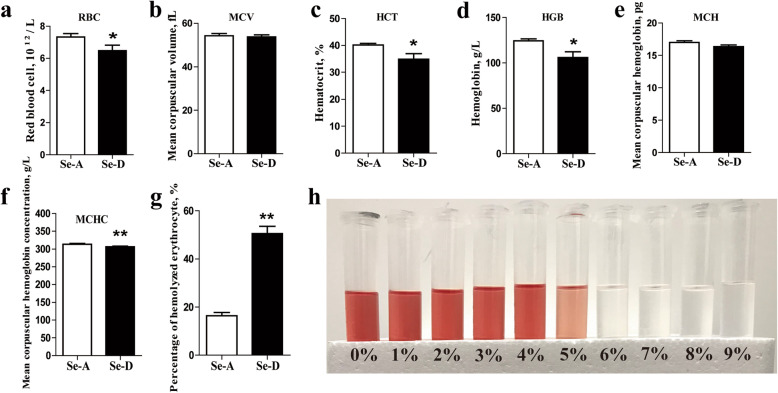
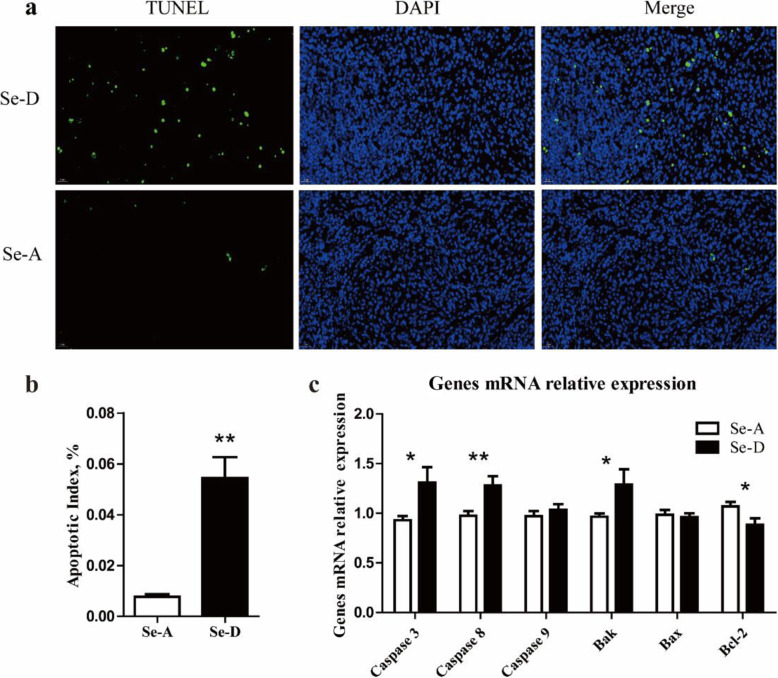
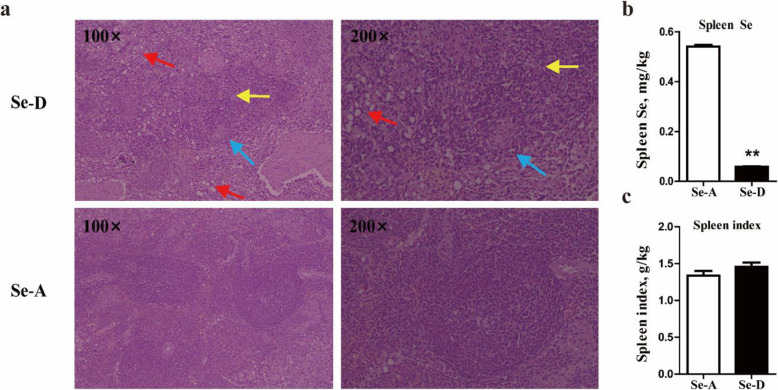
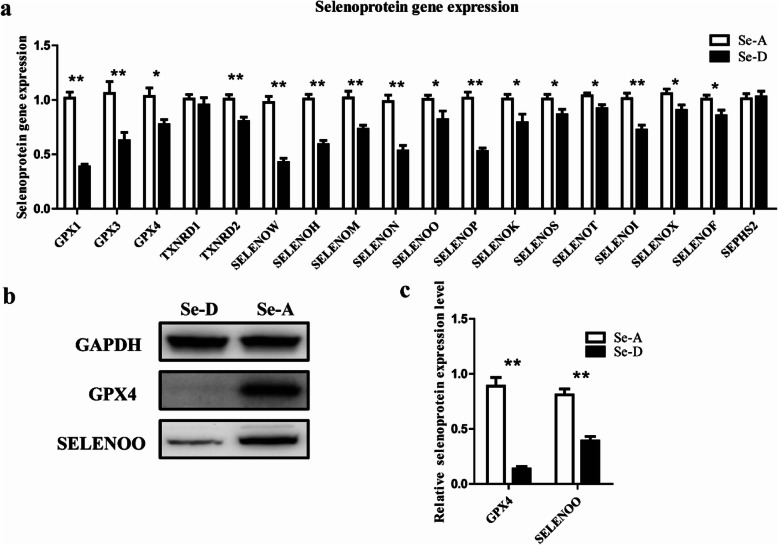
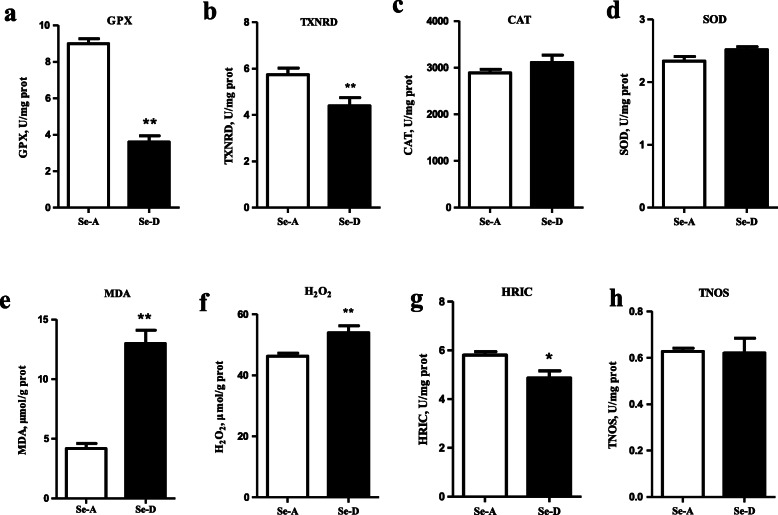
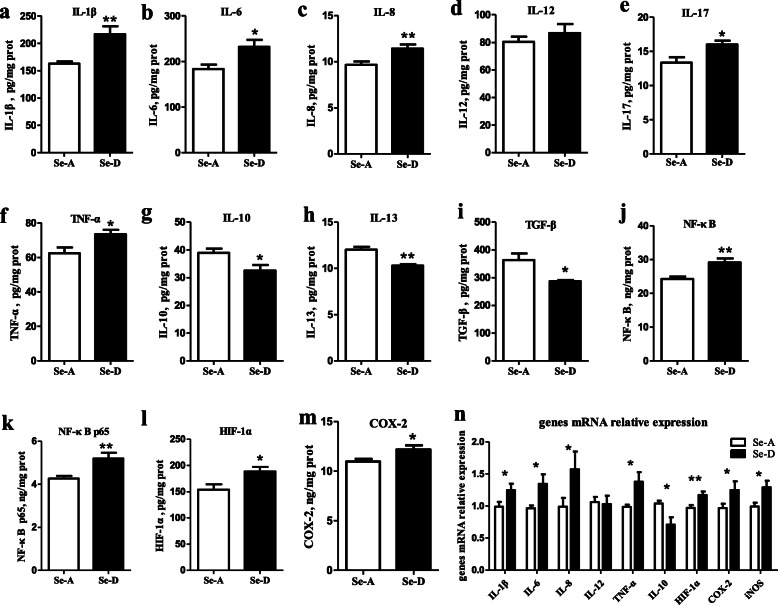
Dietary Se deficiency decreased the erythroid parameters and increased the number of osmotically fragile erythrocytes (P < 0.05). The spleen index did not change, but hematoxylin and eosin and TUNEL staining indicated that the white pulp decreased, the red pulp increased, and splenocyte apoptosis occurred in the Se deficient group. Se deficiency decreased the Se concentration and selenoprotein expression in the spleen (P < 0.05), blocked the glutathione and thioredoxin antioxidant systems, and led to redox imbalance. Se deficiency activated the NF-κB and HIF-1α transcription factors, thus increasing pro-inflammatory cytokines (IL-1β, IL-6, IL-8, IL-17, and TNF-α), decreasing anti-inflammatory cytokines (IL-10, IL-13, and TGF-β) and increasing expression of the downstream genes COX-2 and iNOS (P < 0.05), which in turn induced inflammation. In addition, Se-deficiency induced apoptosis through the mitochondrial pathway, upregulated apoptotic genes (Caspase3, Caspase8, and Bak), and downregulated antiapoptotic genes (Bcl-2) (P < 0.05) at the mRNA level, thus verifying the results of TUNEL staining.
These results indicated that Se deficiency induces spleen injury through the regulation of selenoproteins, oxidative stress, inflammation and apoptosis.
免疫系统是健康的一个方面,会受到膳食硒(Se)水平和硒蛋白表达的影响。脾脏是身体重要的免疫器官,直接参与细胞免疫。然而,关于硒水平与脾脏健康的报道有限。因此,本研究建立了缺硒猪模型,以探讨缺硒诱导脾脏发病机制。
将24头纯种阉割雄性约克夏猪(45日龄,体重12.50±1.32千克,12对全同胞)分为两组,分别饲喂缺硒日粮(0.007毫克硒/千克)或富硒日粮(0.3毫克硒/千克)16周。试验结束时,采集血液和脾脏,检测红细胞参数、红细胞渗透脆性、脾脏指数、组织学、末端脱氧核苷酸转移酶介导的缺口末端标记(TUNEL)染色、硒浓度、硒基因组、氧化还原状态以及与炎症和凋亡相关的信号通路。
膳食缺硒降低了红细胞参数,增加了渗透脆性红细胞数量(P<0.05)。脾脏指数未发生变化,但苏木精-伊红染色和TUNEL染色表明,缺硒组白髓减少,红髓增加,且发生了脾细胞凋亡。缺硒降低了脾脏中的硒浓度和硒蛋白表达(P<0.05),阻断了谷胱甘肽和硫氧还蛋白抗氧化系统,导致氧化还原失衡。缺硒激活了NF-κB和HIF-1α转录因子,从而增加促炎细胞因子(IL-1β、IL-6、IL-8、IL-17和TNF-α),降低抗炎细胞因子(IL-10、IL-13和TGF-β),并增加下游基因COX-2和iNOS的表达(P<0.05),进而诱导炎症。此外,缺硒通过线粒体途径诱导凋亡,在mRNA水平上调凋亡基因(Caspase3、Caspase8和Bak),下调抗凋亡基因(Bcl-2)(P<0.05),从而验证了TUNEL染色结果。
这些结果表明,缺硒通过调节硒蛋白、氧化应激、炎症和凋亡诱导脾脏损伤。