Faculty of Science and Technology, University of Stavanger, Stavanger, Norway.
Said Business School, University of Oxford, Oxford, UK.
Med Decis Making. 2022 Jul;42(5):571-586. doi: 10.1177/0272989X211053563. Epub 2021 Nov 5.
Infectious diseases such as COVID-19 and HIV/AIDS are behaviorally challenging for persons, vaccine and drug companies, and donors.
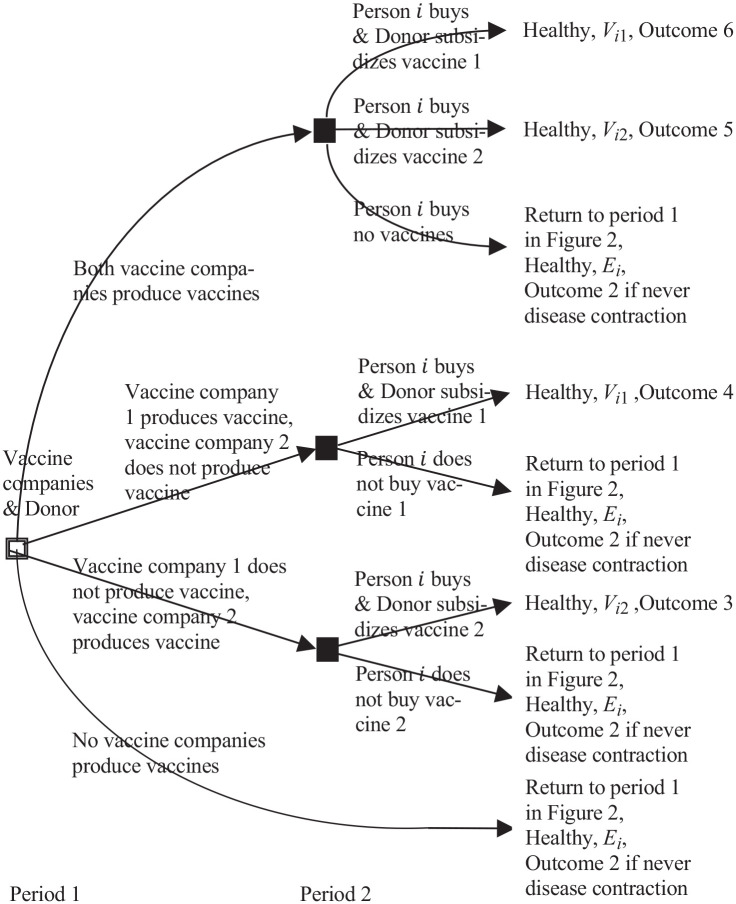
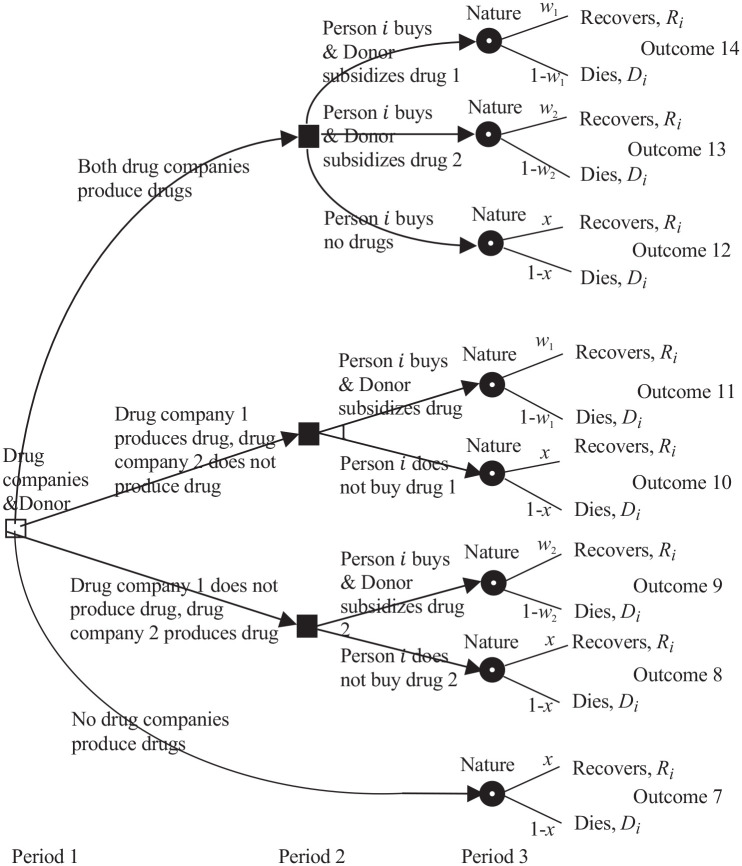
In 3 linked games in which a disease may or may not be contracted, persons choose risky or safe behavior (game 1). Two vaccine companies (game 2) and 2 drug companies (game 3) choose whether to develop vaccines and drugs. Each person chooses whether to buy 1 vaccine (if no disease contraction) or 1 drug (if disease contraction). A donor subsidizes vaccine and drug developments and purchases. Nature probabilistically chooses disease contraction, recovery versus death with and without each drug, and whether vaccines and drugs are developed successfully. COVID-19 data are used for parameter estimation.
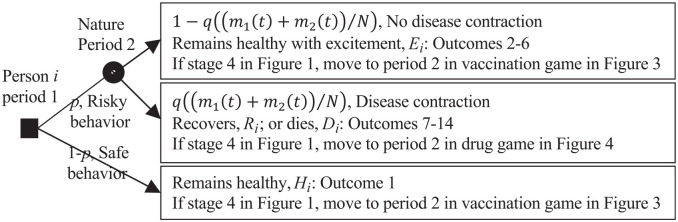
Each person chooses risky behavior if its utility outweighs safe behavior, accounting for nature's probability of disease contraction which depends on how many are vaccinated. Each person buys a vaccine or drug if the companies produce them and if their utilities (accounting for side effects and virus mutation) outweigh the costs, which may be subsidized by a sponsor.
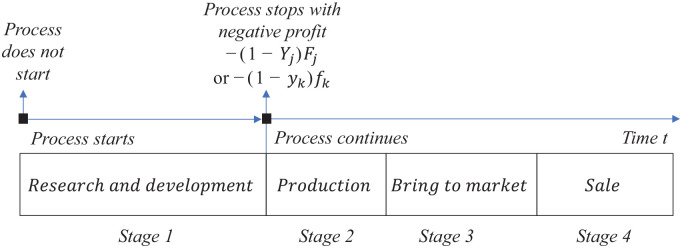
Drug purchases depend on nature's recovery probability exceeding the probability in the absence of a drug. Each company develops and produces a vaccine or drug if nature's probability of successful development is high, if sufficiently many persons buy the vaccine or drug at a sales price that sufficiently exceeds the production price, and if the donor sponsors.
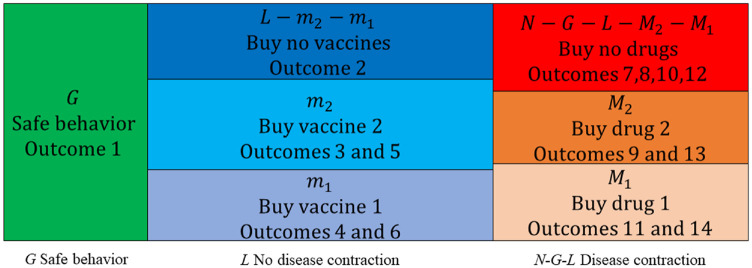
Accounting for all players' interlinked decisions allowing 14 outcomes, which is challenging without a game theoretic analysis, the donor maximizes all persons' expected utilities at the societal level to adjust how persons' purchases and the companies' development and production are subsidized.
A game theoretic approach can help explain the production decisions of vaccine and drug companies, and the decisions of persons and a donor, impacted by Nature.In 3 linked games, persons choose risky behavior if its utility outweighs safe behavior.Vaccine and drug companies develop vaccines and drugs sponsored by a donor if profitable, allowing 14 outcomes.
传染病,如 COVID-19 和艾滋病,对个人、疫苗和制药公司以及捐赠者来说,都是具有挑战性的行为问题。
在三个相关联的游戏中,疾病可能会或不会被感染,个人可以选择冒险或安全的行为(游戏 1)。两家疫苗公司(游戏 2)和两家制药公司(游戏 3)选择是否开发疫苗和药物。每个人都可以选择购买 1 支疫苗(如果没有感染疾病)或 1 种药物(如果感染疾病)。一个捐赠者资助疫苗和药物的开发和购买。自然会以概率选择疾病的感染、有无药物情况下的康复或死亡,以及疫苗和药物是否成功开发。COVID-19 数据用于参数估计。
如果个人的效用超过安全行为,每个人都会选择冒险行为,这取决于有多少人接种疫苗,从而考虑到自然感染疾病的概率。如果公司生产疫苗或药物,并且其效用(考虑到副作用和病毒突变)超过成本,每个人都会购买疫苗或药物,成本可能由赞助商补贴。
药物的购买取决于自然康复的概率是否超过没有药物的情况下的概率。如果自然成功开发的概率高,如果有足够多的人以高于生产成本的销售价格购买疫苗或药物,并且捐赠者赞助,每家公司都会开发和生产疫苗或药物。
考虑到所有参与者相互关联的决策,共有 14 种结果,如果没有博弈论分析,这是具有挑战性的,捐赠者可以最大化所有参与者的预期效用,从而调整个人购买和公司开发和生产的补贴方式。
博弈论方法可以帮助解释疫苗和制药公司的生产决策,以及个人和捐赠者的决策,这些决策受到自然的影响。在三个相关联的游戏中,如果个人的效用超过安全行为,个人会选择冒险行为。如果有利润,疫苗和制药公司在捐赠者的资助下开发疫苗和药物,这允许有 14 种结果。