Division of Statistical Genomics, Department of Genetics, Washington University School of Medicine, St Louis, Missouri, USA.
Biostatistics, Epidemiology, and Research Design Center, Institute for Clinical Research and Health Policy Studies, Tufts University, Boston, Massachusetts, USA.
J Gerontol A Biol Sci Med Sci. 2022 Apr 1;77(4):717-727. doi: 10.1093/gerona/glab333.
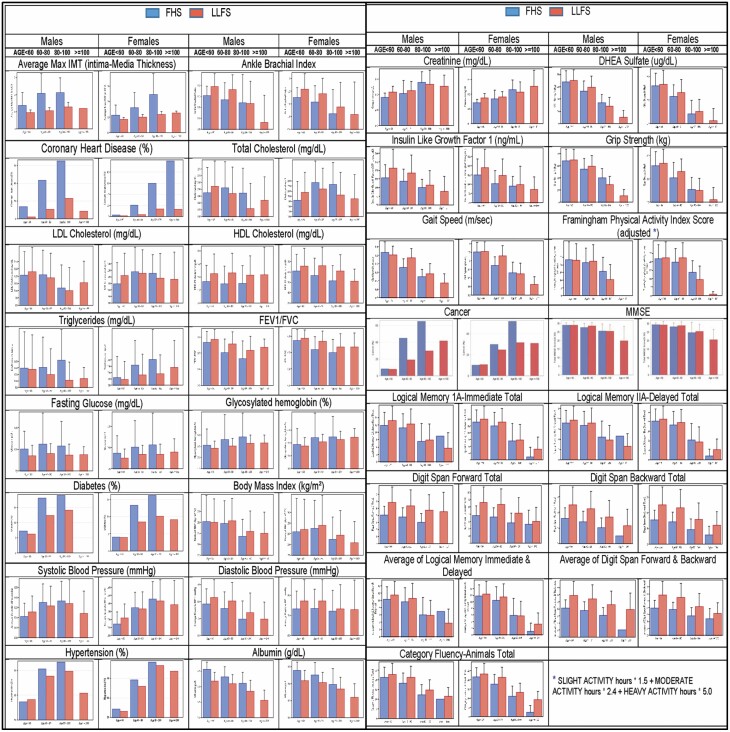
The NIA Long Life Family Study (LLFS) is a longitudinal, multicenter, multinational, population-based multigenerational family study of the genetic and nongenetic determinants of exceptional longevity and healthy aging. The Visit 1 in-person evaluation (2006-2009) recruited 4 953 individuals from 539 two-generation families, selected from the upper 1% tail of the Family Longevity Selection Score (FLoSS, which quantifies the degree of familial clustering of longevity). Demographic, anthropometric, cognitive, activities of daily living, ankle-brachial index, blood pressure, physical performance, and pulmonary function, along with serum, plasma, lymphocytes, red cells, and DNA, were collected. A Genome Wide Association Scan (GWAS) (Ilumina Omni 2.5M chip) followed by imputation was conducted. Visit 2 (2014-2017) repeated all Visit 1 protocols and added carotid ultrasonography of atherosclerotic plaque and wall thickness, additional cognitive testing, and perceived fatigability. On average, LLFS families show healthier aging profiles than reference populations, such as the Framingham Heart Study, at all age/sex groups, for many critical healthy aging phenotypes. However, participants are not uniformly protected. There is considerable heterogeneity among the pedigrees, with some showing exceptional cognition, others showing exceptional grip strength, others exceptional pulmonary function, etc. with little overlap in these families. There is strong heritability for key healthy aging phenotypes, both cross-sectionally and longitudinally, suggesting that at least some of this protection may be genetic. Little of the variance in these heritable phenotypes is explained by the common genome (GWAS + Imputation), which may indicate that rare protective variants for specific phenotypes may be running in selected families.
NIA 长寿家族研究(LLFS)是一项纵向、多中心、多国、基于人群的多代家族研究,旨在研究异常长寿和健康衰老的遗传和非遗传决定因素。首次现场评估(2006-2009 年)从长寿家族选择评分(FLoSS,量化长寿家族聚集程度的程度)的前 1%尾部分选了 539 个二代家庭中的 4953 名个体。收集了人口统计学、人体测量学、认知、日常生活活动、踝臂指数、血压、身体表现和肺功能以及血清、血浆、淋巴细胞、红细胞和 DNA。进行了全基因组关联扫描(GWAS)(Illumina Omni 2.5M 芯片),然后进行了内插。第二次访问(2014-2017 年)重复了所有第一次访问的方案,并增加了颈动脉粥样硬化斑块和壁厚度的超声检查、额外的认知测试和感知疲劳。平均而言,LLFS 家族在所有年龄/性别组中都表现出比参考人群(如弗雷明汉心脏研究)更健康的衰老特征,对于许多关键的健康衰老表型都是如此。然而,参与者并非完全受到保护。系谱之间存在相当大的异质性,有些表现出异常认知,有些表现出异常握力,有些表现出异常肺功能等,这些家族之间几乎没有重叠。关键健康衰老表型具有很强的遗传性,无论是横断面还是纵向,这表明至少部分保护可能是遗传的。这些遗传性表型的变异很少由常见基因组(GWAS+内插)解释,这可能表明特定表型的罕见保护变体可能在选定的家族中运行。