Mathis Victor P, Williams Maya, Fillinger Clementine, Kenny Paul J
Nash Family Department of Neuroscience, Icahn School of Medicine at Mount Sinai, New York, NY 10029, USA.
Sci Adv. 2021 Nov 5;7(45):eabj2225. doi: 10.1126/sciadv.abj2225.
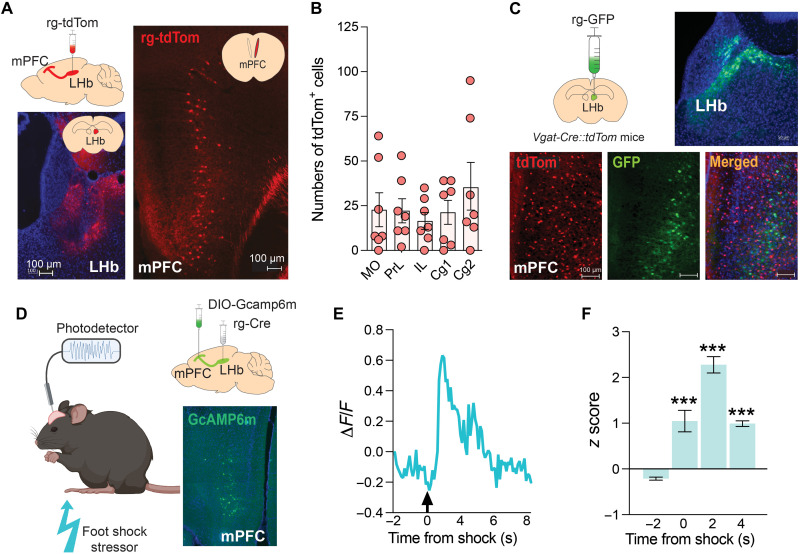
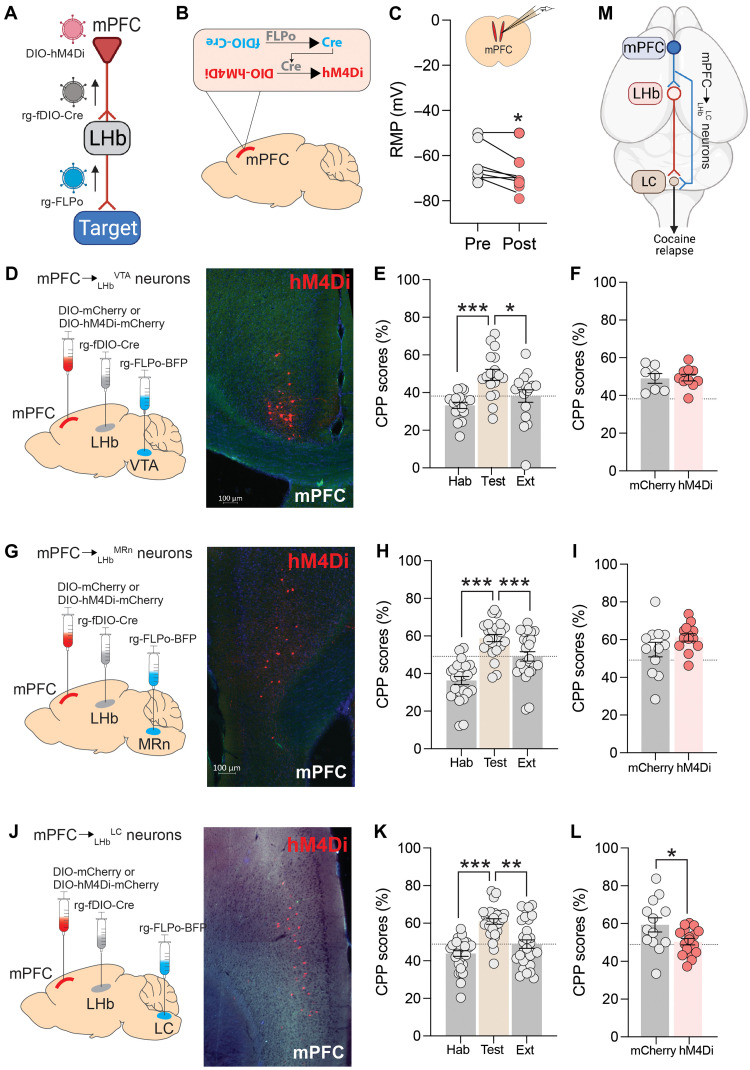
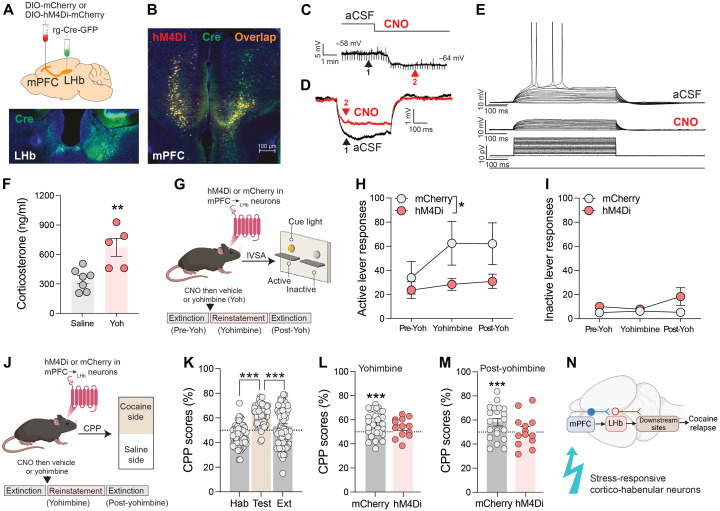
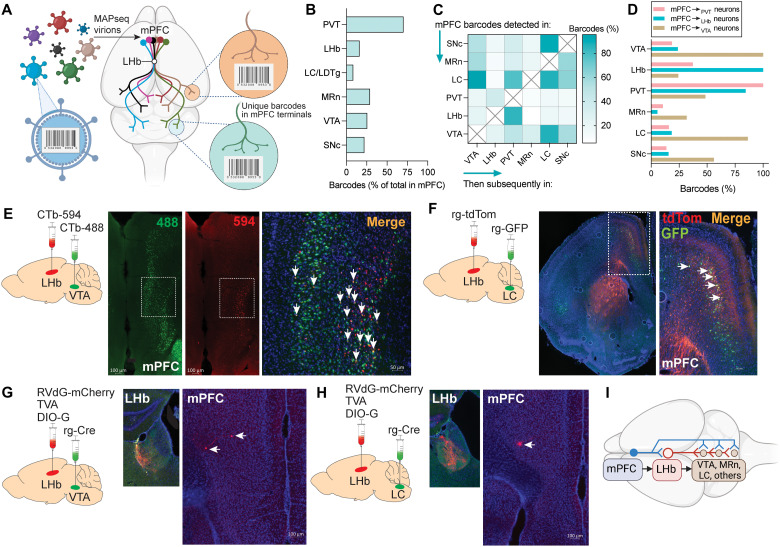
How neurons in the medial prefrontal cortex broadcast stress-relevant information to subcortical brain sites to regulate cocaine relapse remains unclear. The lateral habenula (LHb) serves as a “hub” to filter and propagate stress- and aversion-relevant information in the brain. Here, we show that chemogenetic inhibition of cortical inputs to LHb attenuates relapse-like reinstatement of extinguished cocaine seeking in mice. Using an RNA sequencing–based brain mapping procedure with single-cell resolution, we identify networks of cortical neurons that project to LHb and then preferentially innervate different downstream brain sites, including the ventral tegmental area, median raphe nucleus, and locus coeruleus (LC). By using an intersectional chemogenetics approach, we show that inhibition of cortico-habenular neurons that project to LC, but not to other sites, blocks reinstatement of cocaine seeking. These findings highlight the remarkable complexity of descending cortical inputs to the habenula and identify a cortico-habenulo-hindbrain circuit that regulates cocaine seeking.
内侧前额叶皮质中的神经元如何将与应激相关的信息传递至大脑皮层下区域以调节可卡因复吸,目前尚不清楚。外侧缰核(LHb)作为一个“枢纽”,在大脑中过滤并传播与应激和厌恶相关的信息。在此,我们表明,对投射至LHb的皮质输入进行化学遗传学抑制,可减弱小鼠中已消退的可卡因觅求行为的复吸样恢复。通过使用具有单细胞分辨率的基于RNA测序的脑图谱程序,我们确定了投射至LHb并优先支配不同下游脑区(包括腹侧被盖区、中缝正中核和蓝斑(LC))的皮质神经元网络。通过使用交叉化学遗传学方法,我们表明,抑制投射至LC而非其他部位的皮质-缰核神经元,可阻断可卡因觅求行为的恢复。这些发现突出了皮质向缰核下行输入的显著复杂性,并确定了一个调节可卡因觅求行为的皮质-缰核-后脑回路。