Centre of New Technologies, University of Warsaw, Banacha 2C, 02-097, Warsaw, Poland.
Faculty of Physics, University of Warsaw, Pasteura 5, 02-093, Warsaw, Poland.
J Biomol NMR. 2021 Dec;75(10-12):401-416. doi: 10.1007/s10858-021-00385-7. Epub 2021 Nov 5.
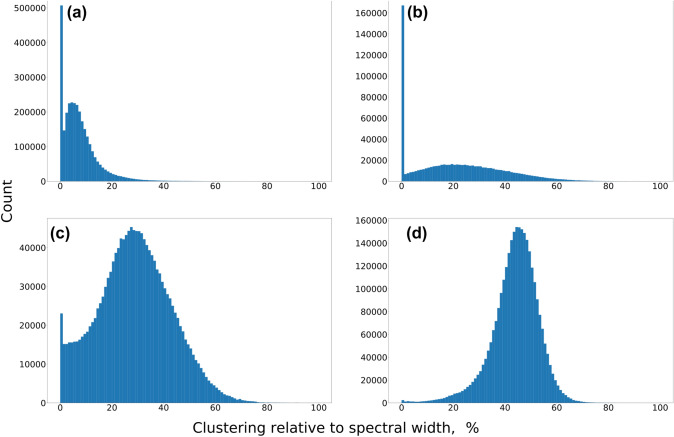
Non-uniform sampling (NUS) is a popular way of reducing the amount of time taken by multidimensional NMR experiments. Among the various non-uniform sampling schemes that exist, the Poisson-gap (PG) schedules are particularly popular, especially when combined with compressed-sensing (CS) reconstruction of missing data points. However, the use of PG is based mainly on practical experience and has not, as yet, been explained in terms of CS theory. Moreover, an apparent contradiction exists between the reported effectiveness of PG and CS theory, which states that a "flat" pseudo-random generator is the best way to generate sampling schedules in order to reconstruct sparse spectra. In this paper we explain how, and in what situations, PG reveals its superior features in NMR spectroscopy. We support our theoretical considerations with simulations and analyses of experimental data from the Biological Magnetic Resonance Bank (BMRB). Our analyses reveal a previously unnoticed feature of many NMR spectra that explains the success of "blue-noise" schedules, such as PG. We call this feature "clustered sparsity". This refers to the fact that the peaks in NMR spectra are not just sparse but often form clusters in the indirect dimension, and PG is particularly suited to deal with such situations. Additionally, we discuss why denser sampling in the initial and final parts of the clustered signal may be useful.
非均匀采样(NUS)是一种减少多维 NMR 实验所需时间的常用方法。在现有的各种非均匀采样方案中,泊松间隔(PG)方案特别受欢迎,尤其是与缺失数据点的压缩感知(CS)重建相结合时。然而,PG 的使用主要基于实践经验,尚未从 CS 理论的角度进行解释。此外,PG 的报告有效性与 CS 理论之间存在明显矛盾,CS 理论指出,为了重建稀疏光谱,“平坦”伪随机生成器是生成采样方案的最佳方法。在本文中,我们解释了 PG 如何以及在什么情况下在 NMR 光谱学中展现出其优越的特性。我们通过模拟和对来自生物磁共振库(BMRB)的实验数据的分析来支持我们的理论考虑。我们的分析揭示了许多 NMR 光谱的一个以前未被注意到的特征,该特征解释了“蓝噪声”方案(如 PG)的成功。我们将此特征称为“聚类稀疏性”。这是指 NMR 光谱中的峰不仅稀疏,而且通常在间接维度中形成簇,而 PG 特别适合处理这种情况。此外,我们还讨论了为什么在聚类信号的初始和最终部分进行更密集的采样可能会很有用。