State Key Laboratory for Oncogenes & Related Genes and Bio-ID Center, School of Biomedical Engineering, Shanghai Jiao Tong University, Shanghai, 200240, China.
Hereditas. 2021 Nov 5;158(1):43. doi: 10.1186/s41065-021-00205-w.
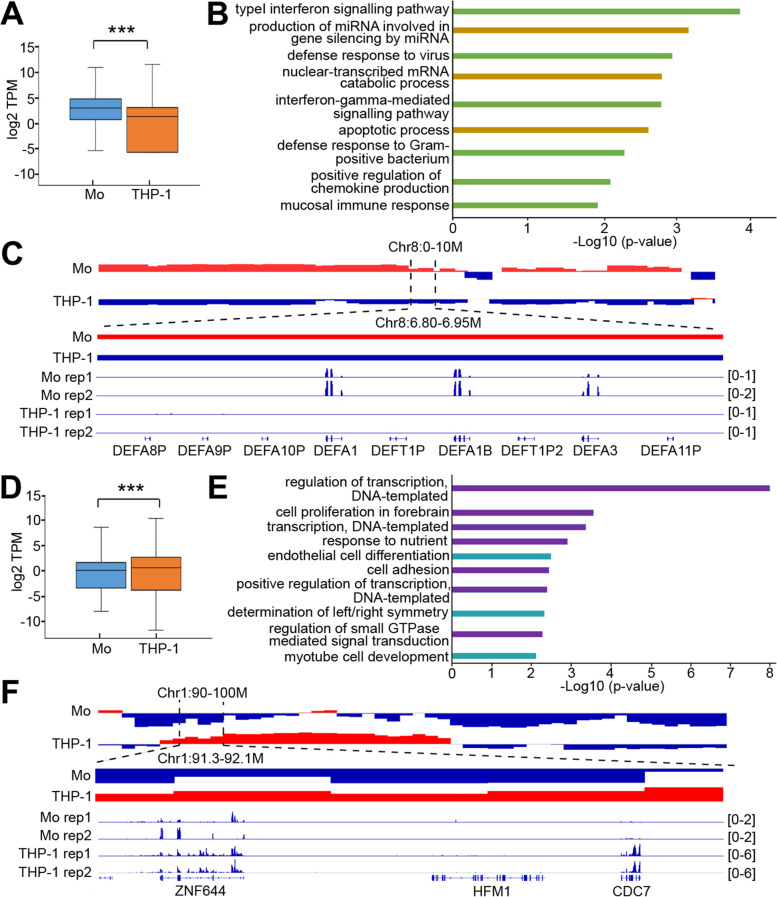
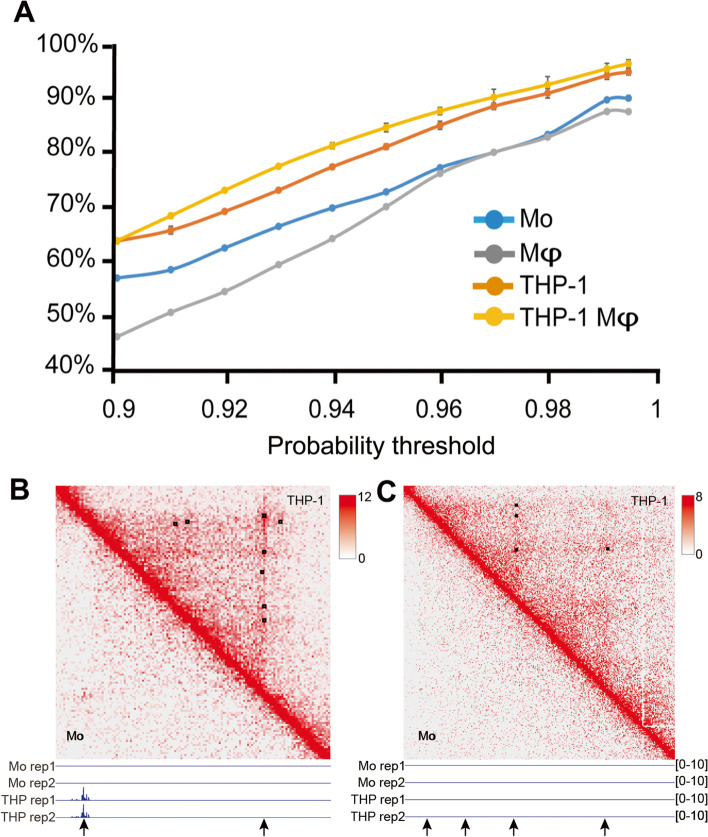
Immortalized cell lines have long been used as model systems to systematically investigate biological processes under controlled and reproducible conditions, providing insights that have greatly advanced cellular biology and medical sciences. Recently, the widely used monocytic leukemia cell line, THP-1, was comprehensively examined to understand mechanistic relationships between the 3D chromatin structure and transcription during the trans-differentiation of monocytes to macrophages. To corroborate these observations in primary cells, we analyze in situ Hi-C and RNA-seq data of human primary monocytes and their differentiated macrophages in comparison to that obtained from the monocytic/macrophagic THP-1 cells. Surprisingly, we find significant differences between the primary cells and the THP-1 cells at all levels of chromatin structure, from loops to topologically associated domains to compartments. Importantly, the compartment-level differences correlate significantly with transcription: those genes that are in A-compartments in the primary cells but are in B-compartments in the THP-1 cells exhibit a higher level of expression in the primary cells than in the THP-1 cells, and vice versa. Overall, the genes in these different compartments are enriched for a wide range of pathways, and, at least in the case of the monocytic cells, their altered expression in certain pathways in the THP-1 cells argues for a less immune cell-like phenotype, suggesting that immortalization or prolonged culturing of THP-1 caused a divergence of these cells from their primary counterparts. It is thus essential to reexamine phenotypic details observed in cell lines with their primary counterparts so as to ensure a proper understanding of functional cell states in vivo.
永生细胞系长期以来一直被用作模型系统,用于在可控和可重复的条件下系统地研究生物学过程,为细胞生物学和医学科学的发展提供了重要的见解。最近,广泛使用的单核细胞白血病细胞系 THP-1 被全面检查,以了解单核细胞向巨噬细胞分化过程中 3D 染色质结构和转录之间的机制关系。为了在原代细胞中证实这些观察结果,我们分析了人类原代单核细胞及其分化的巨噬细胞的原位 Hi-C 和 RNA-seq 数据,并与单核/巨噬细胞 THP-1 细胞的数据进行了比较。令人惊讶的是,我们在染色质结构的所有层次上,从环到拓扑关联域到区室,都发现了原代细胞和 THP-1 细胞之间的显著差异。重要的是,区室水平的差异与转录显著相关:那些在原代细胞中处于 A 区室但在 THP-1 细胞中处于 B 区室的基因,在原代细胞中的表达水平高于 THP-1 细胞,反之亦然。总的来说,这些不同区室中的基因富集了广泛的途径,至少在单核细胞的情况下,它们在 THP-1 细胞中某些途径的改变表达表明细胞表型不太像免疫细胞,这表明 THP-1 的永生化或长期培养导致这些细胞与其原代细胞的分化。因此,必须重新检查细胞系中观察到的表型细节,以确保正确理解体内功能细胞状态。