Department of Obstetrics and Gynaecology, Hadassah-Hebrew University Medical Centre and Faculty of Medicine, Hebrew University of Jerusalem, Israel.
Clinical Virology Unit, Department of Clinical Microbiology and Infectious Diseases, Hadassah-Hebrew University Medical Centre, Jerusalem, Israel.
Clin Microbiol Infect. 2022 Mar;28(3):419-425. doi: 10.1016/j.cmi.2021.10.003. Epub 2021 Nov 3.
We aimed to assess the impact of early versus late third-trimester maternal severe acute respiratory syndrome coronavirus 2 (SARS-CoV-2) vaccination on transplacental transfer and neonatal levels of SARS-CoV-2 antibodies.
Maternal and cord blood sera were collected following term delivery after antenatal SARS-CoV-2 BNT162b2 mRNA vaccination, with the first vaccine dose administered between 27 and 36 weeks of gestation. SARS-CoV-2 spike protein (S) and receptor-binding domain (RBD) -specific, IgG levels and neutralizing potency were evaluated in maternal and cord blood samples.
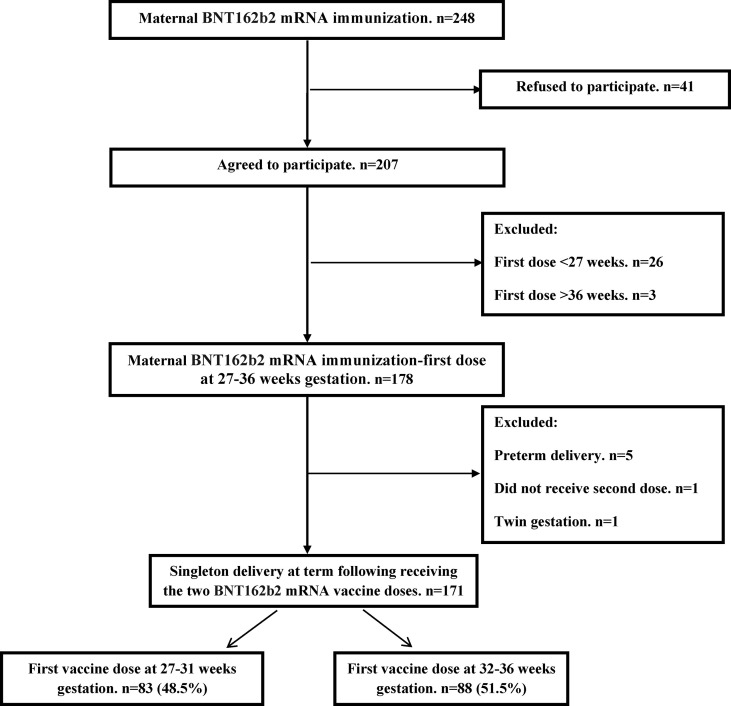
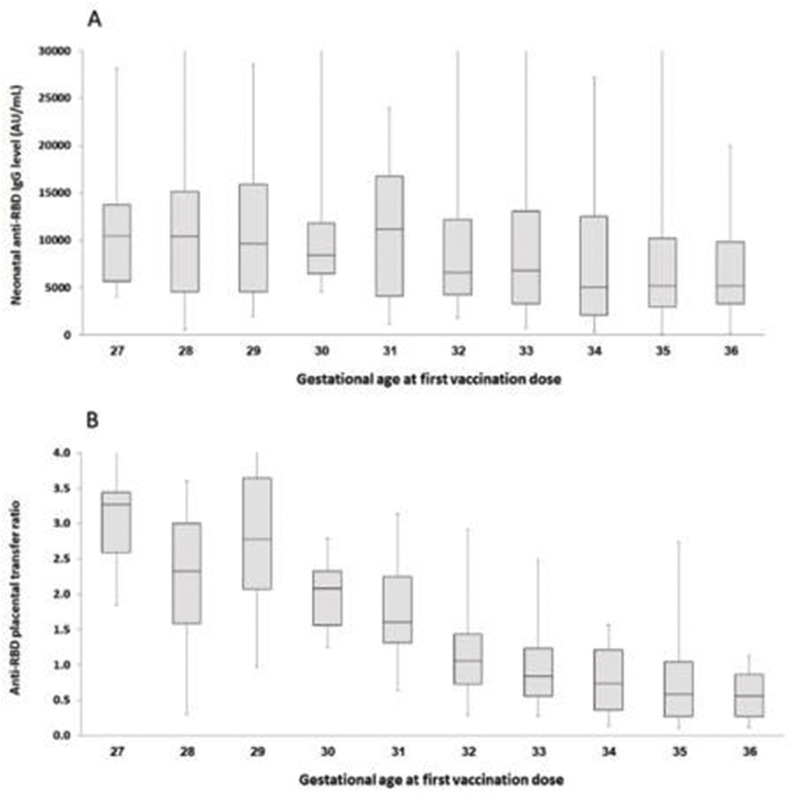
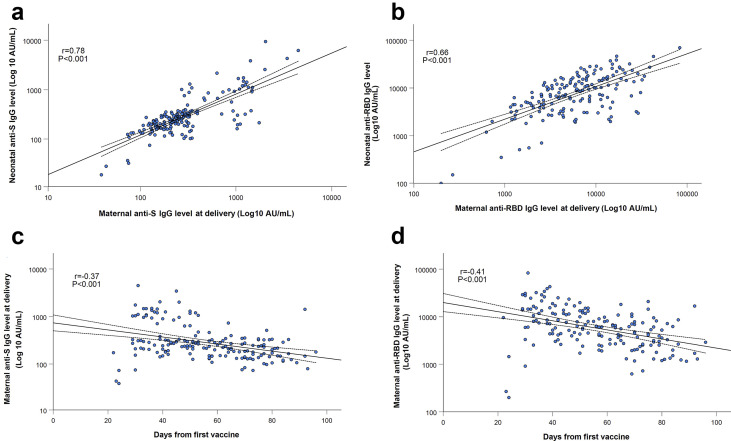
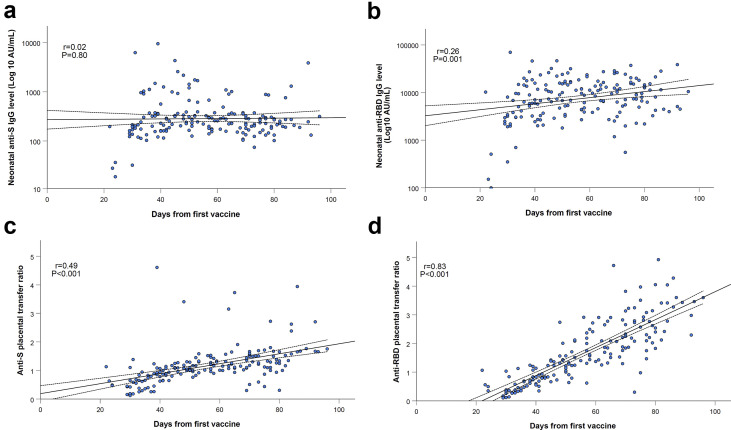
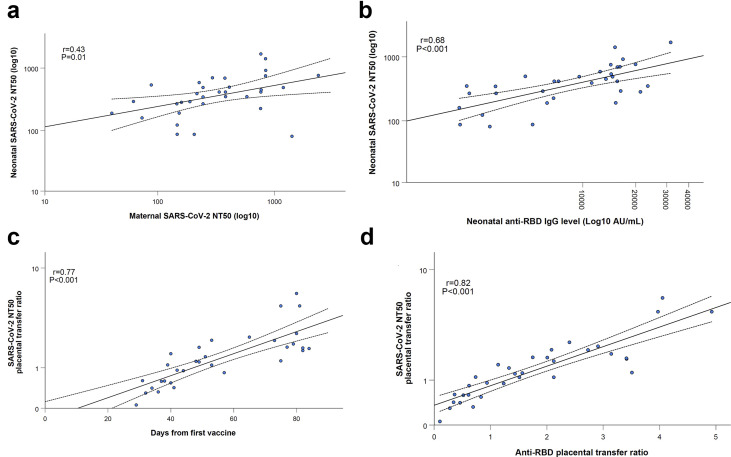
The study cohort consisted of 171 parturients-median age 31 years (interquartile range (IQR) 27-35 years); median gestational age 39 weeks (IQR 38-40 weeks)-83 (48.5%) were immunized in early thrird-trimester (first dose at 27-31 weeks) and 88 (51.5%) were immunized in late third trimester (first dose at 32-36 weeks). All mother-infant paired sera were positive for anti S- and anti-RBD-specific IgG. Anti-RBD-specific IgG concentrations in neonatal sera were higher following early versus late third-trimester vaccination (median 9620 AU/mL (IQR 5131-15332 AU/mL) versus 6697 AU/mL (IQR 3157-14731 AU/mL), p 0.02), and were positively correlated with increasing time since vaccination (r = 0.26; p 0.001). Median antibody placental transfer ratios were increased following early versus late third-trimester immunization (anti-S ratio: 1.3 (IQR 1.1-1.6) versus 0.9 (IQR 0.6-1.1); anti-RBD-specific ratio: 2.3 (IQR 1.7-3.0) versus 0.7 (IQR 0.5-1.2), p < 0.001). Neutralizing antibodies placental transfer ratio was greater following early versus late third-trimester immunization (median 1.9 (IQR 1.7-2.5) versus 0.8 (IQR 0.5-1.1), p < 0.001), and was positively associated with longer duration from vaccination (r = 0.77; p < 0.001).
Early compared with late third-trimester maternal SARS-CoV-2 immunization enhanced transplacental antibody transfer and increased neonatal neutralizing antibody levels. Our findings highlight that vaccination of pregnant women early in the third trimester may enhance neonatal seroprotection.
评估孕晚期早期与晚期接种严重急性呼吸综合征冠状病毒 2(SARS-CoV-2)疫苗对胎盘转移和新生儿 SARS-CoV-2 抗体水平的影响。
在接受产前 SARS-CoV-2 BNT162b2 mRNA 疫苗接种后,于足月分娩时收集产妇和脐带血血清,首剂疫苗接种于妊娠 27-36 周之间。评估产妇和脐带血样本中 SARS-CoV-2 刺突蛋白(S)和受体结合域(RBD)特异性 IgG 水平和中和效力。
研究队列包括 171 名产妇-中位年龄 31 岁(四分位距(IQR)27-35 岁);中位妊娠 39 周(IQR 38-40 周)-83 例(48.5%)在孕晚期早期(首剂在 27-31 周)接种,88 例(51.5%)在孕晚期晚期(首剂在 32-36 周)接种。所有母婴配对血清均对 S-和 RBD-特异性 IgG 呈阳性。与孕晚期晚期接种相比,孕晚期早期接种的新生儿血清中抗-RBD 特异性 IgG 浓度更高(中位数 9620 AU/mL(IQR 5131-15332 AU/mL)与 6697 AU/mL(IQR 3157-14731 AU/mL),p<0.02),且与接种后时间呈正相关(r=0.26;p<0.001)。与孕晚期晚期免疫接种相比,孕晚期早期免疫接种的抗体胎盘转移率更高(抗-S 比值:1.3(IQR 1.1-1.6)与 0.9(IQR 0.6-1.1);抗-RBD 特异性比值:2.3(IQR 1.7-3.0)与 0.7(IQR 0.5-1.2),p<0.001)。与孕晚期晚期免疫接种相比,孕晚期早期免疫接种的中和抗体胎盘转移率更高(中位数 1.9(IQR 1.7-2.5)与 0.8(IQR 0.5-1.1),p<0.001),且与接种后时间呈正相关(r=0.77;p<0.001)。
与孕晚期晚期相比,孕晚期早期母亲 SARS-CoV-2 免疫接种增强了胎盘抗体转移,并增加了新生儿中和抗体水平。我们的研究结果表明,在妊娠晚期早期为孕妇接种疫苗可能会增强新生儿的血清保护作用。