Institute of Biochemical Sciences, National Taiwan University, Taipei, Taiwan.
Department of Chemistry, National Taiwan University, Taipei, Taiwan.
Nat Commun. 2021 Nov 5;12(1):6412. doi: 10.1038/s41467-021-26624-x.
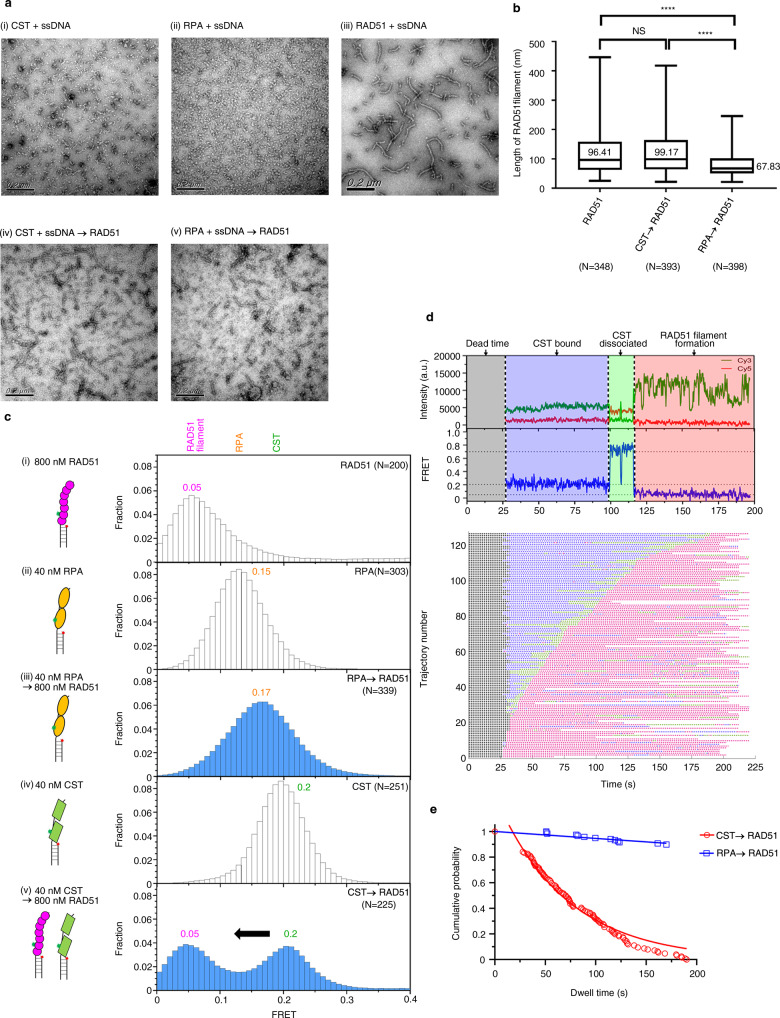
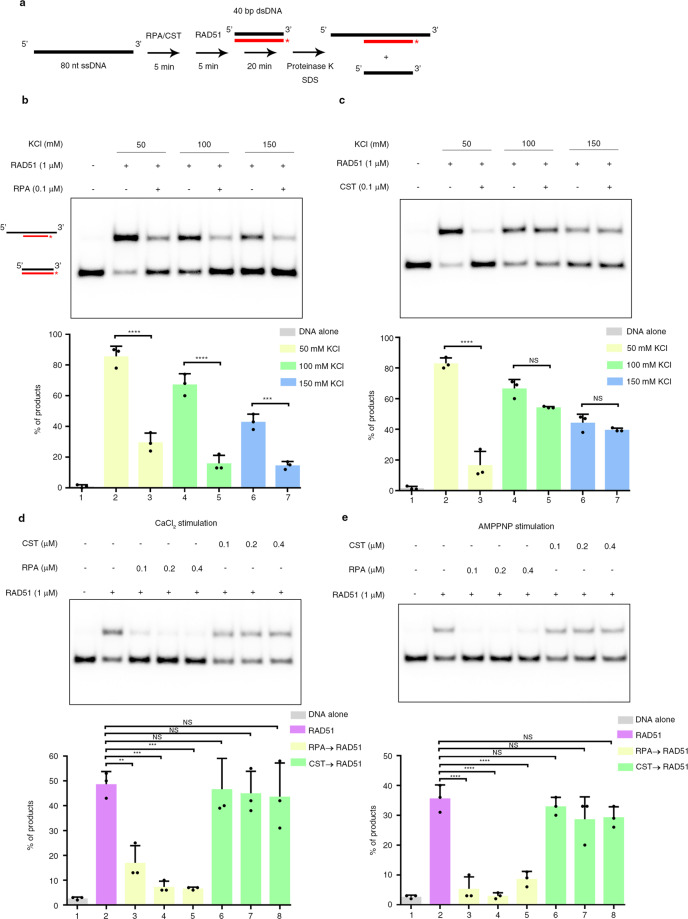
Replication stress causes replication fork stalling, resulting in an accumulation of single-stranded DNA (ssDNA). Replication protein A (RPA) and CTC1-STN1-TEN1 (CST) complex bind ssDNA and are found at stalled forks, where they regulate RAD51 recruitment and foci formation in vivo. Here, we investigate crosstalk between RPA, CST, and RAD51. We show that CST and RPA localize in close proximity in cells. Although CST stably binds to ssDNA with a high affinity at low ionic strength, the interaction becomes more dynamic and enables facilitated dissociation at high ionic strength. CST can coexist with RPA on the same ssDNA and target RAD51 to RPA-coated ssDNA. Notably, whereas RPA-coated ssDNA inhibits RAD51 activity, RAD51 can assemble a functional filament and exhibit strand-exchange activity on CST-coated ssDNA at high ionic strength. Our findings provide mechanistic insights into how CST targets and tethers RAD51 to RPA-coated ssDNA in response to replication stress.
复制压力导致复制叉停滞,从而导致单链 DNA(ssDNA)的积累。复制蛋白 A(RPA)和 CTC1-STN1-TEN1(CST)复合物结合 ssDNA,并在停滞的叉上被发现,在那里它们调节 RAD51 的募集和体内焦点的形成。在这里,我们研究了 RPA、CST 和 RAD51 之间的串扰。我们表明 CST 和 RPA 在细胞中紧密接近定位。尽管 CST 在低盐强度下以高亲和力稳定结合 ssDNA,但相互作用变得更加动态,并在高盐强度下能够促进解离。CST 可以与同一 ssDNA 上的 RPA 共存,并将 RAD51 靶向 RPA 包被的 ssDNA。值得注意的是,虽然 RPA 包被的 ssDNA 抑制 RAD51 活性,但 RAD51 可以在高盐强度下组装功能丝并在 CST 包被的 ssDNA 上表现出链交换活性。我们的研究结果为 CST 如何针对和固定 RAD51 到 RPA 包被的 ssDNA 以响应复制压力提供了机制见解。