Graduate School of Oceanography, University of Rhode Island, Narragansett, RI, USA.
Department of Earth, Atmospheric and Planetary Sciences, Massachusetts Institute of Technology, Cambridge, MA, USA.
Nat Commun. 2021 Nov 5;12(1):6413. doi: 10.1038/s41467-021-26651-8.
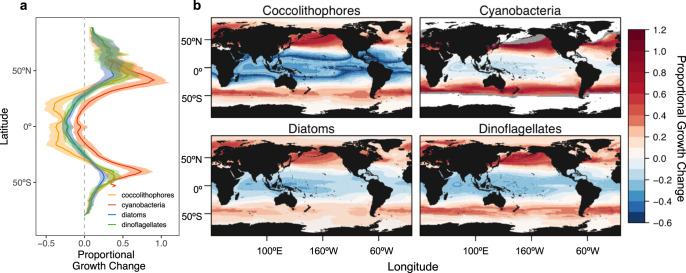
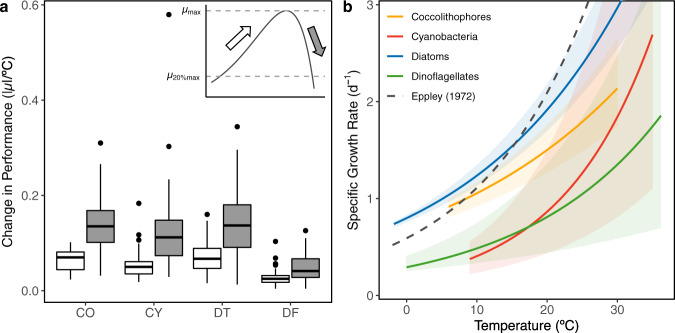
Marine phytoplankton generate half of global primary production, making them essential to ecosystem functioning and biogeochemical cycling. Though phytoplankton are phylogenetically diverse, studies rarely designate unique thermal traits to different taxa, resulting in coarse representations of phytoplankton thermal responses. Here we assessed phytoplankton functional responses to temperature using empirically derived thermal growth rates from four principal contributors to marine productivity: diatoms, dinoflagellates, cyanobacteria, and coccolithophores. Using modeled sea surface temperatures for 1950-1970 and 2080-2100, we explored potential alterations to each group's growth rates and geographical distribution under a future climate change scenario. Contrary to the commonly applied Eppley formulation, our data suggest phytoplankton functional types may be characterized by different temperature coefficients (Q), growth maxima thermal dependencies, and thermal ranges which would drive dissimilar responses to each degree of temperature change. These differences, when applied in response to global simulations of future temperature, result in taxon-specific projections of growth and geographic distribution, with low-latitude coccolithophores facing considerable decreases and cyanobacteria substantial increases in growth rates. These results suggest that the singular effect of changing temperature may alter phytoplankton global community structure, owing to the significant variability in thermal response between phytoplankton functional types.
海洋浮游植物产生了全球一半的初级生产力,对生态系统功能和生物地球化学循环至关重要。尽管浮游植物在系统发育上具有多样性,但研究很少将独特的热特性指定给不同的分类群,从而导致对浮游植物热响应的粗略描述。在这里,我们使用对海洋生产力有四个主要贡献者(硅藻、甲藻、蓝藻和颗石藻)的经验得出的热生长率来评估浮游植物对温度的功能响应。使用模拟的 1950-1970 年和 2080-2100 年的海面温度,我们探索了在未来气候变化情景下,每个组的增长率和地理分布可能发生的变化。与常用的 Eppley 公式相反,我们的数据表明,浮游植物功能类型可能具有不同的温度系数 (Q)、生长最大值的热依赖性和温度范围,这将导致对每度温度变化的不同响应。这些差异在对未来温度的全球模拟中应用时,会导致特定于分类群的生长和地理分布预测,低纬度颗石藻的增长率大幅下降,而蓝藻的增长率大幅上升。这些结果表明,由于浮游植物功能类型之间的热响应存在显著差异,温度变化的单一影响可能会改变浮游植物的全球群落结构。