Centro Singular de Investigación en Química Biolóxica e Materiais Moleculares (CiQUS), Departamento de Química Orgánica, Universidade de Santiago de Compostela, 15705, Santiago de Compostela, Spain.
Nat Commun. 2021 Nov 5;12(1):6421. doi: 10.1038/s41467-021-26681-2.
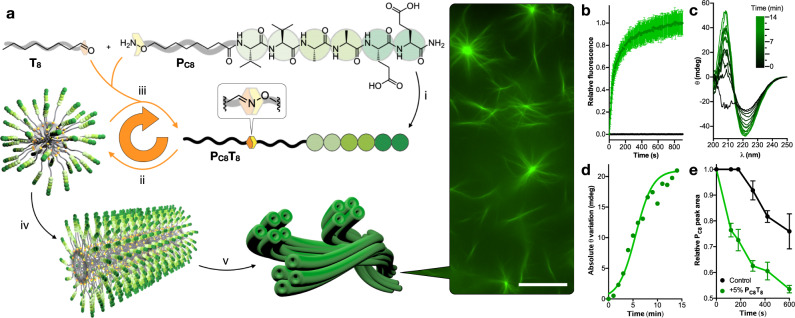
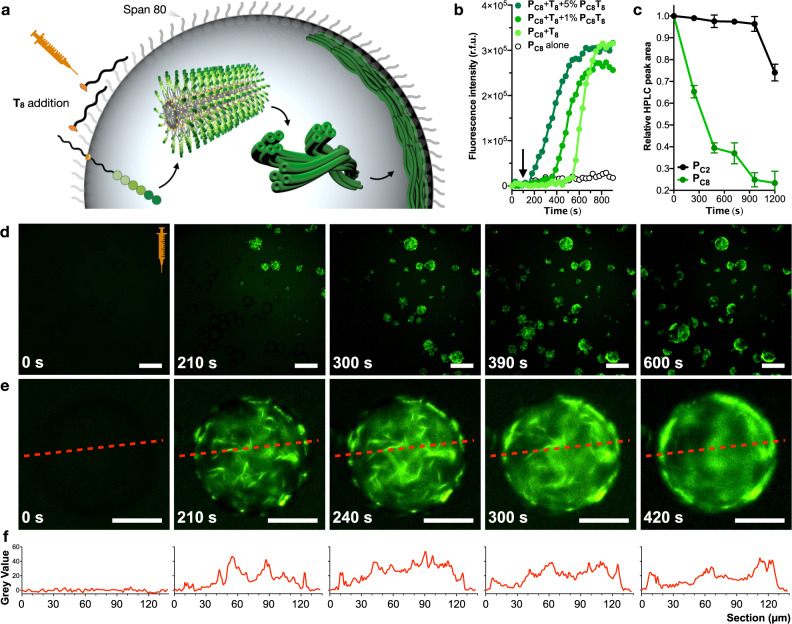
One-dimensional (1D) supramolecular polymers are commonly found in natural and synthetic systems to prompt functional responses that capitalise on hierarchical molecular ordering. Despite amphiphilic self-assembly being significantly studied in the context of aqueous encapsulation and autopoiesis, very little is currently known about the physico-chemical consequences and functional role of 1D supramolecular polymerisation confined in aqueous compartments. Here, we describe the different phenomena that resulted from the chemically triggered supramolecular fibrillation of synthetic peptide amphiphiles inside water microdroplets. The confined connection of suitable dormant precursors triggered a physically autocatalysed chemical reaction that resulted in functional environmental responses such as molecular uptake, fusion and chemical exchange. These results demonstrate the potential of minimalistic 1D supramolecular polymerisation to modulate the behaviour of individual aqueous entities with their environment and within communities.
一维(1D)超分子聚合物在天然和合成系统中很常见,可引发功能响应,利用分子层次有序化。尽管两亲自组装在水包封和自我复制的背景下得到了广泛研究,但目前对于限制在水隔室中的一维超分子聚合的物理化学后果和功能作用知之甚少。在这里,我们描述了在水微滴内合成肽两亲物化学触发超分子原纤化所导致的不同现象。合适的休眠前体的受限连接触发了物理自动催化化学反应,导致分子摄取、融合和化学交换等功能环境响应。这些结果表明,极简的 1D 超分子聚合具有调节单个水实体与其环境以及在群落内行为的潜力。