School of Community Health & Midwifery, University of Central Lancashire, Preston, UK.
Institute of Higher Education and Research in Healthcare, University of Lausanne, Lausanne, Switzerland.
BMC Health Serv Res. 2021 Nov 6;21(1):1206. doi: 10.1186/s12913-021-07238-x.
High numbers of women experience a traumatic birth, which can lead to childbirth-related post-traumatic stress disorder (CB-PTSD) onset, and negative and pervasive impacts for women, infants, and families. Policies, suitable service provision, and training are needed to identify and treat psychological morbidity following a traumatic birth experience, but currently there is little insight into whether and what is provided in different contexts. The aim of this knowledge mapping exercise was to map policy, service and training provision for women following a traumatic birth experience in different European countries.
A survey was distributed as part of the COST Action "Perinatal mental health and birth-related trauma: Maximizing best practice and optimal outcomes". Questions were designed to capture country level data; care provision (i.e., national policies or guidelines for the screening, treatment and/or prevention of a traumatic birth, service provision), and nationally mandated pre-registration and post-registration training for maternity professionals.
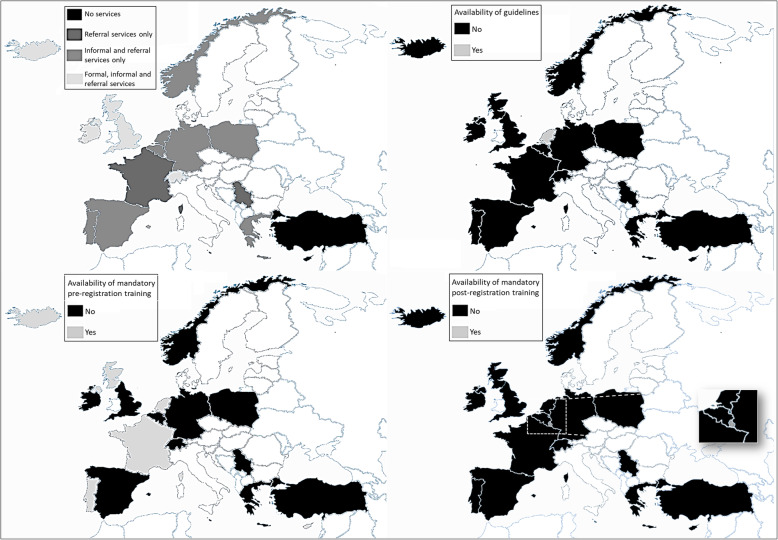
Eighteen countries participated. Only one country (the Netherlands) had national policies regarding the screening, treatment, and prevention of a traumatic birth experience/CB-PTSD. Service provision was provided formally in six countries (33%), and informally in the majority (78%). In almost all countries (89%), women could be referred to specialist perinatal or mental health services. Services tended to be provided by midwives, although some multidisciplinary practice was apparent. Seven (39%) of the countries offered 'a few hours' professional/pre-registration training, but none offered nationally mandated post-registration training.
A traumatic birth experience is a key public health concern. Evidence highlights important gaps regarding formalized care provision and training for care providers.
许多女性经历了创伤性分娩,这可能导致与分娩相关的创伤后应激障碍(CB-PTSD)的发生,并对女性、婴儿和家庭产生负面影响和持久影响。需要制定政策、提供合适的服务和培训,以识别和治疗创伤性分娩经历后的心理发病情况,但目前对于不同背景下是否存在以及存在哪些干预措施,了解甚少。本知识图谱研究的目的是绘制不同欧洲国家在创伤性分娩后提供政策、服务和培训的图谱。
作为 COST 行动“围产期心理健康和与分娩相关的创伤:最大限度地提高最佳实践和最佳结果”的一部分,分发了一项调查。问题旨在获取国家层面的数据;护理提供情况(即筛查、治疗和/或预防创伤性分娩的国家政策或指南、服务提供),以及为产妇专业人员提供的国家强制的注册前和注册后培训。
18 个国家参与了研究。只有一个国家(荷兰)制定了关于筛查、治疗和预防创伤性分娩经历/创伤后应激障碍的国家政策。在六个国家(33%)正式提供服务,在大多数国家(78%)非正式提供。在几乎所有国家(89%),都可以将女性转介到专门的围产期或心理健康服务机构。服务往往由助产士提供,尽管有些多学科实践也存在。七个(39%)国家提供了“几个小时”的专业/注册前培训,但没有一个国家提供国家强制的注册后培训。
创伤性分娩经历是一个重要的公共卫生问题。证据突出了在规范化护理提供和护理提供者培训方面的重要差距。