Department of Internal Medicine Wake Forest School of Medicine Winston-Salem NC.
Division of Public Health Sciences Wake Forest School of Medicine Winston-Salem NC.
J Am Heart Assoc. 2021 Nov 16;10(22):e021901. doi: 10.1161/JAHA.121.021901. Epub 2021 Nov 6.
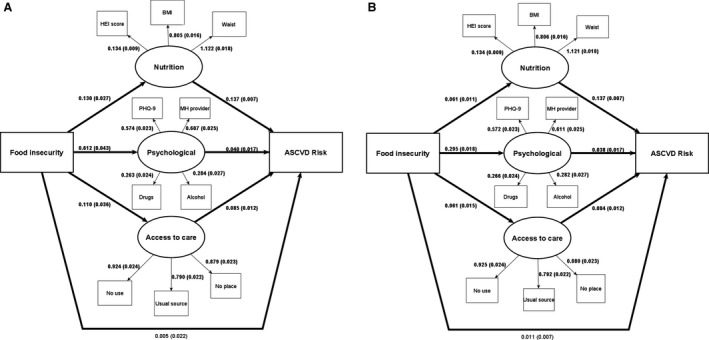
Background Food insecurity (FI) has been associated with an increased atherosclerotic cardiovascular disease (ASCVD) risk; however, the pathways by which FI leads to worse cardiovascular health are unknown. We tested the hypothesis that FI is associated with ASCVD risk through nutritional/anthropometric (eg, worse diet quality and increased weight), psychological/mental health (eg, increased depressive symptoms and risk of substance abuse), and access to care pathways. Methods and Results We conducted a cross-sectional study of adults (aged 40-79 years) using the 2007 to 2016 National Health and Nutrition Examination Survey. Our primary exposure was household FI, and our outcome was 10-year ASCVD risk categorized as low (<5%), borderline (≥5% -<7.5%), intermediate (≥7.5%-<20%), and high risk (≥20%). We used structural equation modeling to evaluate the pathways and multiple mediation analysis to determine direct and indirect effects. Of the 12 429 participants, 2231 (18.0%) reported living in a food-insecure household; 5326 (42.9%) had a low ASCVD risk score, 1402 (11.3%) borderline, 3606 (29.0%) intermediate, and 2095 (16.9%) had a high-risk score. In structural models, we found significant path coefficients between FI and the nutrition/anthropometric (β, 0.130; SE, 0.027; <0.001), psychological/mental health (β, 0.612; SE, 0.043; <0.001), and access to care (β, 0.110; SE, 0.036; =0.002) pathways. We did not find a significant direct effect of FI on ASCVD risk, and the nutrition, psychological, and access to care pathways accounted for 31.6%, 43.9%, and 15.8% of the association, respectively. Conclusions We found that the association between FI and ASCVD risk category was mediated through the nutrition/anthropometric, psychological/mental health, and access to care pathways. Interventions that address all 3 pathways may be needed to mitigate the negative impact of FI on cardiovascular disease.
食物不安全(FI)与动脉粥样硬化性心血管疾病(ASCVD)风险增加有关;然而,FI 导致心血管健康状况恶化的途径尚不清楚。我们检验了这样一个假设,即 FI 通过营养/人体测量学(例如,饮食质量更差和体重增加)、心理/心理健康(例如,抑郁症状增加和滥用物质的风险增加)以及获得保健途径与 ASCVD 风险相关。
我们使用 2007 年至 2016 年全国健康和营养调查的数据,对 40-79 岁的成年人进行了横断面研究。我们的主要暴露因素是家庭 FI,我们的结局是 10 年 ASCVD 风险分类为低(<5%)、边界(≥5%-<7.5%)、中(≥7.5%-<20%)和高风险(≥20%)。我们使用结构方程模型评估途径,并用多重中介分析来确定直接和间接影响。在 12429 名参与者中,2231 名(18.0%)报告生活在一个食物不安全的家庭中;5326 名(42.9%)的 ASCVD 风险评分较低,1402 名(11.3%)为边界,3606 名(29.0%)为中,2095 名(16.9%)为高风险。在结构模型中,我们发现 FI 与营养/人体测量学(β,0.130;SE,0.027;<0.001)、心理/心理健康(β,0.612;SE,0.043;<0.001)和获得保健途径(β,0.110;SE,0.036;=0.002)之间存在显著的路径系数。我们没有发现 FI 对 ASCVD 风险有显著的直接影响,营养、心理和获得保健途径分别解释了 31.6%、43.9%和 15.8%的关联。
我们发现,FI 与 ASCVD 风险类别的关联通过营养/人体测量学、心理/心理健康和获得保健途径来介导。可能需要干预所有 3 个途径,以减轻 FI 对心血管疾病的负面影响。