Henan Key Laboratory of Cancer Epigenetics; Cancer hospital, The First Affiliated Hospital, College of Clinical Medicine, Medical College of Henan University of Science and Technology, No.24 jinghua Road, Jianxi District, Luoyang, 471003, China.
Zhoukou first people's Hospital, Zhoukou, China.
BMC Cancer. 2021 Nov 7;21(1):1188. doi: 10.1186/s12885-021-08914-1.
In recent years, gene expression-based analysis has been used for disease biomarker discovery, providing ways for better diagnosis, leading to improvement of clinical treatment efficacy. This study aimed to explore the role of miR-16-5p and ANLN in breast cancer (BC).
Cohort datasets of BC were obtained from the Gene Expression Omnibus (GEO) and the Cancer Genome Atlas (TCGA) and analyzed by bioinformatics tools. qRT-PCR and western blotting were applied to validate ANLN and its protein expression. A dual-luciferase reporter assay was used to prove the regulatory relationship of miR-16-5p and ANLN. Finally, MTT, wound healing, Transwell invasion and flow cytometry analyses of the cell cycle and apoptosis were performed to assess cell proliferation, migration, invasion, cell cycle and apoptosis, respectively.
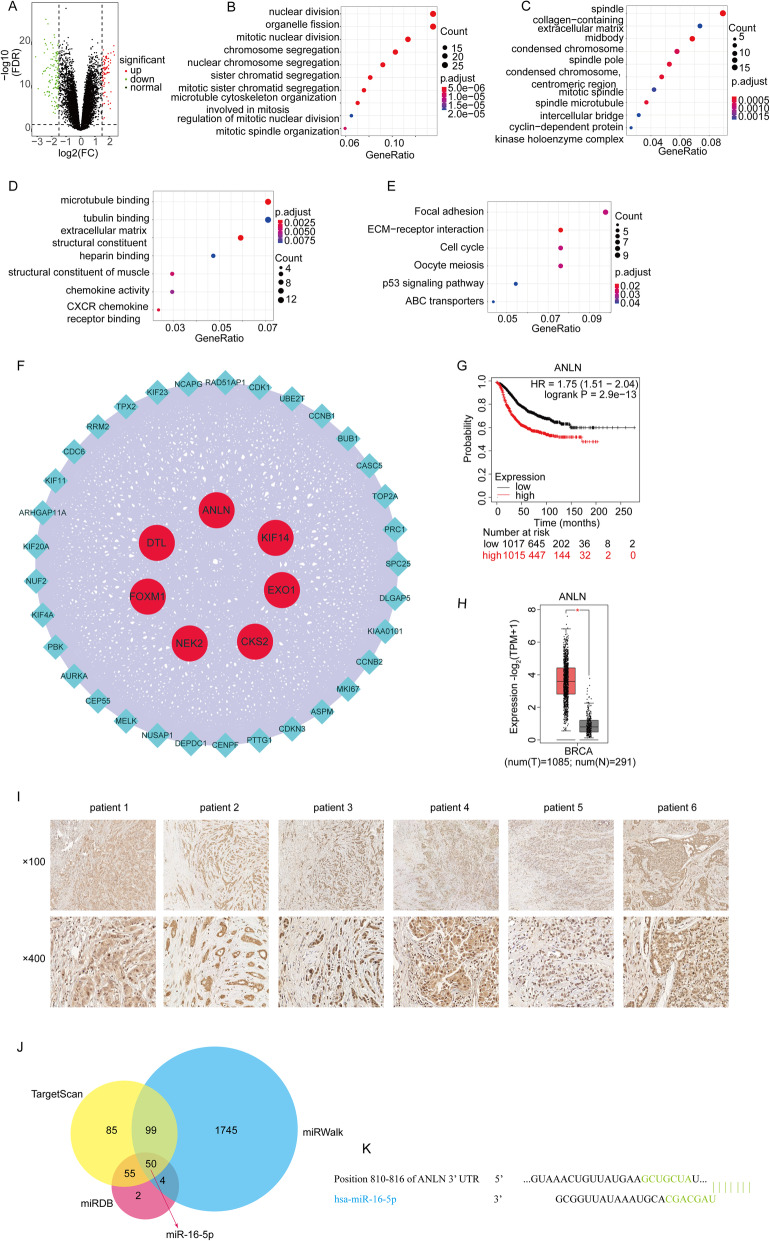
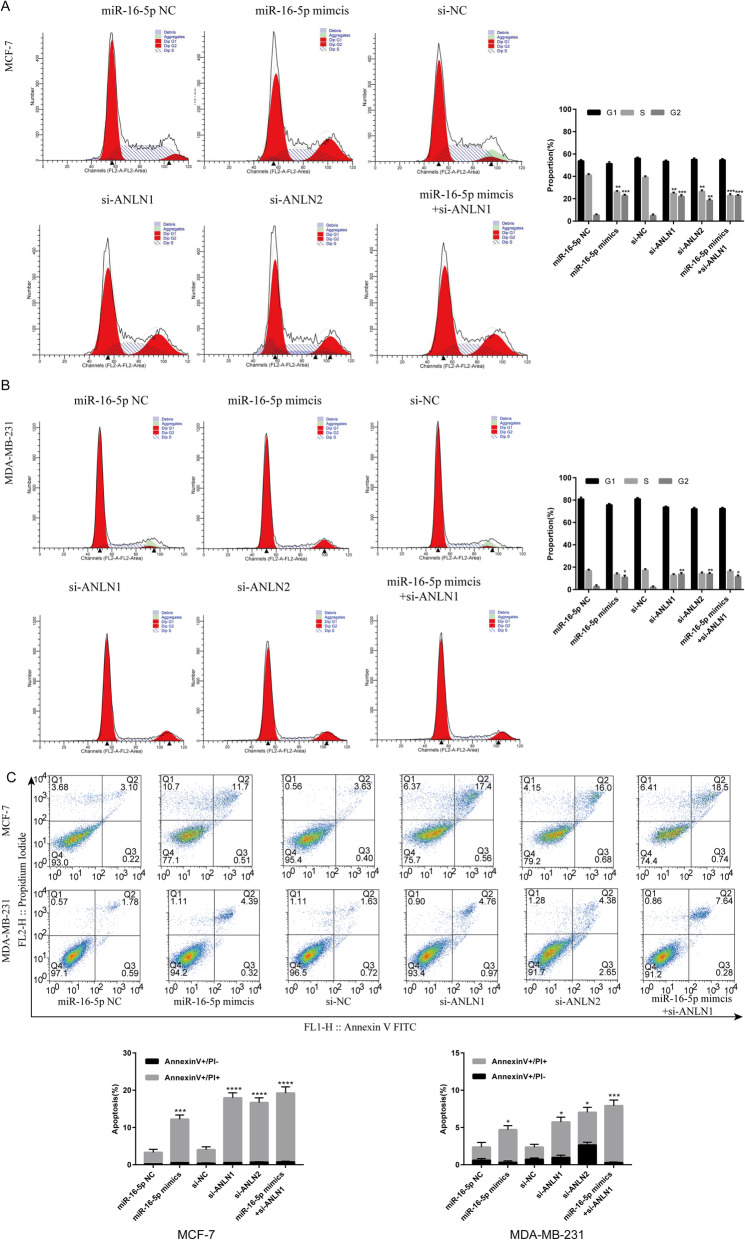
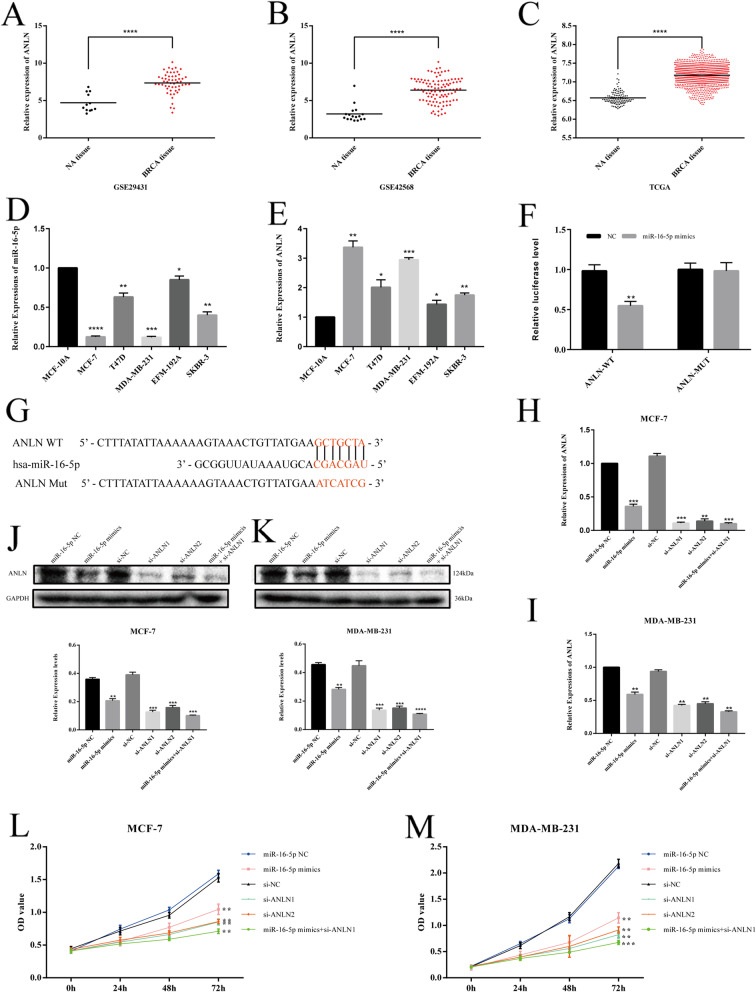
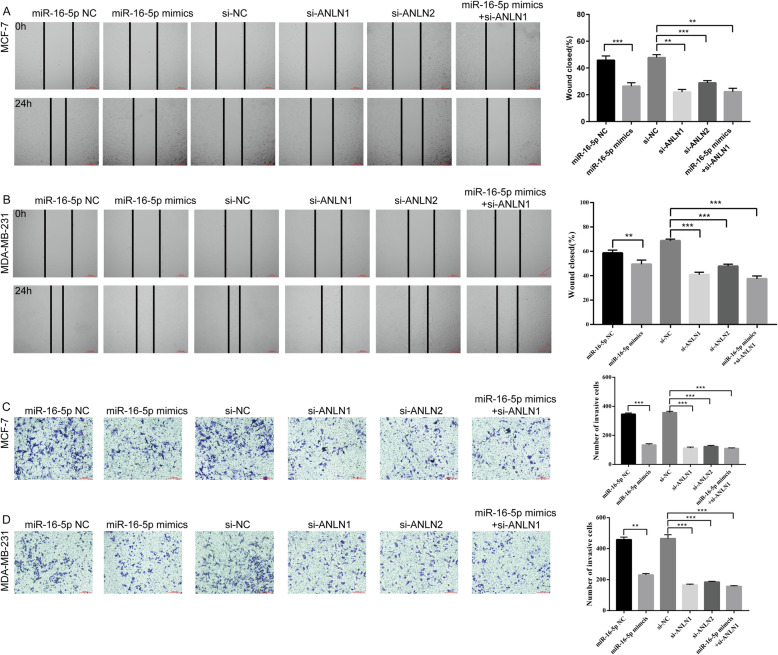
A total of 195 differentially expressed genes (DEGs) and 50 overlapping microRNAs (miRNAs) were identified. Among these DEGs and miRNAs, ANLN, associated with poor overall survival in BC, overlapped in the GSE29431, GSE42568, TCGA and GEPIA2 databases. Moreover, ANLN was highly expressed, while miR-16-5p was lower in BC cells than in breast epithelial cells. Then, we confirmed that ANLN was directly targeted by miR-16-5p in BC cells. Over-expression of miR-16-5p and knock-down of ANLN remarkably inhibited cell proliferation and migration as well as cell invasion, arrested the cells in G2/M phase and induced apoptosis in BC cells.
These findings suggest that miR-16-5p restrains proliferation, migration and invasion while affecting cell cycle and promotes apoptosis by regulating ANLN, thereby providing novel candidate biomarkers for the diagnosis and treatment of BC.
近年来,基于基因表达的分析已被用于疾病生物标志物的发现,为更好的诊断提供了途径,从而提高了临床治疗效果。本研究旨在探讨 miR-16-5p 和 ANLN 在乳腺癌(BC)中的作用。
从基因表达综合数据库(GEO)和癌症基因组图谱(TCGA)中获取 BC 的队列数据集,并通过生物信息学工具进行分析。qRT-PCR 和 Western blot 用于验证 ANLN 及其蛋白表达。双荧光素酶报告实验用于证明 miR-16-5p 和 ANLN 的调控关系。最后,通过 MTT、划痕愈合、Transwell 侵袭和流式细胞术分析细胞周期和细胞凋亡,分别评估细胞增殖、迁移、侵袭、细胞周期和细胞凋亡。
共鉴定出 195 个差异表达基因(DEGs)和 50 个重叠 microRNAs(miRNAs)。在这些 DEGs 和 miRNAs 中,与 BC 总生存期不良相关的 ANLN 在 GSE29431、GSE42568、TCGA 和 GEPIA2 数据库中重叠。此外,BC 细胞中 ANLN 表达较高,而 miR-16-5p 表达较低。然后,我们证实了 miR-16-5p 在 BC 细胞中直接靶向 ANLN。过表达 miR-16-5p 和敲低 ANLN 可显著抑制 BC 细胞的增殖、迁移和侵袭,将细胞阻滞在 G2/M 期,并诱导细胞凋亡。
这些发现表明,miR-16-5p 通过调节 ANLN 抑制增殖、迁移和侵袭,影响细胞周期并促进细胞凋亡,从而为 BC 的诊断和治疗提供了新的候选生物标志物。