Sánchez-Hidalgo José Juan, Suárez-Cuenca Juan Antonio, Lozano-Nuevo José Juan, García-López Víctor Hugo, Leal-Gutiérrez María Graciela, León-Angel Sein Antonio, Ramírez-Villa María Leslye, Rodea-Rubio Martha Elena, González-Hernández José Enrique, Canela-Mayoral José Antonio, Murillo-Heredia Eduardo, Vera-Gómez Eduardo, Hernández-Patricio Alejandro, Zamora-Alemán Carlos Ramiro, Domínguez-Pérez Gabriela Alexandra, Gutiérrez-Buendia Juan Ariel, Mondragón-Terán Paul
Internal Medicine Department, Ticomán General Hospital, Mexico City Health Department. 7, Plan de San Luis, La Purísima Ticomán, Alcaldía Gustavo A. Madero, P.O. 07330, Mexico City, Mexico.
Division of Clinical Research, "20 de Noviembre" National Medical Centre, ISSSTE, No. 540, Félix Cuevas, Colonia del Valle Sur, Alcaldía Benito Juárez, P.O. 03229, Mexico City, Mexico.
Diabetol Metab Syndr. 2021 Nov 7;13(1):128. doi: 10.1186/s13098-021-00745-1.
Albumin, along with other proteins, is abnormally eliminated via the urine during early stages of diabetic nephropathy. Moreover, endothelial dysfunction (ED) accompanying early diabetic nephropathy may develop even before microalbuminuria is detectable. Transferrin has a molecular weight comparable to albumin, whereas transferrinuria and microalbuminuria in a 24-h urine sample may comparably reflect early diabetic nephropathy. Whereas transferrin metabolism is related with ED during very early diabetic nephropathy has not been elucidated yet. This case-control study aimed to evaluate the relation between ED and urine transferrin, even before early diabetic nephropathy is present.
Patients were enrolled from two study sites in Mexico City: Ticomán General Hospital (healthy controls); and a Specialized Clinic for the Management of the Diabetic Patient (cases). All patients provided written informed consent. The primary endpoint was the correlation between urinary transferrin concentration and ED measured in type 2 diabetic patients without albuminuria. ED was evaluated by ultrasonographic validated measurements, which included carotid intima-media thickness (CIMT) and flow mediated dilation (FMD). Plasma biomarkers included glycated hemoglobin, creatinine, cholesterol and triglycerides, as well as urine albumin, transferrin and evidence of urinary tract infection.
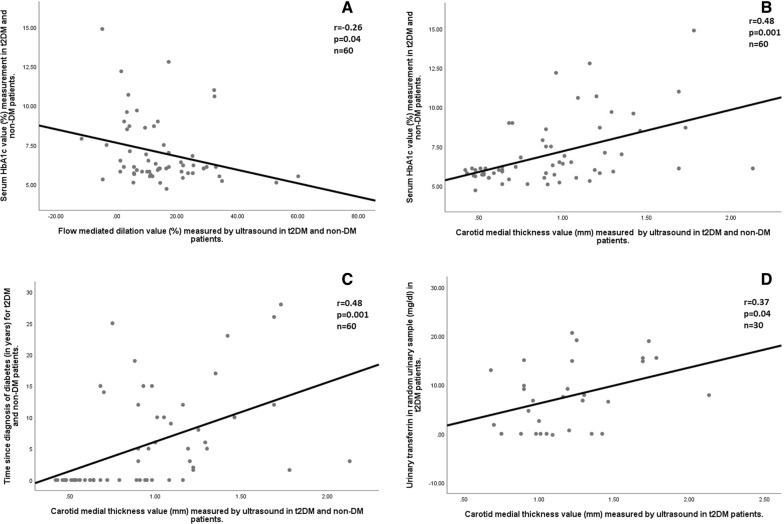
Sixty patients with type 2 Diabetes Mellitus (t2DM; n = 30) or without t2DM (n = 30), both negative for microalbuminuria, were recruited. The group with t2DM were older, with higher values of HbA1c and higher ED. This group also showed significant differences in urine transferrin and urine/plasma transferrin ratio, as compared with healthy controls (14.4 vs. 18.7 mg/mL, p = 0.04, and 74.2 vs. 49.5; p = 0.01; respectively). Moreover, urine transferrin correlated with higher CIMT values (r = 0.37, p = 0.04), being particularly significant for t2DM population. CIMT also correlated with time from t2DM diagnosis (r = 0.48, p < 0.001) and HbA1c (r = 0.48; p < 0.001).
Urine transferrin correlated with subclinical atherogenesis in patients with t2DM without renal failure, suggesting its potential to identify cardiovascular risk in patients at very early nephropathy stage without microalbuminuria.
在糖尿病肾病早期,白蛋白与其他蛋白质一起会通过尿液异常排出。此外,早期糖尿病肾病伴随的内皮功能障碍(ED)甚至可能在微量白蛋白尿可检测到之前就已出现。转铁蛋白的分子量与白蛋白相当,而24小时尿样中的转铁蛋白尿和微量白蛋白尿可能同样反映早期糖尿病肾病。然而,在糖尿病肾病极早期,转铁蛋白代谢与内皮功能障碍之间的关系尚未阐明。本病例对照研究旨在评估在早期糖尿病肾病出现之前,内皮功能障碍与尿转铁蛋白之间的关系。
患者来自墨西哥城的两个研究地点:蒂科曼综合医院(健康对照组);以及糖尿病患者管理专科诊所(病例组)。所有患者均提供了书面知情同意书。主要终点是在无蛋白尿的2型糖尿病患者中,尿转铁蛋白浓度与内皮功能障碍之间的相关性。通过超声验证测量来评估内皮功能障碍,包括颈动脉内膜中层厚度(CIMT)和血流介导的血管舒张(FMD)。血浆生物标志物包括糖化血红蛋白、肌酐、胆固醇和甘油三酯,以及尿白蛋白、转铁蛋白和尿路感染的证据。
招募了60例2型糖尿病(t2DM;n = 30)或无t2DM(n = 30)且微量白蛋白尿均为阴性的患者。t2DM组年龄更大,糖化血红蛋白值更高,内皮功能障碍更严重。与健康对照组相比,该组在尿转铁蛋白和尿/血浆转铁蛋白比值方面也存在显著差异(分别为14.4对18.7mg/mL,p = 0.04;以及74.2对49.5;p = 0.01)。此外,尿转铁蛋白与更高的CIMT值相关(r = 0.37,p = 0.04),在t2DM人群中尤为显著。CIMT还与t2DM诊断后的时间(r = 0.48,p < 0.001)和糖化血红蛋白(r = 0.48;p < 0.001)相关。
在无肾衰竭的t2DM患者中,尿转铁蛋白与亚临床动脉粥样硬化相关,表明其在无微量白蛋白尿的极早期肾病阶段识别心血管风险的潜力。