Department of Internal Medicine, School of Medicine, University Hospital Clementino Fraga Filho, Universidade Federal do Rio de Janeiro, Rua Rodolpho Rocco, 255, Cidade Universitária, Rio de Janeiro, CEP 21941-913, Brazil.
Civil Engineering Program, COPPE, Universidade Federal do Rio de Janeiro, Rio de Janeiro, Brazil.
Cardiovasc Diabetol. 2019 Jan 10;18(1):2. doi: 10.1186/s12933-019-0809-1.
The prognostic importance of carotid atherosclerosis in individuals with diabetes is unsettled. We aimed to evaluate the relationships between parameters of carotid atherosclerosis and the future occurrence of micro- and cardiovascular complications in individuals with type 2 diabetes.
Ultrasonographic parameters of carotid atherosclerosis, intima-media thickness (CIMT) and plaques, were measured at baseline in 478 participants who were followed-up for a median of 10.8 years. Multivariate Cox analysis was used to examine the associations between carotid parameters and the occurrence of microvascular (retinopathy, renal, and peripheral neuropathy) and cardiovascular complications (total cardiovascular events [CVEs] and cardiovascular mortality), and all-cause mortality. The improvement in risk stratification was assessed by using the C-statistic and the integrated discrimination improvement (IDI) index.
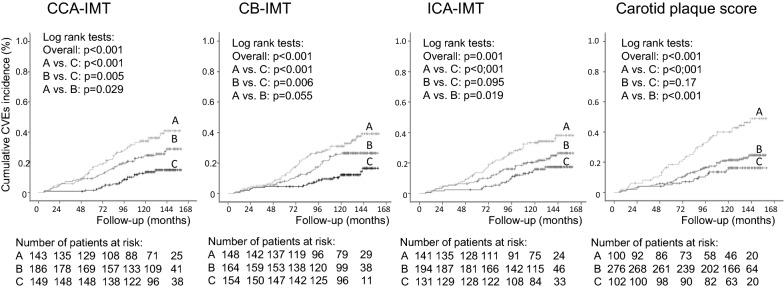
During follow-up, 116 individuals had a CVE and 115 individuals died (56 from cardiovascular diseases); 131 newly-developed or worsened diabetic retinopathy, 156 achieved the renal composite outcome (94 newly developed microalbuminuria and 78 deteriorated renal function), and 83 newly-developed or worsened peripheral neuropathy. CIMT, either analysed as a continuous or as a categorical variable, and presence of plaques predicted CVEs occurrence and renal outcomes, but not mortality or other microvascular complications. Individuals with an increased CIMT and plaques had a 1.5- to 1.8-fold increased risk of CVEs and a 1.6-fold higher risk of renal outcome. CIMT and plaques modestly improved cardiovascular risk discrimination over classic risk factors, with IDIs ranging from 7.8 to 8.4%; but more markedly improved renal risk discrimination, with IDIs from 14.8 to 18.5%.
Carotid atherosclerosis parameters predicted cardiovascular and renal outcomes, and improved renal risk stratification. Ultrasonographic carotid imaging may be useful in type 2 diabetes management.
颈动脉粥样硬化在糖尿病患者中的预后意义尚未确定。我们旨在评估 2 型糖尿病患者颈动脉粥样硬化参数与微血管和心血管并发症未来发生之间的关系。
在中位随访 10.8 年期间,对 478 名参与者进行了颈动脉粥样硬化的超声参数(颈动脉内膜中层厚度 [CIMT] 和斑块)的基线测量。使用多变量 Cox 分析检查颈动脉参数与微血管(视网膜病变、肾脏和周围神经病变)和心血管并发症(总心血管事件 [CVE] 和心血管死亡率)以及全因死亡率之间的关联。使用 C 统计量和综合鉴别改善(IDI)指数评估风险分层的改善情况。
随访期间,116 名参与者发生 CVE,115 名参与者死亡(56 例死于心血管疾病);131 名新出现或恶化的糖尿病视网膜病变,156 名达到肾脏复合结局(94 名新出现微量白蛋白尿和 78 名肾功能恶化),83 名新出现或恶化的周围神经病变。CIMT 无论是作为连续变量还是作为分类变量进行分析,以及斑块的存在均预测 CVE 的发生和肾脏结局,但不预测死亡率或其他微血管并发症。CIMT 增加和斑块的存在使 CVE 和肾脏结局的风险增加 1.5-1.8 倍和 1.6 倍。CIMT 和斑块适度提高了经典危险因素对心血管风险的区分度,IDI 范围为 7.8%至 8.4%;但对肾脏风险的区分度提高更为显著,IDI 范围为 14.8%至 18.5%。
颈动脉粥样硬化参数预测心血管和肾脏结局,并改善了肾脏风险分层。超声颈动脉成像可能对 2 型糖尿病的管理有用。