McGuire Kelli, Firestone Gabrielle M, Zhang Nanhua, Zhang Fawen
Department of Communication Sciences and Disorders, University of Cincinnati, Cincinnati, OH, United States.
Division of Biostatistics and Epidemiology, Cincinnati Children's Hospital Medical Center, Cincinnati, OH, United States.
Front Hum Neurosci. 2021 Oct 21;15:757254. doi: 10.3389/fnhum.2021.757254. eCollection 2021.
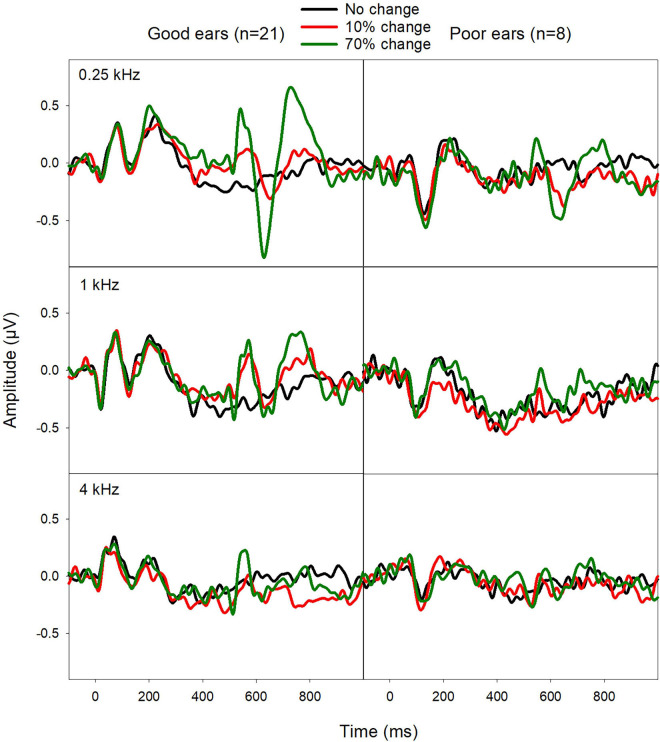
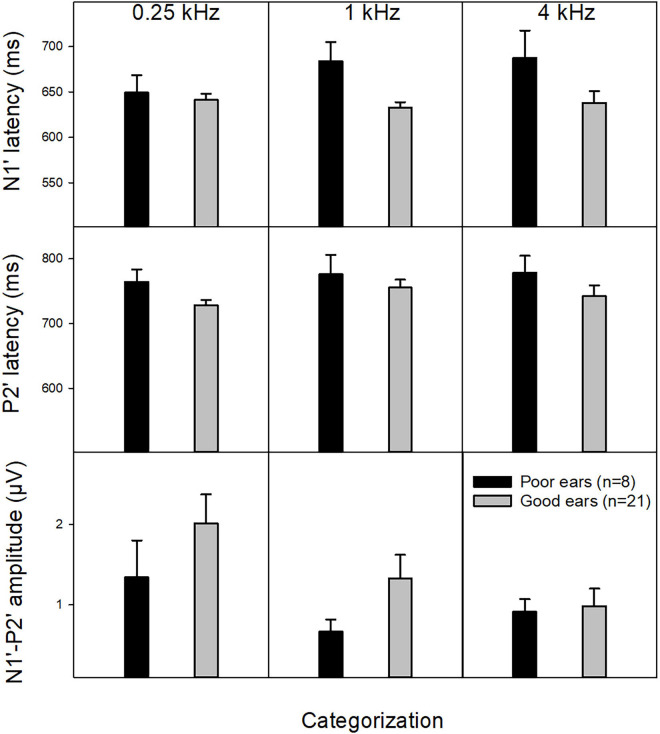
One of the biggest challenges that face cochlear implant (CI) users is the highly variable hearing outcomes of implantation across patients. Since speech perception requires the detection of various dynamic changes in acoustic features (e.g., frequency, intensity, timing) in speech sounds, it is critical to examine the ability to detect the within-stimulus acoustic changes in CI users. The primary objective of this study was to examine the auditory event-related potential (ERP) evoked by the within-stimulus frequency changes (F-changes), one type of the acoustic change complex (ACC), in adult CI users, and its correlation to speech outcomes. Twenty-one adult CI users (29 individual CI ears) were tested with psychoacoustic frequency change detection tasks, speech tests including the Consonant-Nucleus-Consonant (CNC) word recognition, Arizona Biomedical Sentence Recognition in quiet and noise (AzBio-Q and AzBio-N), and the Digit-in-Noise (DIN) tests, and electroencephalographic (EEG) recordings. The stimuli for the psychoacoustic tests and EEG recordings were pure tones at three different base frequencies (0.25, 1, and 4 kHz) that contained a F-change at the midpoint of the tone. Results showed that the frequency change detection threshold (FCDT), ACC N1' latency, and P2' latency did not differ across frequencies ( > 0.05). ACC N1'-P2 amplitude was significantly larger for 0.25 kHz than for other base frequencies ( < 0.05). The mean N1' latency across three base frequencies was negatively correlated with CNC word recognition ( = -0.40, < 0.05) and CNC phoneme ( = -0.40, < 0.05), and positively correlated with mean FCDT ( = 0.46, < 0.05). The P2' latency was positively correlated with DIN ( = 0.47, < 0.05) and mean FCDT ( = 0.47, < 0.05). There was no statistically significant correlation between N1'-P2' amplitude and speech outcomes (all > 0.05). Results of this study indicated that variability in CI speech outcomes assessed with the CNC, AzBio-Q, and DIN tests can be partially explained (approximately 16-21%) by the variability of cortical sensory encoding of F-changes reflected by the ACC.
人工耳蜗(CI)使用者面临的最大挑战之一是不同患者植入后的听力结果差异很大。由于言语感知需要检测语音中各种声学特征(如频率、强度、时间)的动态变化,因此检查CI使用者检测刺激内声学变化的能力至关重要。本研究的主要目的是检查成年CI使用者中由刺激内频率变化(F变化)诱发的听觉事件相关电位(ERP),F变化是声学变化复合体(ACC)的一种类型,并研究其与言语结果的相关性。对21名成年CI使用者(29只个体CI耳)进行了心理声学频率变化检测任务、言语测试(包括辅音-元音-辅音(CNC)单词识别、安静和噪声环境下的亚利桑那生物医学句子识别(AzBio-Q和AzBio-N)以及噪声中的数字(DIN)测试)和脑电图(EEG)记录。心理声学测试和EEG记录的刺激是三种不同基频(0.25、1和4kHz)的纯音,在音调中点处包含一个F变化。结果显示,频率变化检测阈值(FCDT)、ACC N1'潜伏期和P2'潜伏期在不同频率之间没有差异(>0.05)。0.25kHz的ACC N1'-P2振幅明显大于其他基频(<0.05)。三个基频的平均N1'潜伏期与CNC单词识别(=-0.40,<0.05)和CNC音素(=-0.40,<0.05)呈负相关,与平均FCDT呈正相关(=0.46,<0.05)。P2'潜伏期与DIN(=0.47,<0.05)和平均FCDT(=0.47,<0.05)呈正相关。N1'-P2'振幅与言语结果之间没有统计学上的显著相关性(均>0.05)。本研究结果表明,用CNC、AzBio-Q和DIN测试评估的CI言语结果的变异性可以部分地(约16-21%)由ACC反映的F变化的皮质感觉编码变异性来解释。