Vacchiano Veria, Mastrangelo Andrea, Zenesini Corrado, Masullo Marco, Quadalti Corinne, Avoni Patrizia, Polischi Barbara, Cherici Arianna, Capellari Sabina, Salvi Fabrizio, Liguori Rocco, Parchi Piero
Department of Biomedical and NeuroMotor Sciences (DIBINEM), University of Bologna, Bologna, Italy.
IRCCS Istituto delle Scienze Neurologiche di Bologna, Bologna, Italy.
Front Aging Neurosci. 2021 Oct 22;13:753242. doi: 10.3389/fnagi.2021.753242. eCollection 2021.
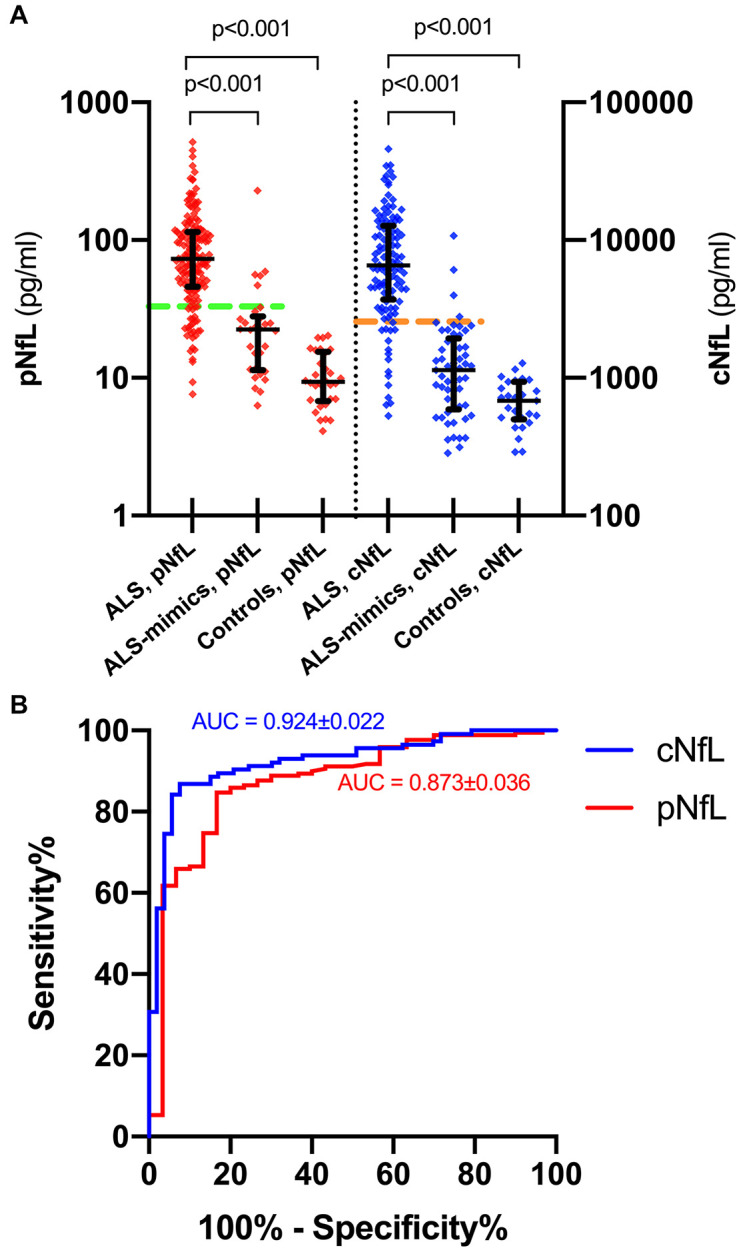
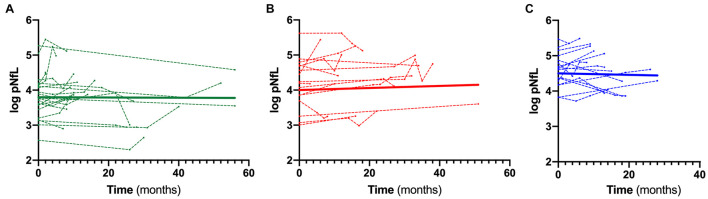
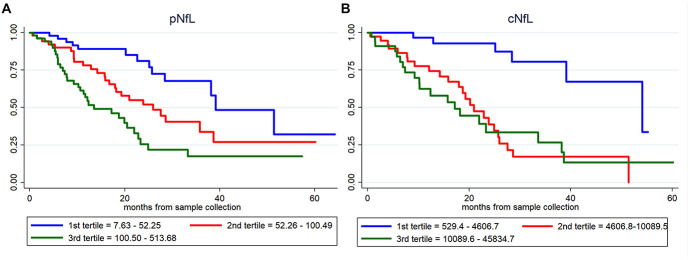
Neurofilament light chain (NfL) is a validated biofluid marker of neuroaxonal damage with great potential for monitoring patients with neurodegenerative diseases. We aimed to further validate the clinical utility of plasma (p) vs. CSF (c) NfL for distinguishing patients with Amyotrophic Lateral Sclerosis (ALS) from ALS mimics. We also assessed the association of biomarker values with clinical variables and survival and established the longitudinal changes of pNfL during the disease course. We studied 231 prospectively enrolled patients with suspected ALS who underwent a standardized protocol including neurological examination, electromyography, brain MRI, and lumbar puncture. Patients who received an alternative clinical diagnosis were considered ALS mimics. We classified the patients based on the disease progression rate (DPR) into fast (DPR > 1), intermediate (DPR 0.5-1), and slow progressors (DPR < 0.5). All patients were screened for the most frequent ALS-associated genes. Plasma and CSF samples were retrospectively analyzed; NfL concentrations were measured with the SIMOA platform using a commercial kit. ALS patients ( = 171) showed significantly higher pNfL ( < 0.0001) and cNfL ( < 0.0001) values compared to ALS mimics ( = 60). Both cNfL and pNfL demonstrated a good diagnostic value in discriminating the two groups, although cNfL performed slightly better (cNfL: AUC 0.924 ± 0.022, sensitivity 86.8%, specificity 92.4; pNfL: AUC 0.873 ± 0.036, sensitivity 84.7%, specificity 83.3%). Fast progressors showed higher cNfL and pNfL as compared to intermediate ( = 0.026 and = 0.001) and slow progressors (both < 0.001). Accordingly, ALS patients with higher baseline cNfL and pNfL levels had a shorter survival (highest tertile of cNfL vs. lowest tertile, HR 4.58, = 0.005; highest tertile of pNfL vs. lowest tertile, HR 2.59, = 0.015). Moreover, there were positive associations between cNfL and pNfL levels and the number of body regions displaying UMN signs (rho = 0.325, < 0.0001; rho = 0.308, = 0.001). Finally, longitudinal analyses in 57 patients showed stable levels of pNfL during the disease course. Both cNfL and pNfL have excellent diagnostic and prognostic performance for symptomatic patients with ALS. The stable longitudinal trajectory of pNfL supports its use as a marker of drug effect in clinical trials.
神经丝轻链(NfL)是一种经过验证的神经轴突损伤生物标志物,在监测神经退行性疾病患者方面具有巨大潜力。我们旨在进一步验证血浆(p)与脑脊液(c)NfL在区分肌萎缩侧索硬化症(ALS)患者与ALS疑似病例方面的临床效用。我们还评估了生物标志物值与临床变量及生存率的关联,并确定了疾病过程中pNfL的纵向变化。我们研究了231例前瞻性入组的疑似ALS患者,他们接受了包括神经系统检查、肌电图、脑部MRI和腰椎穿刺在内的标准化方案。接受其他临床诊断的患者被视为ALS疑似病例。我们根据疾病进展率(DPR)将患者分为快速进展型(DPR>1)、中间型(DPR 0.5 - 1)和缓慢进展型(DPR<0.5)。所有患者都筛查了最常见的与ALS相关的基因。对血浆和脑脊液样本进行回顾性分析;使用商用试剂盒通过SIMOA平台测量NfL浓度。与ALS疑似病例(n = 60)相比,ALS患者(n = 171)的pNfL(p<0.0001)和cNfL(p<0.0001)值显著更高。cNfL和pNfL在区分两组方面均显示出良好的诊断价值,尽管cNfL表现略好(cNfL:AUC 0.924±0.022,敏感性86.8%,特异性92.4;pNfL:AUC 0.873±0.036,敏感性84.7%,特异性83.3%)。与中间型(p = 0.026和p =