Mira Rodrigo G, Lira Matías, Cerpa Waldo
Laboratorio de Función y Patología Neuronal, Departamento de Biología Celular y Molecular, Facultad de Ciencias Biológicas, Pontificia Universidad Católica de Chile, Santiago, Chile.
Centro de Excelencia en Biomedicina de Magallanes (CEBIMA), Universidad de Magallanes, Punta Arenas, Chile.
Front Physiol. 2021 Oct 22;12:740939. doi: 10.3389/fphys.2021.740939. eCollection 2021.
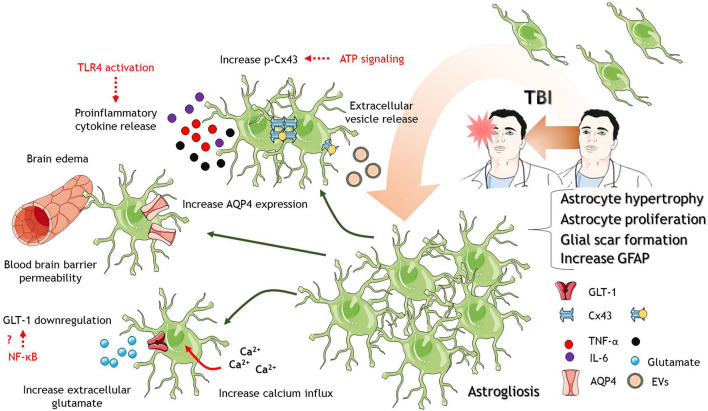
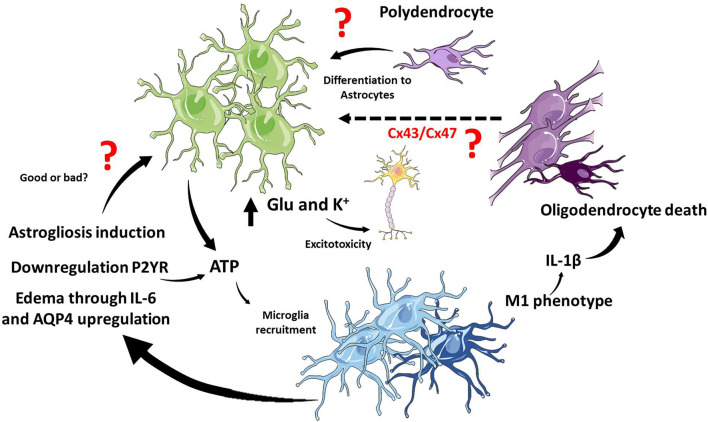
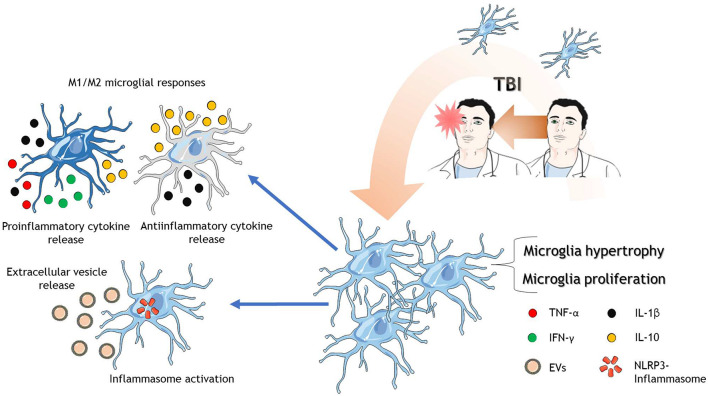
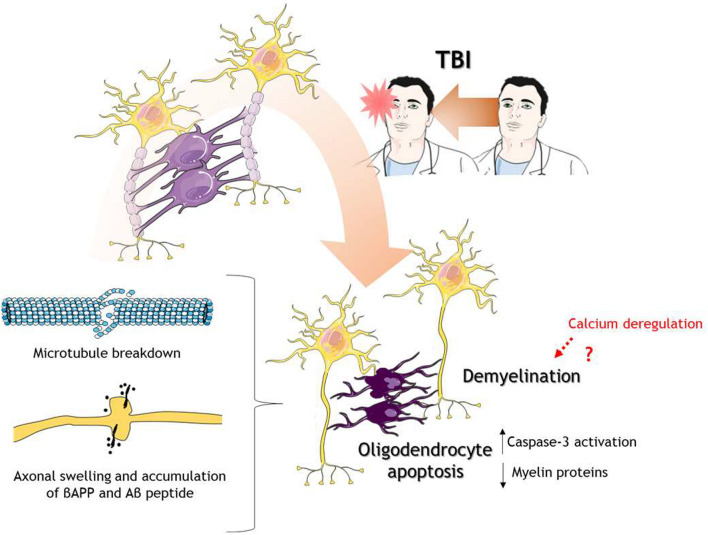
Traumatic brain injury (TBI) is a heterogeneous disorder that involves brain damage due to external forces. TBI is the main factor of death and morbidity in young males with a high incidence worldwide. TBI causes central nervous system (CNS) damage under a variety of mechanisms, including synaptic dysfunction, protein aggregation, mitochondrial dysfunction, oxidative stress, and neuroinflammation. Glial cells comprise most cells in CNS, which are mediators in the brain's response to TBI. In the CNS are present astrocytes, microglia, oligodendrocytes, and polydendrocytes (NG2 cells). Astrocytes play critical roles in brain's ion and water homeostasis, energy metabolism, blood-brain barrier, and immune response. In response to TBI, astrocytes change their morphology and protein expression. Microglia are the primary immune cells in the CNS with phagocytic activity. After TBI, microglia also change their morphology and release both pro and anti-inflammatory mediators. Oligodendrocytes are the myelin producers of the CNS, promoting axonal support. TBI causes oligodendrocyte apoptosis, demyelination, and axonal transport disruption. There are also various interactions between these glial cells and neurons in response to TBI that contribute to the pathophysiology of TBI. In this review, we summarize several glial hallmarks relevant for understanding the brain injury and neuronal damage under TBI conditions.
创伤性脑损伤(TBI)是一种异质性疾病,涉及因外力导致的脑损伤。TBI是全球范围内年轻男性死亡和发病的主要因素,发病率很高。TBI通过多种机制导致中枢神经系统(CNS)损伤,包括突触功能障碍、蛋白质聚集、线粒体功能障碍、氧化应激和神经炎症。神经胶质细胞构成了CNS中的大多数细胞,它们是大脑对TBI反应的介质。CNS中存在星形胶质细胞、小胶质细胞、少突胶质细胞和多突胶质细胞(NG2细胞)。星形胶质细胞在大脑的离子和水平衡、能量代谢、血脑屏障和免疫反应中发挥关键作用。对TBI的反应中,星形胶质细胞会改变其形态和蛋白质表达。小胶质细胞是CNS中具有吞噬活性的主要免疫细胞。TBI后,小胶质细胞也会改变其形态并释放促炎和抗炎介质。少突胶质细胞是CNS的髓鞘生成细胞,促进轴突支持。TBI会导致少突胶质细胞凋亡、脱髓鞘和轴突运输中断。在TBI的反应中,这些神经胶质细胞和神经元之间还存在各种相互作用,这有助于TBI的病理生理学。在本综述中,我们总结了几个与理解TBI条件下脑损伤和神经元损伤相关的神经胶质细胞特征。