Wu Zhangying, Zhong Xiaomei, Peng Qi, Chen Ben, Zhang Min, Zhou Huarong, Mai Naikeng, Huang Xingxiao, Ning Yuping
Department of Geriatric Psychiatry, The Affiliated Brain Hospital of Guangzhou Medical University (Guangzhou Huiai Hospital), Guangzhou, China.
Department of Neurology, The Affiliated Brain Hospital of Guangzhou Medical University (Guangzhou Huiai Hospital), Guangzhou, China.
Front Psychiatry. 2021 Oct 22;12:577058. doi: 10.3389/fpsyt.2021.577058. eCollection 2021.
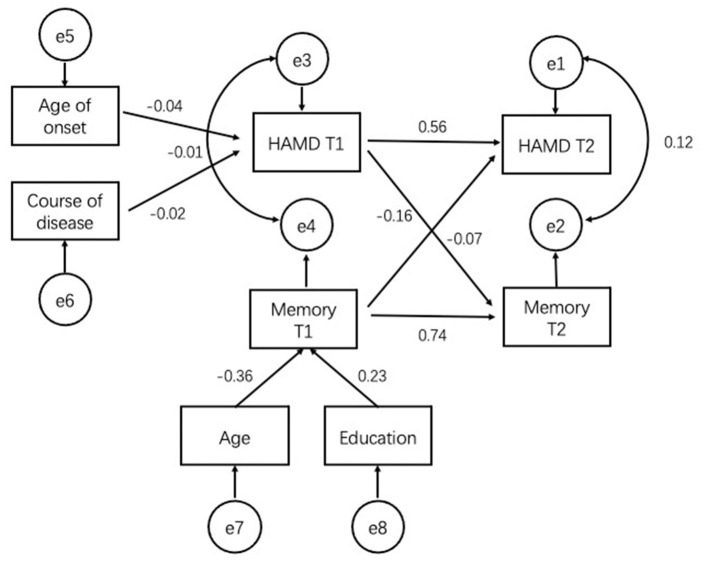
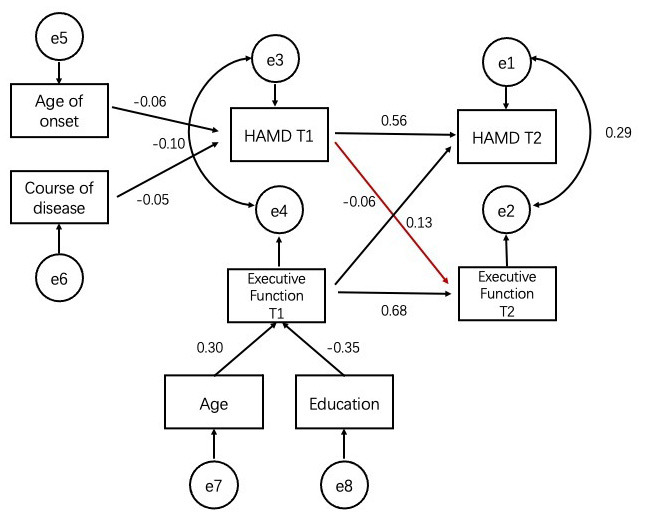
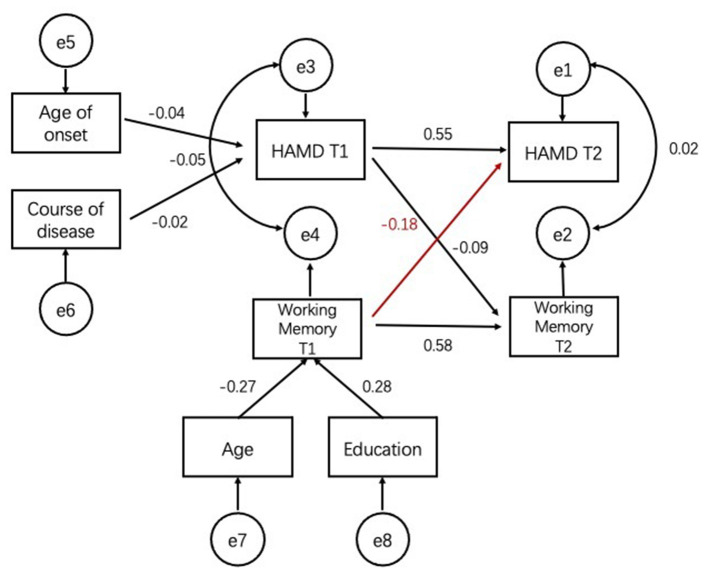
Although previous studies have extensively confirmed the cross-sectional relationship between cognitive impairment and depression in depressed elderly patients, the findings of their longitudinal associations are still mixed. The purpose of this study was to explore the two-way causal relationship between depression symptoms and cognition in patients with late-life depression (LLD). A total of 90 patients with LLD were assessed across two time points (baseline and 1-year follow up) on measures of 3 aspects of cognition and depressive symptoms. The data were then fitted to a structural equation model to examine two cross-lagged effects. Depressive symptoms predicted a decline in executive function (β = 0.864, = 0.049) but not vice versa. Moreover, depressive symptoms were predicted by a decline in scores of working memory test (β = -0.406, = 0.023), respectively. None of the relationships between the two factors was bidirectional. These results provide robust evidence that the relationship between cognition and depressive symptoms is unidirectional. Depressive symptoms may be a risk factor for cognitive decline. The decrease of information processing speed predicts depressive symptoms.
尽管先前的研究已广泛证实了老年抑郁症患者认知障碍与抑郁之间的横断面关系,但其纵向关联的研究结果仍存在分歧。本研究的目的是探讨老年抑郁症(LLD)患者抑郁症状与认知之间的双向因果关系。共有90名LLD患者在两个时间点(基线和1年随访)接受了认知和抑郁症状三个方面的测量评估。然后将数据拟合到结构方程模型中,以检验两个交叉滞后效应。抑郁症状预示着执行功能下降(β = 0.864,P = 0.049),但反之则不然。此外,工作记忆测试得分下降分别预示着抑郁症状(β = -0.406,P = 0.023)。这两个因素之间的关系均非双向的。这些结果提供了有力证据,证明认知与抑郁症状之间的关系是单向的。抑郁症状可能是认知衰退的一个风险因素。信息处理速度的下降预示着抑郁症状。