Ma Haixia, Lin Jingxia, He Jiali, Lo Dilys Hoi Ting, Tsang Hector W H
Department of Rehabilitation, The Hong Kong Polytechnic University, Kowloon, Hong Kong, SAR China.
Mental Health Research Centre, The Hong Kong Polytechnic University, Kowloon, Hong Kong, SAR China.
Front Psychiatry. 2021 Oct 22;12:744475. doi: 10.3389/fpsyt.2021.744475. eCollection 2021.
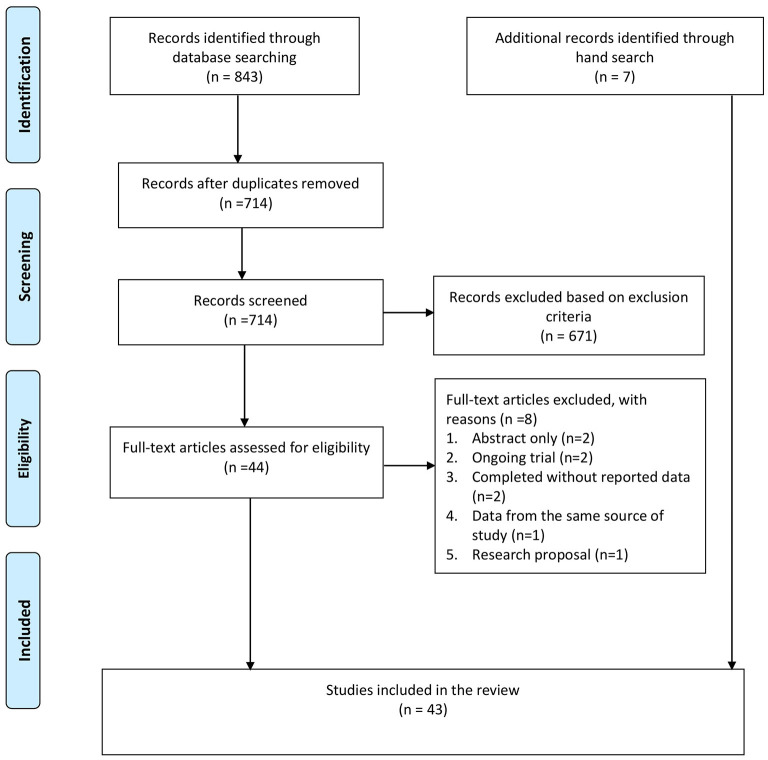
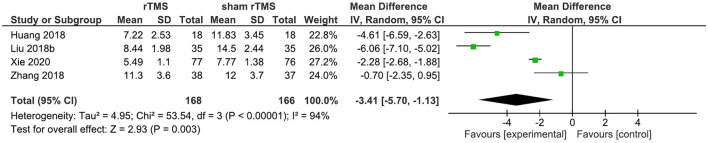
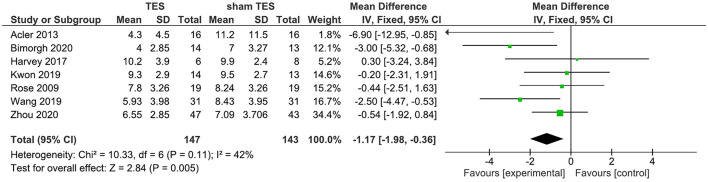
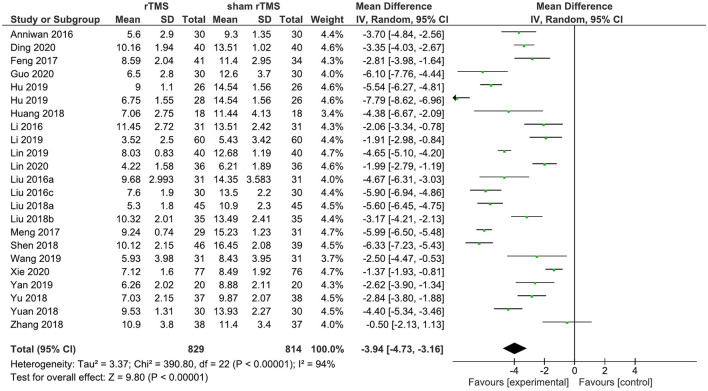
Transcranial electric stimulation (TES) and repetitive transcranial magnetic stimulation (rTMS) have experienced significant development in treating insomnia. This review aims to examine the effectiveness of randomized sham-controlled trials of TES and rTMS in improving insomnia and examine potential moderators associated with the effect of the treatment. Nine electronic databases were searched for studies comparing the effects of TES/rTMS with sham group on insomnia from the inception of these databases to June 25, 2021, namely, Medline, Embase, PsycINFO, CINAHL, Cochrane Library, Web of Science, PubMed, ProQuest Dissertation and Thesis, and CNKI. Meta-analyses were conducted to examine the effect of TES and rTMS in treating insomnia. Univariate meta-regression was performed to explore potential treatment moderators that may influence the pooled results. Risk of bias was assessed by using the Cochrane Risk of Bias Tool. A total of 16 TES studies and 27 rTMS studies were included in this review. The pooled results indicated that there was no significant difference between the TES group and the sham group in improving objective measures of sleep. rTMS was superior to its sham group in improving sleep efficiency, total sleep time, sleep onset latency, wake up after sleep onset, and number of awakenings (all < 0.05). Both TES and rTMS were superior to their sham counterparts in improving sleep quality as measured by the Pittsburgh Sleep Quality Index at post-intervention. The weighted mean difference for TES and rTMS were -1.17 (95% CI: -1.98, -0.36) and -4.08 (95% CI: -4.86, -3.30), respectively. Gender, total treatment sessions, number of pulses per session, and length of treatment per session were associated with rTMS efficacy. No significant relationship was observed between TES efficacy and the stimulation parameters. It seems that TES and rTMS have a chance to play a decisive role in the therapy of insomnia. Possible dose-dependent and gender difference effects of rTMS are suggested.
经颅电刺激(TES)和重复经颅磁刺激(rTMS)在治疗失眠方面取得了显著进展。本综述旨在研究TES和rTMS随机假对照试验在改善失眠方面的有效性,并探讨与治疗效果相关的潜在调节因素。检索了九个电子数据库,以查找从这些数据库建立到2021年6月25日比较TES/rTMS与假刺激组对失眠影响的研究,即医学期刊数据库(Medline)、荷兰医学文摘数据库(Embase)、心理学文摘数据库(PsycINFO)、护理学与健康领域数据库(CINAHL)、考科蓝图书馆(Cochrane Library)、科学引文索引数据库(Web of Science)、美国国立医学图书馆生物医学期刊数据库(PubMed)、博硕士论文数据库(ProQuest Dissertation and Thesis)和中国知网(CNKI)。进行荟萃分析以研究TES和rTMS治疗失眠的效果。进行单变量荟萃回归以探索可能影响汇总结果的潜在治疗调节因素。使用考科蓝偏倚风险工具评估偏倚风险。本综述共纳入16项TES研究和27项rTMS研究。汇总结果表明,TES组和假刺激组在改善睡眠客观指标方面无显著差异。rTMS在改善睡眠效率、总睡眠时间、入睡潜伏期、睡眠中觉醒后清醒时间和觉醒次数方面优于其假刺激组(均P<0.05)。干预后,通过匹兹堡睡眠质量指数测量,TES和rTMS在改善睡眠质量方面均优于各自的假刺激对照组。TES和rTMS的加权平均差分别为-1.17(95%CI:-1.98,-0.36)和-4.08(95%CI:-4.86,-3.30)。性别、总治疗次数、每次治疗的脉冲数和每次治疗的时长与rTMS疗效相关。未观察到TES疗效与刺激参数之间存在显著关系。似乎TES和rTMS在失眠治疗中有可能发挥决定性作用。提示rTMS可能存在剂量依赖性和性别差异效应。