Guo Duan, Lin Taiping, Deng Chuanyao, Zheng Yuxia, Gao Langli, Yue Jirong
Department of Geriatrics and National Clinical Research Center for Geriatrics, West China Hospital, Sichuan University, Chengdu, China.
Department of Palliative Medicine, West China School of Public Health and West China Fourth Hospital, Sichuan University, Chengdu, China.
Front Psychiatry. 2021 Oct 21;12:772387. doi: 10.3389/fpsyt.2021.772387. eCollection 2021.
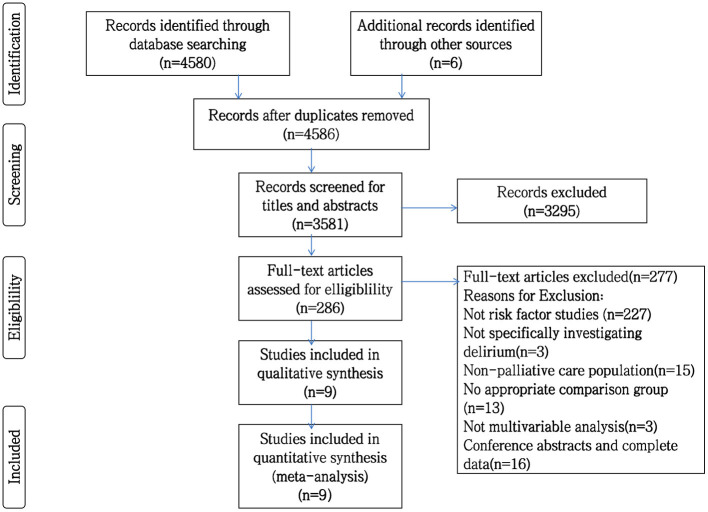
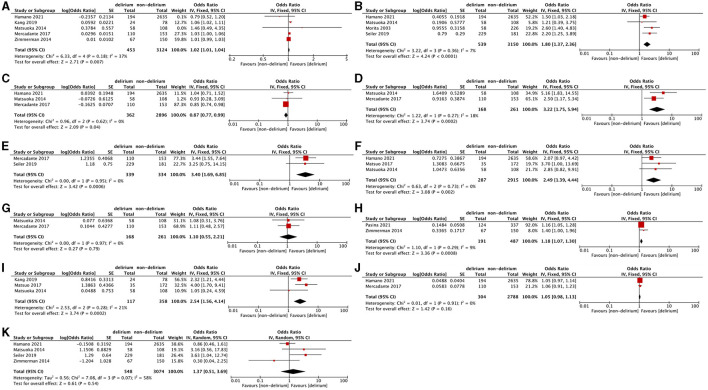
Delirium is common and highly distressing for the palliative care population. Until now, no study has systematically reviewed the risk factors of delirium in the palliative care population. Therefore, we performed a systematic review and meta-analysis to evaluate delirium risk factors among individuals receiving palliative care. We systematically searched PubMed, Medline, Embase, and Cochrane database to identify relevant observational studies from database inception to June 2021. The methodological quality of the eligible studies was assessed by the Newcastle Ottawa Scale. We estimated the pooled adjusted odds ratio (aOR) for individual risk factors using the inverse variance method. Nine studies were included in the review (five prospective cohort studies, three retrospective case-control studies and one retrospective cross-section study). In pooled analyses, older age (aOR: 1.02, 95% CI: 1.01-1.04, = 37%), male sex (aOR:1.80, 95% CI: 1.37-2.36, = 7%), hypoxia (aOR: 0.87, 95% CI: 0.77-0.99, = 0%), dehydration (aOR: 3.22, 95%CI: 1.75-5.94, = 18%), cachexia (aOR:3.40, 95% CI: 1.69-6.85, = 0%), opioid use (aOR: 2.49, 95%CI: 1.39-4.44, = 0%), anticholinergic burden (aOR: 1.18, 95% CI: 1.07-1.30, = 9%) and Eastern Cooperative Oncology Group Performance Status (aOR: 2.54, 95% CI: 1.56-4.14, = 21%) were statistically significantly associated with delirium. The risk factors identified in our review can help to highlight the palliative care population at high risk of delirium. Appropriate strategies should be implemented to prevent delirium and improve the quality of palliative care services.
谵妄在姑息治疗人群中很常见且令人极为痛苦。到目前为止,尚无研究系统评价过姑息治疗人群中谵妄的危险因素。因此,我们进行了一项系统评价和荟萃分析,以评估接受姑息治疗的个体中谵妄的危险因素。我们系统检索了PubMed、Medline、Embase和Cochrane数据库,以识别从数据库建立至2021年6月的相关观察性研究。采用纽卡斯尔渥太华量表评估符合条件研究的方法学质量。我们使用逆方差法估计个体危险因素的合并调整比值比(aOR)。该评价纳入了9项研究(5项前瞻性队列研究、3项回顾性病例对照研究和1项回顾性横断面研究)。在汇总分析中,年龄较大(aOR:1.02,95%CI:1.01 - 1.04,I² = 37%)、男性(aOR:1.80,95%CI:1.37 - 2.36,I² = 7%)、缺氧(aOR:0.87,95%CI:0.77 - 0.99,I² = 0%)、脱水(aOR:3.22,95%CI:1.75 - 5.94,I² = 18%)、恶病质(aOR:3.40,95%CI:1.69 - 6.85,I² = 0%)、使用阿片类药物(aOR:2.49,95%CI:1.39 - 4.44,I² = 0%)、抗胆碱能负担(aOR:1.18,95%CI:1.07 - 1.30,I² = 9%)和东部肿瘤协作组体能状态(aOR:2.54,95%CI:1.56 - 4.14,I² = 21%)与谵妄在统计学上显著相关。我们评价中确定的危险因素有助于凸显谵妄高危的姑息治疗人群。应实施适当策略以预防谵妄并提高姑息治疗服务质量。