Shin Jeongmi, Kim Yejin, Yoo Shin Hye, Sim Jin-Ah, Keam Bhumsuk
Public Healthcare Center, Seoul National University Hospital, Seoul, Korea.
Center for Palliative Care and Clinical Ethics, Seoul National University Hospital, Seoul, Korea.
J Hosp Palliat Care. 2022 Dec 1;25(4):150-158. doi: 10.14475/jhpc.2022.25.4.150.
Social distancing and strict visitor restrictions at hospitals have been national policies since the onset of the coronavirus disease 2019 (COVID-19) pandemic. This has challenged the concept of a good death in comfort with the opportunity to say goodbye. Little is known about how these measures have influenced end-of-life (EOL) care among cancer patients who die in acute care hospitals. This study examined changes in the EOL care of cancer patients during the COVID-19 pandemic.
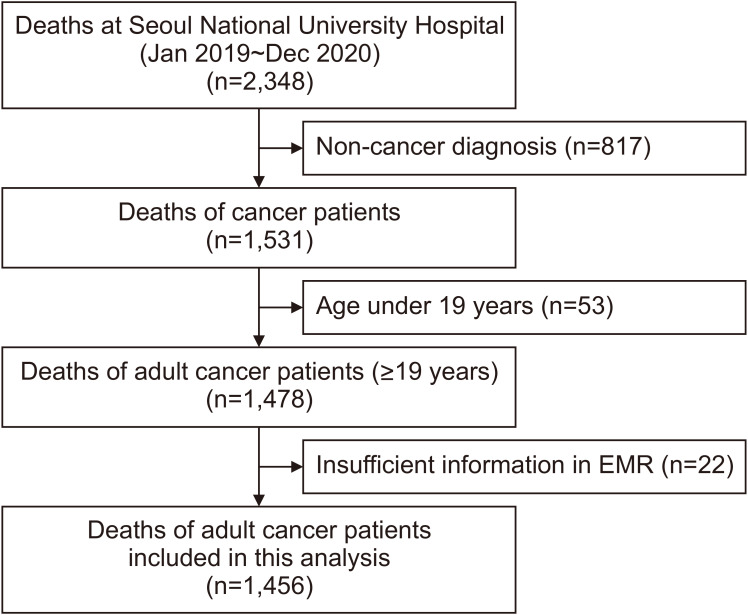
We retrospectively analyzed 1,456 adult cancer patients who died in 2019 (n=752) and 2020 (n=704) at a tertiary hospital. Data on EOL care-symptom control and comfort care in an imminently dying state, preparation for death, place of death, and aggressive care in the last month-were reviewed.
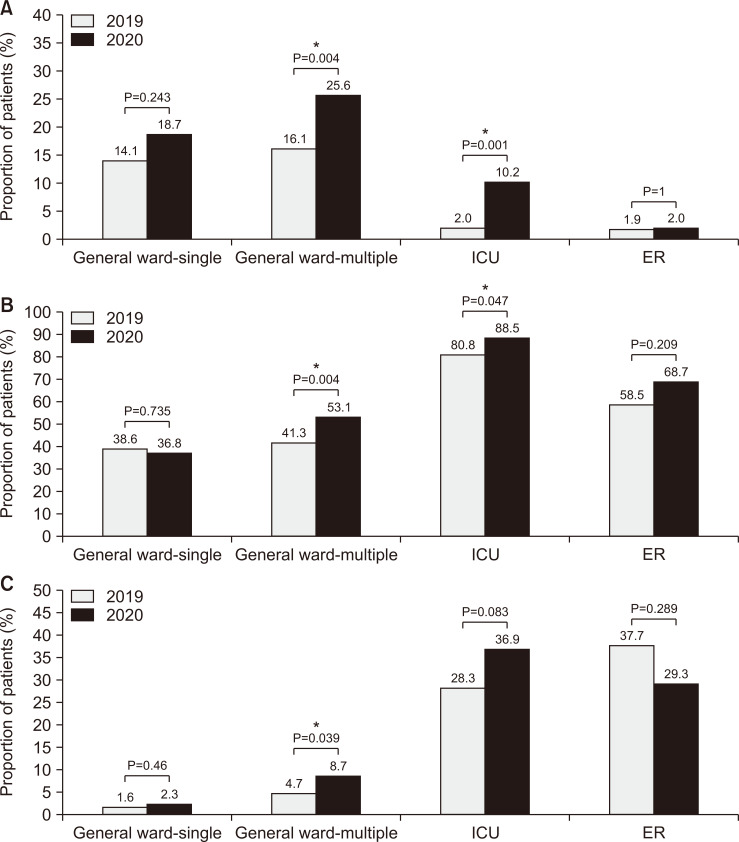
The 1,456 patients had a median age of 67 years, and 62.5% were men. Patients who died in 2020 were more likely to experience agitation or delirium before death (17.2% vs. 10.9%), to use inotropes/vasopressors near death (59.2% vs. 52.3%), and to receive cardiopulmonary resuscitation in their last months (16.3% vs. 12.5%) than those who died in 2019. Additionally, the number of deaths in the emergency room doubled in 2020 compared to 2019 (from 7.1% to 14.1%).
This study suggests that EOL care for cancer patients who died in a tertiary hospital deteriorated during the COVID-19 pandemic. The implementation of medical care at the EOL and the preferred place of death should be discussed carefully in advance for high-quality EOL care.
自2019年冠状病毒病(COVID-19)大流行开始以来,保持社交距离和严格限制医院访客一直是国家政策。这对在舒适环境中有机会道别的善终概念提出了挑战。对于这些措施如何影响在急症医院死亡的癌症患者的临终关怀,人们知之甚少。本研究调查了COVID-19大流行期间癌症患者临终关怀的变化。
我们回顾性分析了一家三级医院2019年(n = 752)和2020年(n = 704)死亡的1456例成年癌症患者。审查了临终关怀的数据,包括临终状态下的症状控制和舒适护理、死亡准备、死亡地点以及最后一个月的积极治疗。
1456例患者的中位年龄为67岁,62.5%为男性。与2019年死亡的患者相比,2020年死亡的患者在死亡前更有可能出现躁动或谵妄(17.2%对10.9%),在临死前更有可能使用血管活性药物(59.2%对52.3%),并且在最后几个月接受心肺复苏的比例更高(16.3%对12.5%)。此外,与2019年相比,2020年急诊室的死亡人数增加了一倍(从7.1%增至14.1%)。
本研究表明,在COVID-19大流行期间,在三级医院死亡的癌症患者的临终关怀质量下降。为了提供高质量的临终关怀,应提前仔细讨论临终医疗护理的实施和首选死亡地点。