Zhang Michelle Y, Mlynash Michael, Sainani Kristin L, Albers Gregory W, Lansberg Maarten G
Stanford University School of Medicine, Stanford, CA, United States.
Department of Neurology and Neurological Sciences and the Stanford Stroke Center, Stanford University Medical Center, Stanford, CA, United States.
Front Neurol. 2021 Oct 22;12:727171. doi: 10.3389/fneur.2021.727171. eCollection 2021.
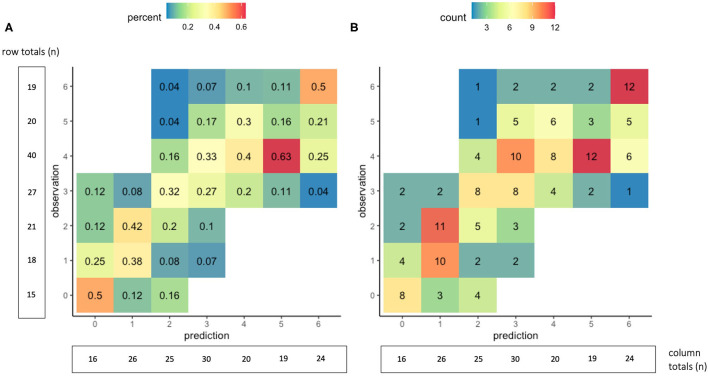
Prediction models for functional outcomes after ischemic stroke are useful for statistical analyses in clinical trials and guiding patient expectations. While there are models predicting dichotomous functional outcomes after ischemic stroke, there are no models that predict ordinal mRS outcomes. We aimed to create a model that predicts, at the time of hospital discharge, a patient's modified Rankin Scale (mRS) score on day 90 after ischemic stroke. We used data from three multi-center prospective studies: CRISP, DEFUSE 2, and DEFUSE 3 to derive and validate an ordinal logistic regression model that predicts the 90-day mRS score based on variables available during the stroke hospitalization. Forward selection was used to retain independent significant variables in the multivariable model. The prediction model was derived using data on 297 stroke patients from the CRISP and DEFUSE 2 studies. National Institutes of Health Stroke Scale (NIHSS) at discharge and age were retained as significant ( < 0.001) independent predictors of the 90-day mRS score. When applied to the external validation set (DEFUSE 3, = 160), the model accurately predicted the 90-day mRS score within one point for 78% of the patients in the validation cohort. A simple model using age and NIHSS score at time of discharge can predict 90-day mRS scores in patients with ischemic stroke. This model can be useful for prognostication in routine clinical care and to impute missing data in clinical trials.
缺血性中风后功能结局的预测模型对于临床试验中的统计分析和引导患者预期很有用。虽然有预测缺血性中风后二分法功能结局的模型,但尚无预测改良Rankin量表(mRS)序贯结局的模型。我们旨在创建一个模型,在出院时预测缺血性中风后第90天患者的改良Rankin量表(mRS)评分。我们使用了来自三项多中心前瞻性研究的数据:CRISP、DEFUSE 2和DEFUSE 3,以推导和验证一个序贯逻辑回归模型,该模型根据中风住院期间可用的变量预测90天mRS评分。向前选择用于在多变量模型中保留独立的显著变量。预测模型是使用来自CRISP和DEFUSE 2研究的297名中风患者的数据推导出来的。出院时的美国国立卫生研究院卒中量表(NIHSS)和年龄被保留为90天mRS评分的显著(<0.001)独立预测因子。当应用于外部验证集(DEFUSE 3,n = 160)时,该模型在验证队列中78%的患者中准确预测了90天mRS评分,误差在1分以内。一个使用出院时年龄和NIHSS评分的简单模型可以预测缺血性中风患者的90天mRS评分。该模型可用于常规临床护理中的预后评估以及在临床试验中估算缺失数据。