Bartley Christopher M, Parikshak Neelroop N, Ngo Thomas T, Alexander Jessa A, Zorn Kelsey C, Alvarenga Bonny A, Kang Min K, Pedriali Massimo, Pleasure Samuel J, Wilson Michael R
Weill Institute for Neurosciences, University of California, San Francisco, San Francisco, CA, United States.
Department of Psychiatry and Behavioral Sciences, University of California, San Francisco, San Francisco, CA, United States.
Front Neurol. 2021 Oct 22;12:728700. doi: 10.3389/fneur.2021.728700. eCollection 2021.
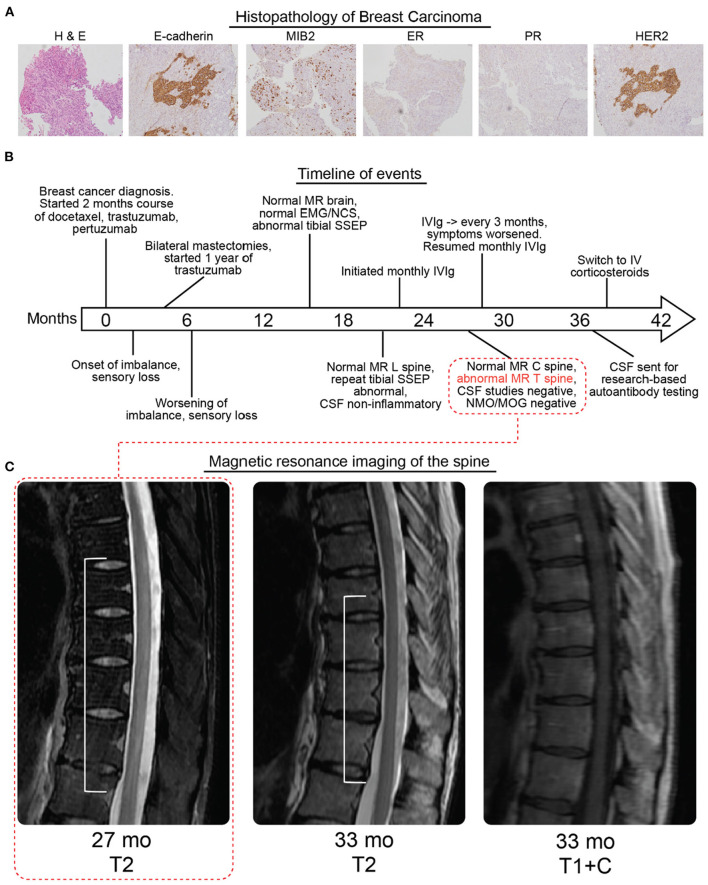
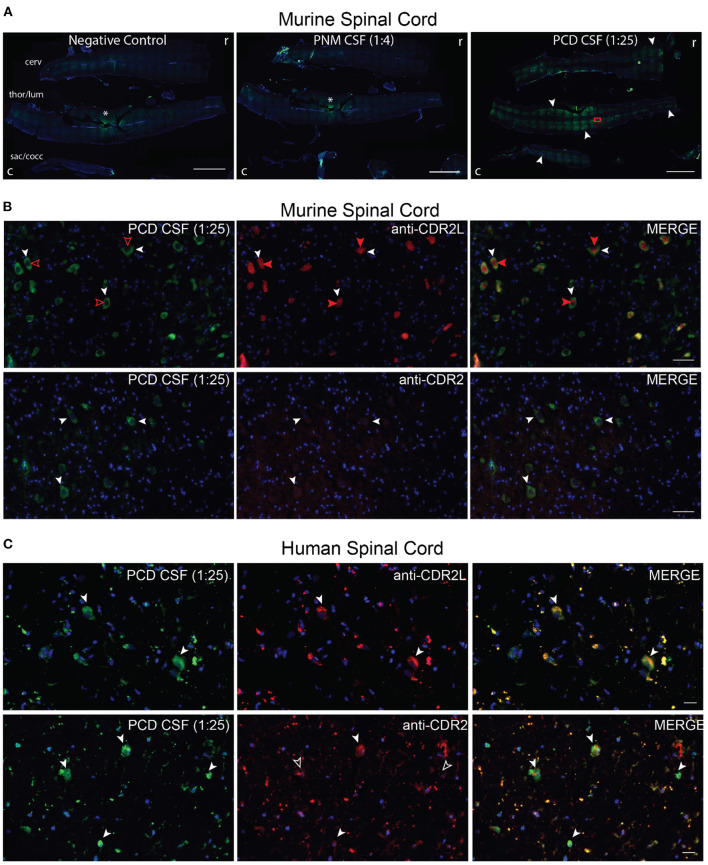
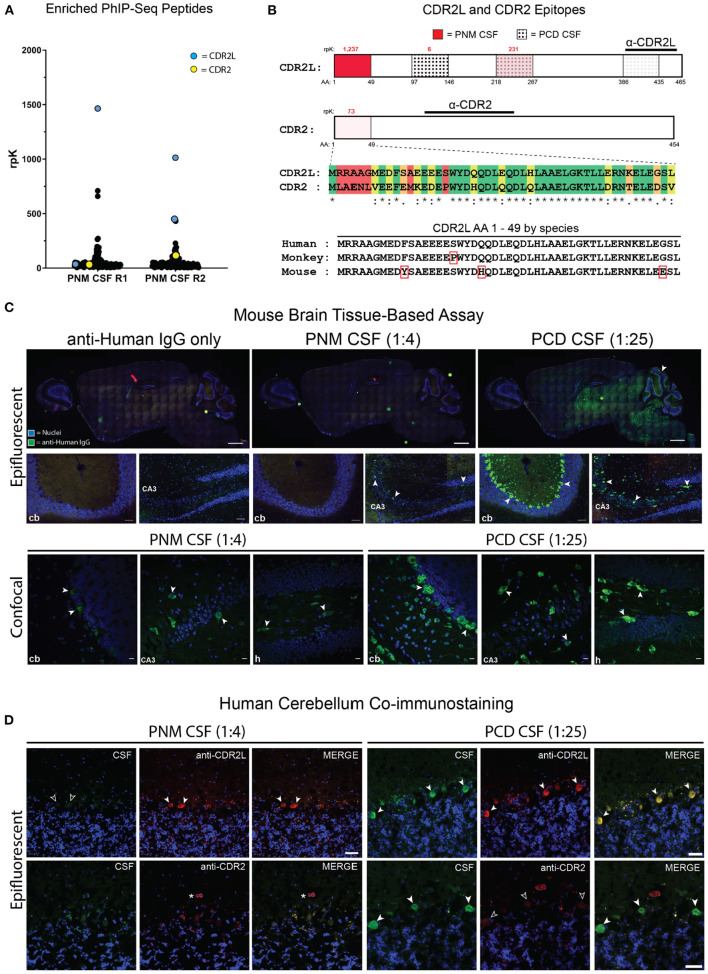
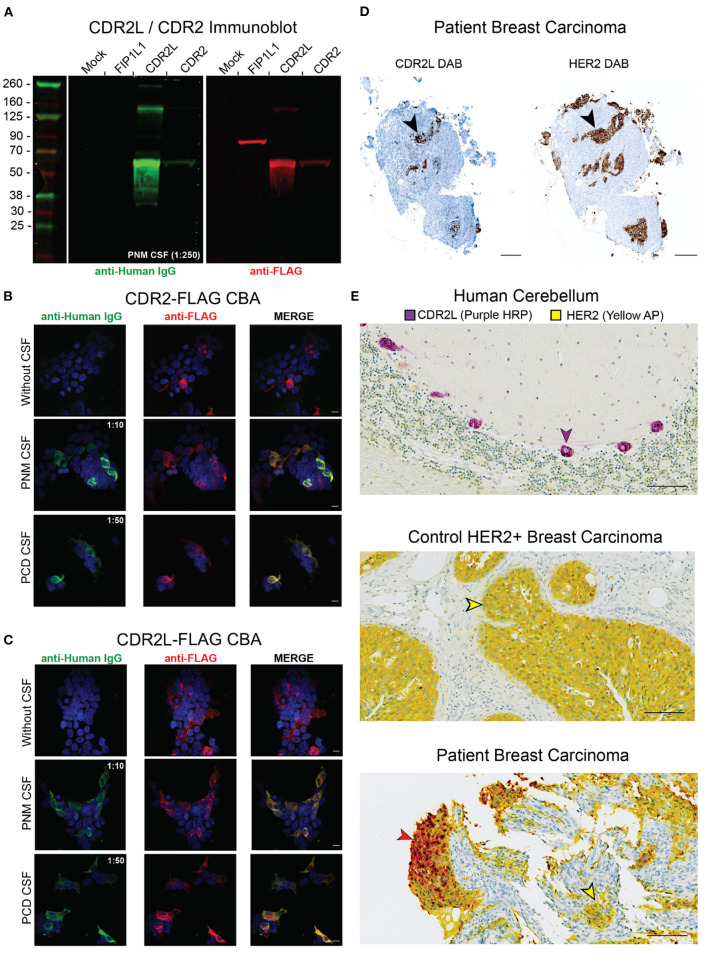
The development of autoimmune antibody panels has improved the diagnosis of paraneoplastic neurological disorders (PNDs) of the brain and spinal cord. Here, we present a case of a woman with a history of breast cancer who presented with a subacute sensory ataxia that progressed over 18 months. Her examination and diagnostic studies were consistent with a myelopathy. Metabolic, infectious, and autoimmune testing were non-diagnostic. However, she responded to empirical immunosuppression, prompting further workup for an autoimmune etiology. An unbiased autoantibody screen utilizing phage display immunoprecipitation sequencing (PhIP-Seq) identified antibodies to the anti-Yo antigens cerebellar degeneration related protein 2 like (CDR2L) and CDR2, which were subsequently validated by immunoblot and cell-based overexpression assays. Furthermore, CDR2L protein expression was restricted to HER2 expressing tumor cells in the patient's breast tissue. Recent evidence suggests that CDR2L is likely the primary antigen in anti-Yo paraneoplastic cerebellar degeneration, but anti-Yo myelopathy is poorly characterized. By immunostaining, we detected neuronal CDR2L protein expression in the murine and human spinal cord. This case demonstrates the diagnostic utility of unbiased assays in patients with suspected PNDs, supports prior observations that anti-Yo PND can be associated with isolated myelopathy, and implicates CDR2L as a potential antigen in the spinal cord.
自身免疫抗体检测组合的发展改善了脑和脊髓副肿瘤性神经系统疾病(PND)的诊断。在此,我们报告一例有乳腺癌病史的女性患者,其表现为亚急性感觉性共济失调,病程长达18个月。她的检查和诊断性研究结果与脊髓病相符。代谢、感染和自身免疫检测均未明确诊断。然而,她对经验性免疫抑制治疗有反应,这促使进一步排查自身免疫病因。利用噬菌体展示免疫沉淀测序(PhIP-Seq)进行的无偏倚自身抗体筛查鉴定出了针对小脑变性相关蛋白2样(CDR2L)和CDR2的抗Yo抗原的抗体,随后通过免疫印迹和基于细胞的过表达试验进行了验证。此外,CDR2L蛋白表达在患者乳腺组织中仅限于表达HER2的肿瘤细胞。最近的证据表明,CDR2L可能是抗Yo副肿瘤性小脑变性的主要抗原,但抗Yo脊髓病的特征尚不明确。通过免疫染色,我们在小鼠和人类脊髓中检测到了神经元CDR2L蛋白表达。该病例证明了无偏倚检测方法在疑似PND患者中的诊断效用,支持了先前关于抗Yo PND可与孤立性脊髓病相关的观察结果,并表明CDR2L是脊髓中的一种潜在抗原。